

Residual flux values in a three-phase transformer cannot always be chosen independently. They must be consistent with the core topology, available return paths and the magnetic model’s internal states. Three convenient numbers can produce an initial condition that the represented magnetic network cannot physically support.
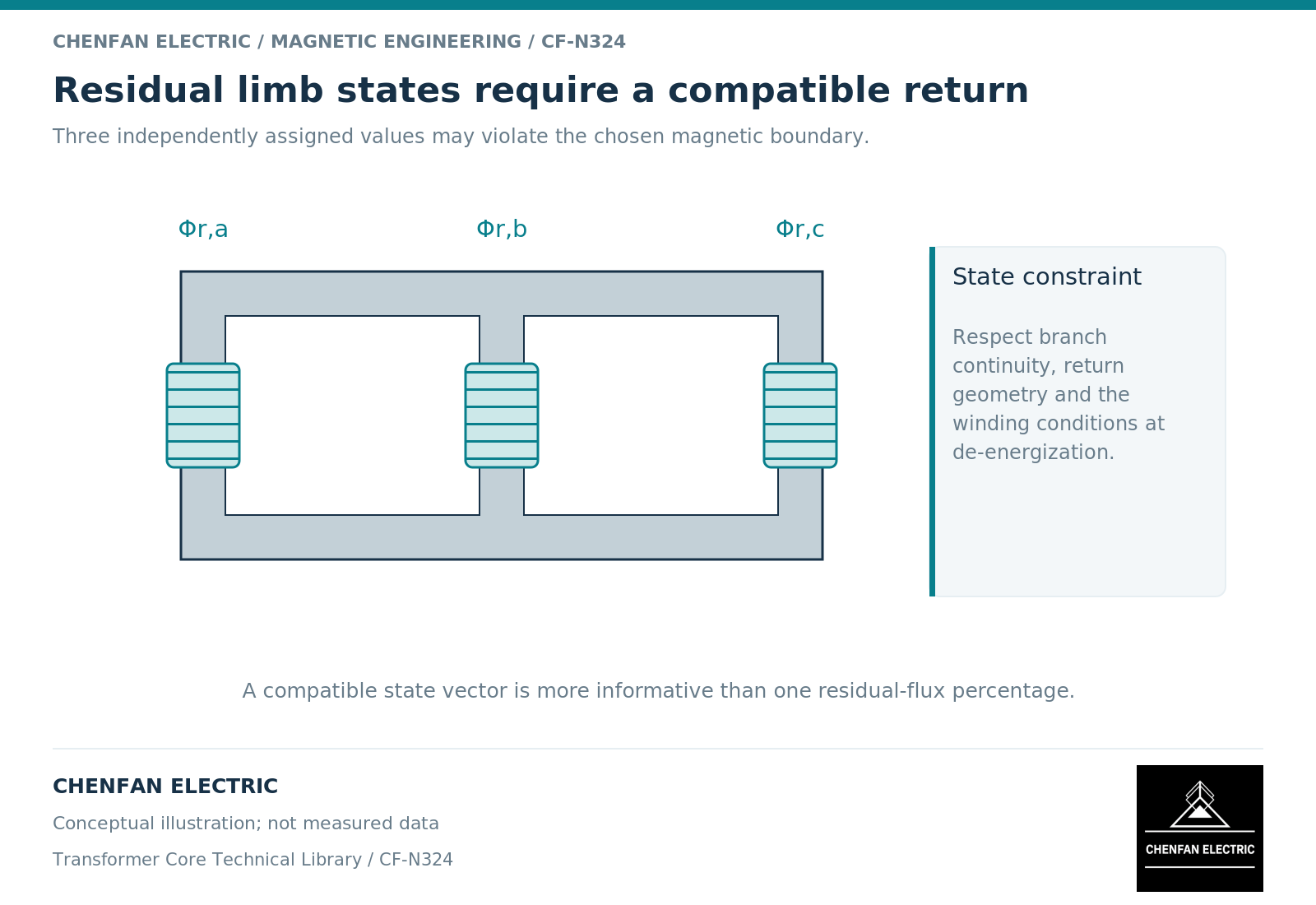
Apply continuity to the represented network
For a three-limb core, a nonzero sum of wound-limb flux requires an external return. A model that omits that return while enforcing zero summed flux imposes a different constraint from a model that includes it. Five-limb construction introduces additional iron branches which can carry return components. Geometrical equivalent-circuit formulations make these shared paths explicit. [1]
The initial-state constraint must therefore be derived from the actual model, not from a rule that all three residual values always sum to zero. That rule may be appropriate for a particular idealized boundary, but it is not a complete description of every real transformer.
Likewise, the outer-limb states in a five-limb model should not be selected without checking how they close the wound-limb fluxes through the yokes.
Distinguish branch flux from winding flux linkage
A state file may store flux linkage for an equivalent winding, magnetization variables for material regions or flux in magnetic branches. Those quantities are related but not identical.
Multiplying flux by turns is appropriate only for the defined linked flux and winding representation. Leakage contributions and model conventions can change the interpretation of an electrical state variable. Document whether the stored quantity represents mutual flux linkage, total linkage or another internal variable.
Polarity is equally important. A change in winding-dot convention or branch orientation can reverse the numerical sign without changing the physical state. A state vector copied between differently oriented models needs an explicit mapping.
Reproduce a history when possible
A history-dependent material model can generate residual states by simulating a defined excitation and interruption sequence. Such models retain information beyond a single-valued magnetization curve. [2] This can be more consistent than assigning branch states manually, provided the preceding circuit and event are themselves credible.
The result is still a calculated state, not a measurement. Label it with the preceding simulation case and preserve the final state file. If the operating history is uncertain, use several physically consistent histories or constrained state scenarios rather than claiming one exact residual pattern.
A useful comparison checks whether the model begins the next event without artificial discontinuities or corrective impulses caused by inconsistent initialization. Numerical settling introduced solely to repair an invalid state should not be mistaken for a real transformer transient.
Handover a state map, not a three-number note
| State item | Required definition |
|---|---|
| Branch identifier | Matching limb or yoke in the topology drawing |
| Stored variable | Flux, flux linkage or constitutive internal state |
| Sign convention | Branch direction and winding polarity |
| State origin | Measured estimate, prior simulation or sensitivity assumption |
| Constraint check | Continuity and model initialization consistency |
For controlled-switching or inrush work, retain the relation between each state and the electrical phase reference. A perfectly valid magnetic state can still be used incorrectly if its phase labels are permuted.
The objective is not to make initialization unnecessarily elaborate. It is to prevent an apparently precise residual-flux input from contradicting the model that uses it. A constrained, documented range is preferable to an exact but physically inconsistent state vector.
References
[1] Manitoba Hydro International / PSCAD. The UMEC Approach.
[2] Cesare Tozzo / COMSOL. Modeling Ferromagnetic Materials in COMSOL Multiphysics.