

Demagnetization changes the magnetic starting condition for a later diagnostic measurement. It does not repair a damaged winding, remove every source of measurement variation or certify that residual flux is exactly zero. Its value is in improving the comparability of tests whose response depends on magnetic history.
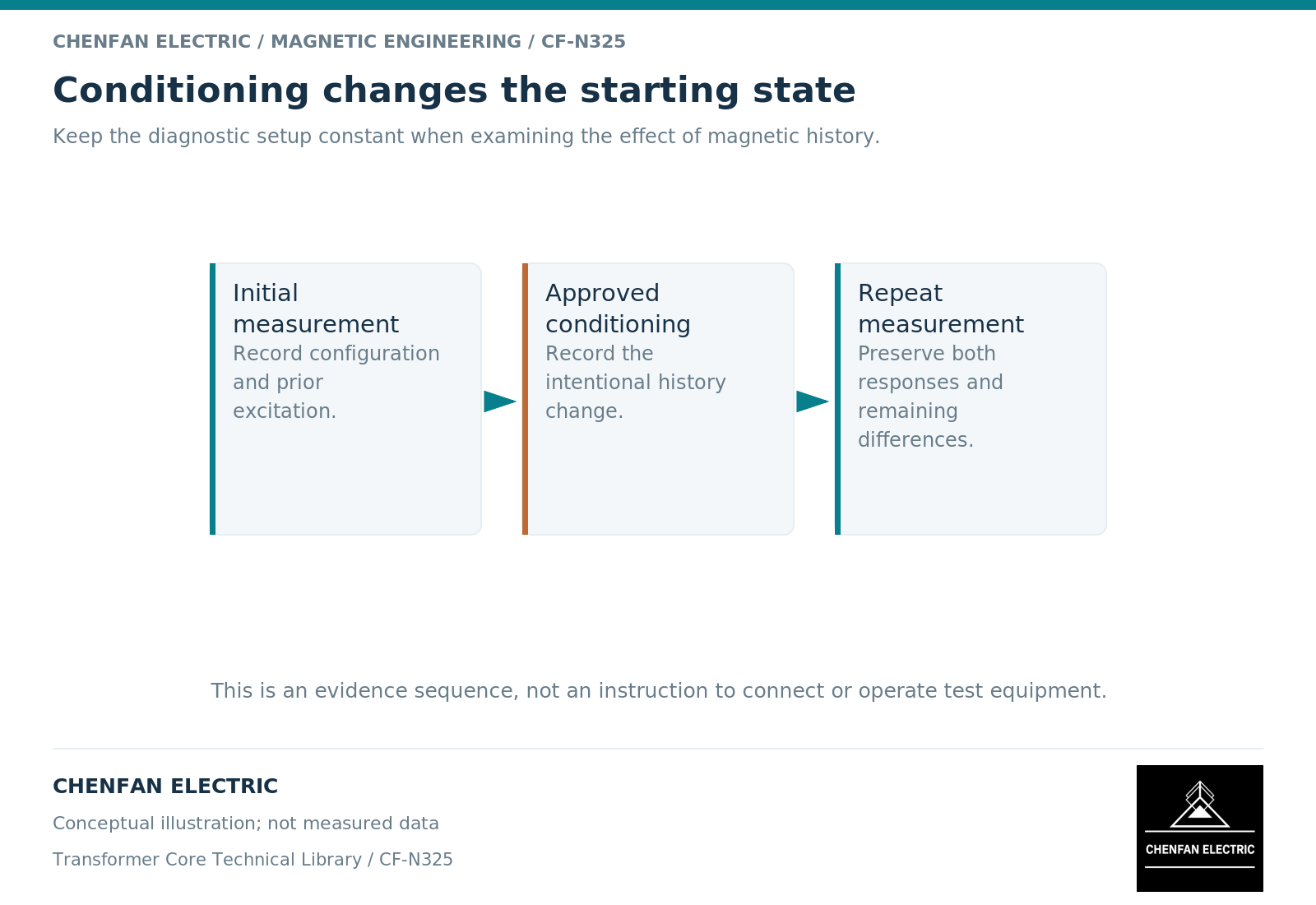
Treat conditioning as part of the measurement definition
A ferromagnetic assembly can follow different trajectories after different prior excitations. A history-dependent model captures that distinction; a single-valued B-H curve does not. [1] When a diagnostic observable is sensitive to that state, the conditioning history belongs beside the connection and instrument settings in the record.
This is why two otherwise similar measurements can disagree without demonstrating a new physical defect. One may follow a direct-current test, while the other follows an agreed conditioning process. The comparison is incomplete until that difference is known.
The reverse caution is equally important: a changed magnetic state is a possible explanation, not an automatic explanation for every anomaly. A discrepancy that remains under controlled repeat conditions needs its own investigation.
Separate the tests by their purpose
Winding resistance, excitation-current measurement and frequency-response measurement interrogate different aspects of the transformer. Manufacturer test guidance treats these as distinct activities rather than interchangeable health indicators. [2]
A conditioning step can change the initial state seen by a later test without changing the quantity that an earlier test was intended to measure. Preserve both records. Do not overwrite a resistance result because a subsequent magnetic measurement was repeated after conditioning.
For frequency-response comparison, the connection arrangement and measurement repeatability remain important. Demagnetization does not compensate for inconsistent lead placement, different terminal states or an incorrectly matched reference record.
Record what was actually established
The report should name the conditioning method or approved procedure, its completion status and the time at which the subsequent measurement was made. Avoid substituting a broad label such as “core reset” for the actual process record.
Where the procedure provides a verification quantity, retain it with its definition. Where it does not directly measure residual flux, do not invent a numerical residual value. “Conditioned according to the identified procedure” and “measured residual flux below a specified value” are different claims.
This article provides no energization sequence, voltage, current or connection instructions. Those depend on the transformer, test equipment and responsible safety procedure. The engineering issue here is interpretation and traceability.
Use a controlled comparison sequence in the evidence file
| Comparison question | Record needed |
|---|---|
| Did the starting state change? | Prior excitation and conditioning chronology |
| Was the measurement repeated consistently? | Same test configuration and defined settings |
| Did the response change after conditioning? | Both original and repeat records |
| Does an anomaly remain? | Technical assessment against a suitable reference |
A useful conclusion might state that a particular difference reduced after documented conditioning, while identifying any remaining discrepancy. That is stronger than declaring the transformer healthy merely because one curve moved closer to a reference.
For a new core or active part, conditioning should also be tied to the delivered assembly state. Later winding installation, testing and handling can create a different history from the bare-core test. The complete-transformer test record therefore needs its own chronology rather than inheriting an assumed magnetic state from an earlier manufacturing stage.
References
[1] Cesare Tozzo / COMSOL. Modeling Ferromagnetic Materials in COMSOL Multiphysics.
[2] OMICRON. TESTRANO 600 Brochure.