

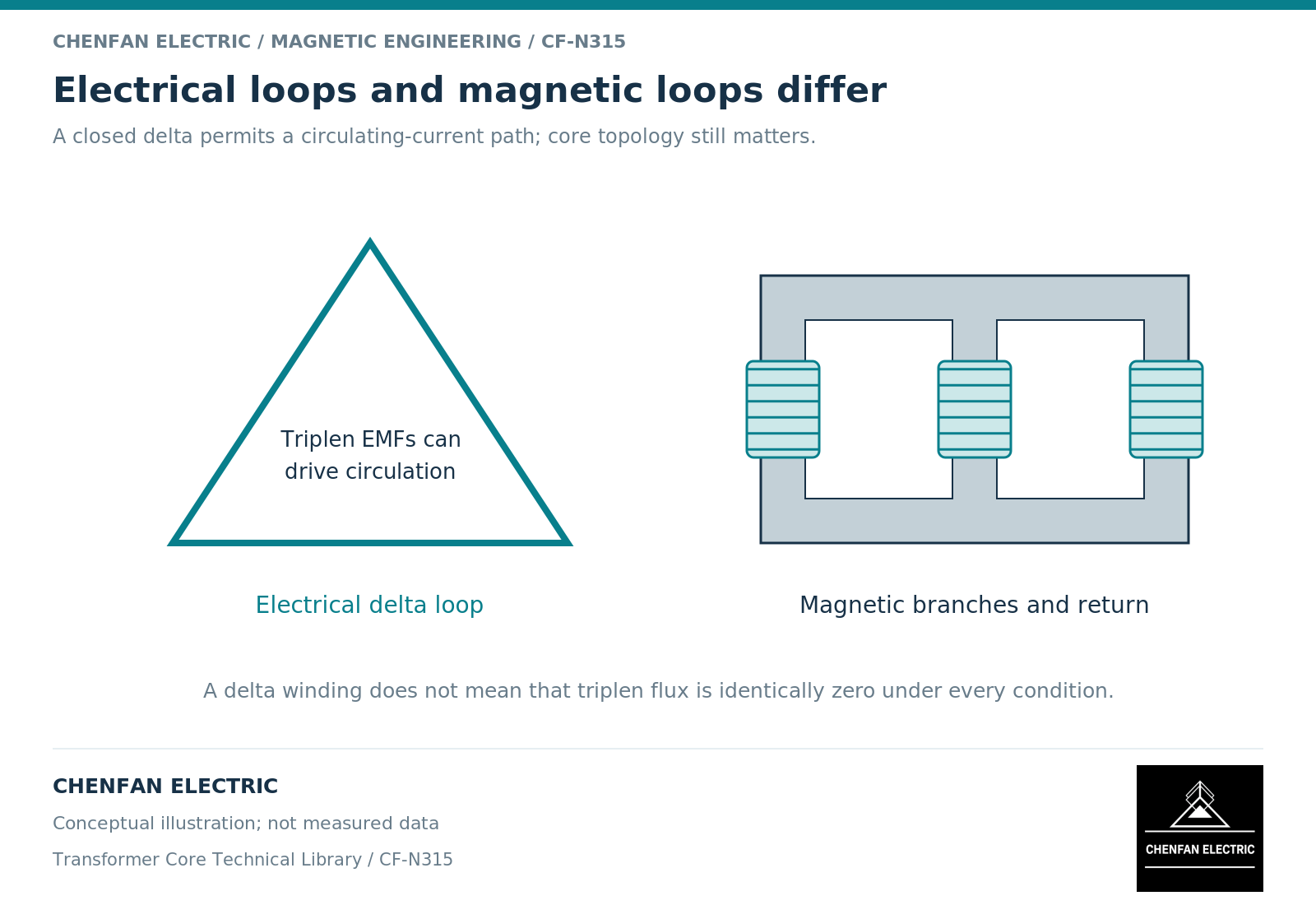
A delta winding provides an electrical circuit in which certain internally driven currents can circulate. It is not itself a magnetic return limb. Keep the circulating-current path and the core-flux path separate when discussing triplen harmonics, otherwise an apparently simple explanation can conceal the actual ampere-turn balance.
Triplen components share a phase relationship
Triplen harmonics are integer multiples of the third harmonic. For a balanced set derived from three phase waveforms displaced by 120 electrical degrees at the fundamental, the corresponding triplen components are in phase. Whether they appear in flux, induced voltage or current depends on the excitation and the available circuit paths.
In a closed delta, compatible induced harmonic voltages can drive a circulating current around the winding. That current creates ampere-turns which interact with the core excitation. Its magnitude is determined by the complete circuit and nonlinear magnetic response; it is not set by the word “delta” alone.
Equivalent transformer models distinguish winding coupling from the nonlinear magnetizing branch. [1] Treating those two parts as a single verbal shortcut loses the information needed to predict the response.
Draw two diagrams, not one ambiguous loop
The electrical diagram should show the delta closure, phase winding polarities and any connection that changes the circuit. The magnetic diagram should show wound limbs, yokes and available return regions. Linking the diagrams through winding turns and polarity makes the physical interaction visible.
A circulating current may not appear as the same component in the external line currents. Therefore an external current measurement is not automatically a measurement of every current inside the delta. Conversely, the absence of a neutral terminal does not mean that no internal harmonic current can exist.
The magnetic circuit still has to satisfy continuity. A delta can alter the excitation that drives a common-mode flux component, but it does not create two outer iron limbs on a three-limb core. Core topology remains relevant. [2]
Avoid three overstatements
“The delta absorbs all third harmonic” is too absolute. A finite winding impedance and a nonlinear magnetic circuit determine the actual response. The relevant harmonic may be reduced in one measured quantity while remaining significant in another.
“Delta current is always a fault current” is also incorrect as a classification rule. The reason for the current, its waveform, duration and thermal consequence must be established. A permitted internal response and an abnormal operating condition cannot be distinguished from connection letters alone.
Finally, “the core is unaffected because the line currents look balanced” is not an adequate conclusion. Balanced terminal observations do not disclose all internal waveform components or branch fluxes. The measurement boundary must match the claim.
Ask for a connection-specific harmonic comparison
A useful study compares the same excitation with the actual delta circuit represented, including its impedance and coupling. It reports the quantity of interest explicitly: circulating winding current, winding loss, phase flux waveform, external line current or terminal voltage distortion.
For each reported harmonic, state whether the value is a peak amplitude, a root-mean-square component or a percentage of a named reference. Keep harmonic order and absolute frequency together. A third harmonic at one fundamental frequency is not the same frequency at another.
The design handover should identify winding connection, neutral state, core topology, excitation waveform and the thermal duty of any circulating current. That package supports an engineering decision. A statement that a transformer “has a delta for harmonics” does not, by itself, establish acceptable flux, winding temperature or performance under every unbalanced condition.
References
[1] Manitoba Hydro International / PSCAD. The Classical Approach.
[2] Manitoba Hydro International / PSCAD. The UMEC Approach.