

The lowest no-load-loss design is not necessarily the transformer the project should build.
First decide whether no-load loss is the sole objective, a constrained requirement or one term in a wider evaluation.
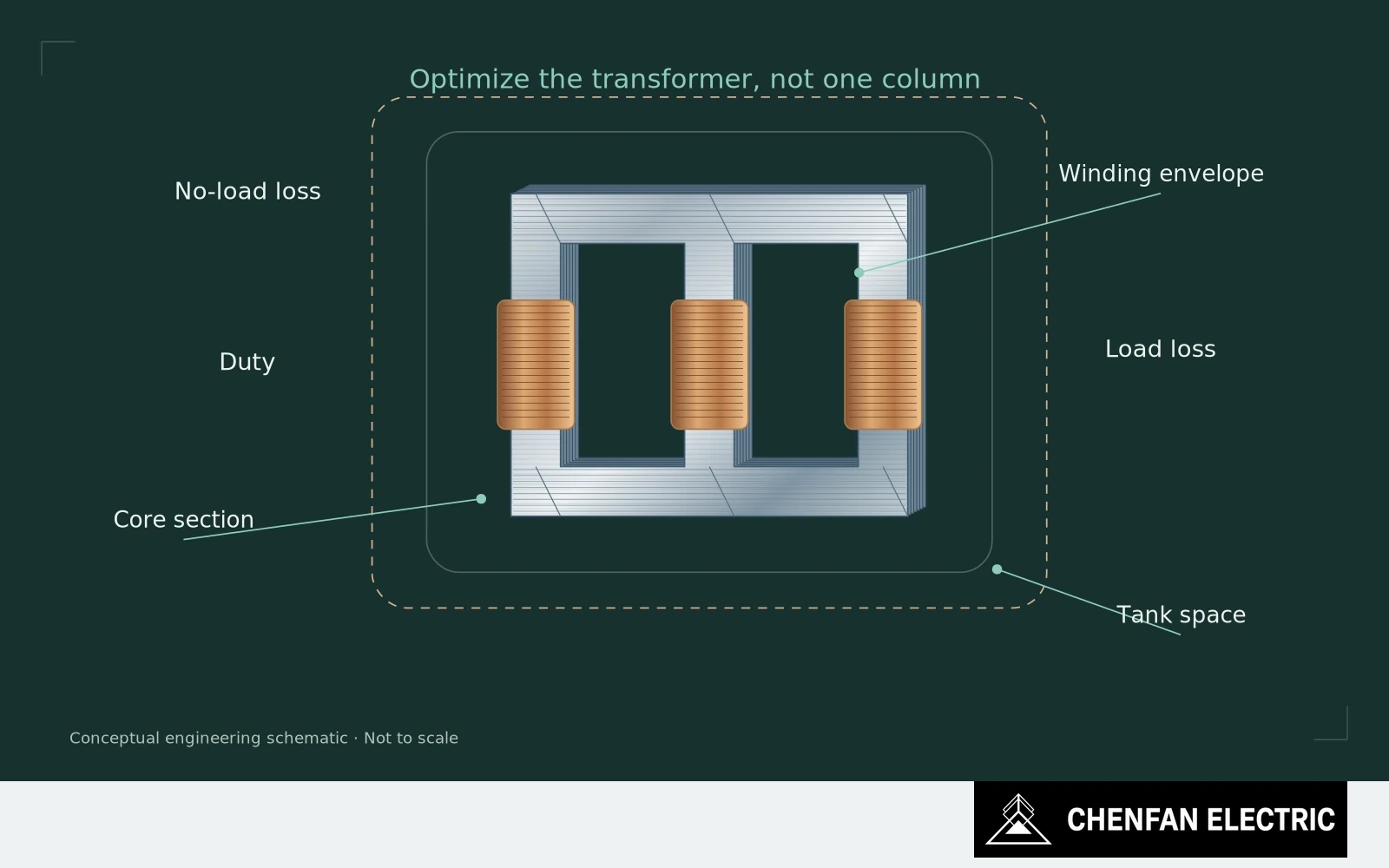
Review coupled changes in core and winding geometry
Reducing operating flux density can require more effective iron area for a fixed voltage, frequency and turns. That change can increase the core envelope and alter the winding geometry. A magnetic improvement may therefore affect steel mass, conductor length, tank dimensions and assembly arrangements.
Changing turns introduces another set of couplings. The resulting core and winding design must still meet the required electrical, thermal, insulation and mechanical conditions. There is no isolated control labelled “reduce core loss” that leaves the rest of the transformer unchanged.
A lower-loss steel grade may avoid some geometric changes, but its premium and processing requirements need to be evaluated against the actual improvement at the design’s operating point. The smallest catalogue loss value is not a complete economic comparison.
Compare alternatives at transformer level
Manufacturing complexity also has a boundary. A more demanding packet arrangement or thinner material can be appropriate when the production route is qualified for it. If the design depends on a level of handling or joint consistency that has not been demonstrated, the predicted improvement remains conditional.
Compare feasible alternatives at transformer level. Keep the rated output, applicable performance requirements and relevant service duty consistent. Include load loss and other affected costs rather than allowing the no-load-loss column to dominate by omission.
The duty profile can change the preferred trade-off. Loss incurred whenever the transformer is energized and loss associated with loading contribute differently to the evaluation. The weighting should come from the project assumptions, not a generic claim that one loss category always matters more.
Make the consequences of each loss reduction visible
A useful design review identifies alternatives that offer different balances of loss, size, cost and manufacturing burden. It then selects against the actual project criteria. An option that is inferior on every relevant criterion has little reason to remain; options with genuine trade-offs need an explicit decision.
Procurement should ask for the consequences of the proposed loss reduction, not just the improved watt figure. Which dimensions changed? Which interfaces need approval? Which production capability is now assumed?
A technically sound low-loss proposal makes those consequences visible. Hiding them does not make the transformer more efficient; it makes the optimization incomplete.
Practical takeaway
Minimizing one loss component can move cost and complexity into the rest of the transformer.
Chenfan Electric manufactures custom transformer cores according to customer drawings. Where applicable to the specified material and core design, agreed process controls include burr height below 0.02 mm and stacking factor above 97%. Measurement methods and acceptance conditions are defined for each order.