

A tighter transformer loss budget changes what a useful supplier quotation needs to demonstrate.
A material price and an attractive sample result leave the production question open.
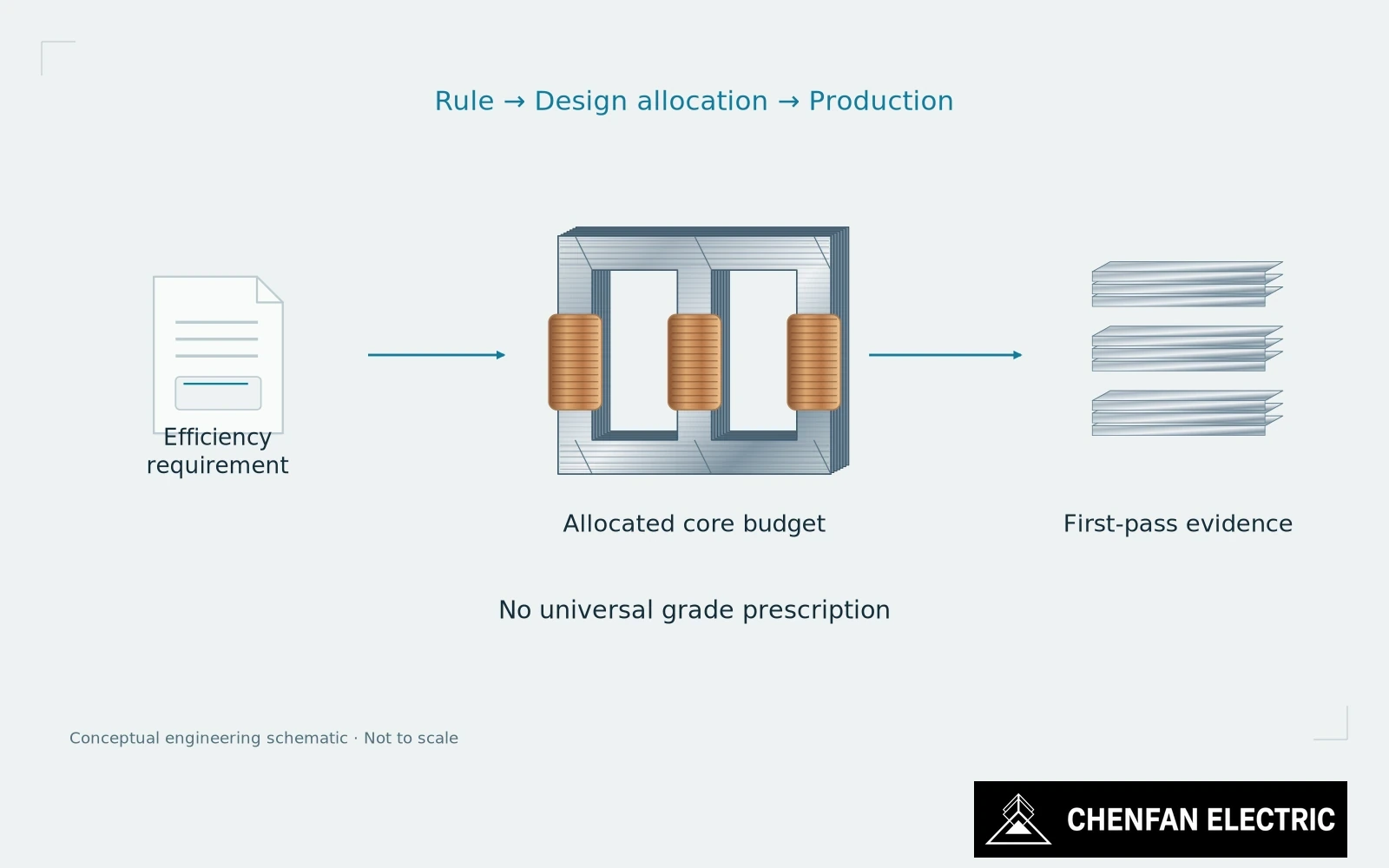
Translate the transformer requirement into a core allocation
Efficiency requirements are applied through the relevant transformer category and test basis. They are not a universal instruction to buy one GOES grade, and they do not automatically turn every finished-core data request into a regulatory requirement.
As checked on 4 October 2026, the US DOE’s 2024 amended standards for covered distribution transformers require compliance for units manufactured on or after 23 April 2029. DOE’s June 2026 request for information is not itself a replacement standard. In the EU, Regulation (EU) No 548/2014, as amended by Regulation (EU) 2019/1783, remains the applicable transformer ecodesign text, including category-specific Tier 2 requirements applicable since 1 July 2021. The Commission’s current review page proposes not to proceed with a further revision; that proposal is not a new adopted efficiency tier. Scope, exclusions and the complete-transformer test basis must be checked for the actual product.
The procurement consequence starts with the manufacturer’s own allocation. Once engineering assigns a core-related loss budget, the supplier must show that the agreed design and manufacturing route can deliver within that allocation with suitable consistency.
Request representative production evidence
That shifts the discussion toward comparable production evidence. Which material and geometry were tested? How much variation occurred across the relevant family? Were the reported results first-pass values or the best values after repeated adjustment? What happens when an approved material batch or process condition changes?
Price remains relevant. So do material availability and delivery capability. The point is that they are evaluated alongside the ability to meet the allocated performance, rather than used to assume it.
A supplier with a very low isolated result may still require more qualification than one with a well-characterized production route. That is an evidence question, not a claim that a particular company or manufacturing technology will win future orders.
Align the buyer’s requirements with the qualified route
The buyer has responsibilities too. A stable acceptance basis, timely drawing approval and a defined receiving configuration are needed before repeatability can be meaningfully assessed. Inconsistent buyer requirements can create variation that a supplier report cannot resolve.
For future sourcing rounds, ask suppliers to explain the demonstrated range and limits of their process for the intended core family. Avoid imposing an unrelated benchmark simply because it looks demanding.
Efficiency requirements make the translation from design allocation to repeatable production more consequential. The practical differentiator is evidence that the agreed performance survives normal manufacturing, not a promise that a premium steel label will settle the whole question.
Practical takeaway
A tighter allocated loss budget makes production evidence more consequential than an isolated sample result.
Chenfan Electric manufactures custom transformer cores according to customer drawings. Where applicable to the specified material and core design, agreed process controls include burr height below 0.02 mm and stacking factor above 97%. Measurement methods and acceptance conditions are defined for each order.