

Watts describe energy dissipation. RMS amperes do not.
That is why a normal no-load-loss result cannot be used to waive an unexplained exciting-current result, or vice versa.
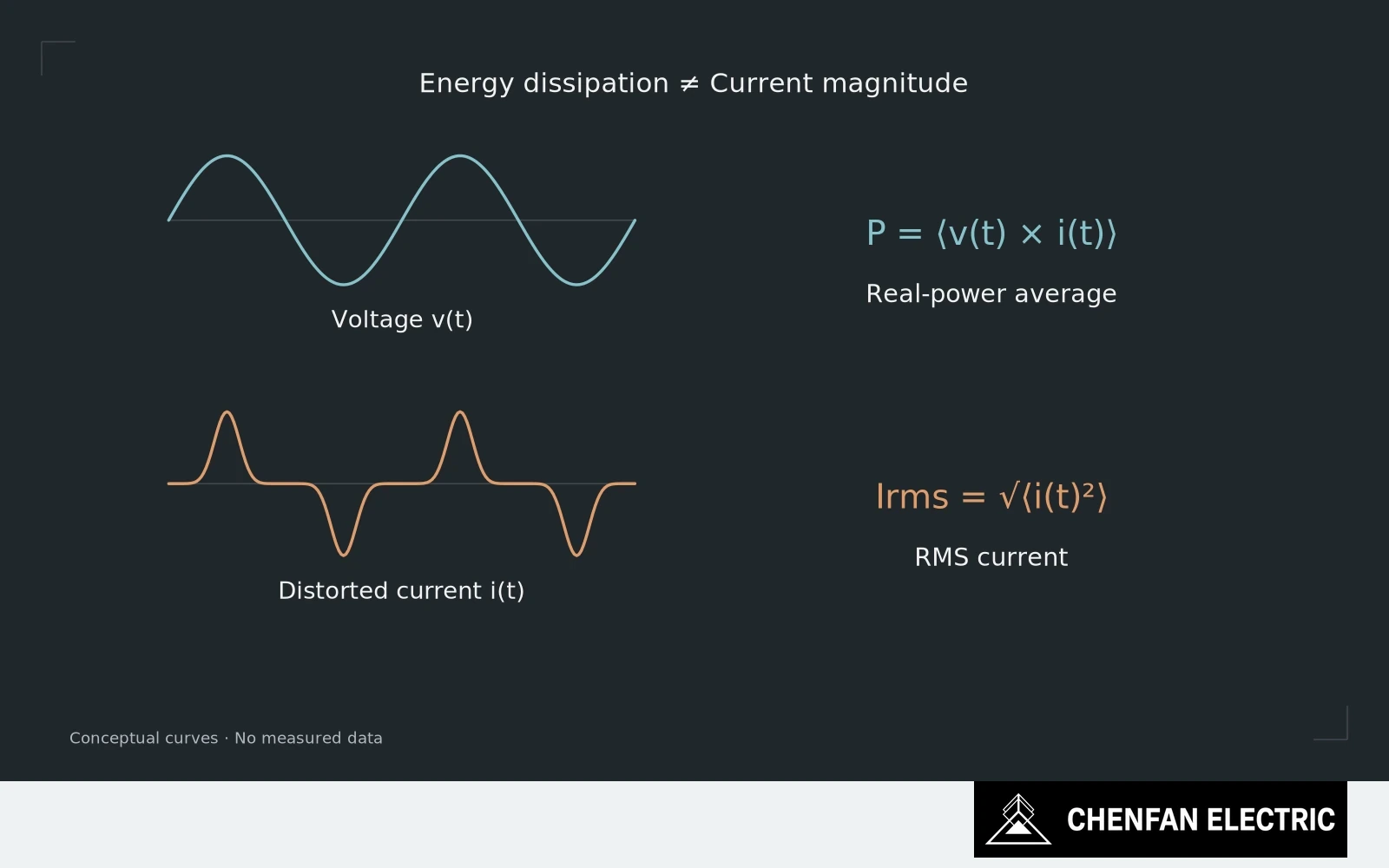
Separate real power from RMS current
Real power is obtained from the average of instantaneous voltage multiplied by current over the measurement interval. RMS current describes a different property of the current waveform. The two quantities are related through the electrical behaviour of the tested system, not interchangeable by definition.
For an ideal sinusoidal voltage and current, the familiar V I cos(phi) relationship applies. Exciting current can be distorted, however, so using only a fundamental phase angle with the total RMS current can give an incorrect interpretation of real power.
A magnetic-circuit change can increase the magnetizing demand without a proportional rise in dissipated power. Conversely, an additional loss mechanism can raise watts without producing a similarly conspicuous change in a reported current percentage. The observed pattern depends on the complete circuit and measurement basis.
Use the paired response to guide investigation
This makes the pair useful diagnostically. If loss and current both shift, ask which common change could affect them. If only one shifts materially, verify the measurement channel and consider mechanisms that can separate their responses. Neither pattern gives a unique root cause on its own.
Keep the measurement boundary clear. A finished-core test with temporary windings and a complete-transformer no-load test do not necessarily include identical contributions. Corrections and reporting conventions must match the quantity being claimed.
The instruments deserve separate attention. Accurate current measurement does not establish accurate low-power-factor watt measurement. Phase errors and waveform handling can matter to real-power accuracy even when the displayed voltage and current look stable.
Check wattmeter accuracy and independent acceptance limits
A test report should therefore retain both quantities under the same stated excitation, along with the information needed to interpret them. One should not be calculated from the other using an assumed fixed ratio or a generic power factor.
For acceptance, preserve separate requirements where the design calls for them. A supplier’s exceptionally low loss value is not a numerical credit that can offset an unexplained current anomaly.
When engineers discuss whether a core “tests well,” ask which response they are describing. The wattmeter and ammeter are observing different aspects of the magnetic system; their disagreement can be the most useful part of the test.
Practical takeaway
Real power and RMS current describe different properties, so neither measurement can replace the other.
Chenfan Electric manufactures custom transformer cores according to customer drawings. Where applicable to the specified material and core design, agreed process controls include burr height below 0.02 mm and stacking factor above 97%. Measurement methods and acceptance conditions are defined for each order.