

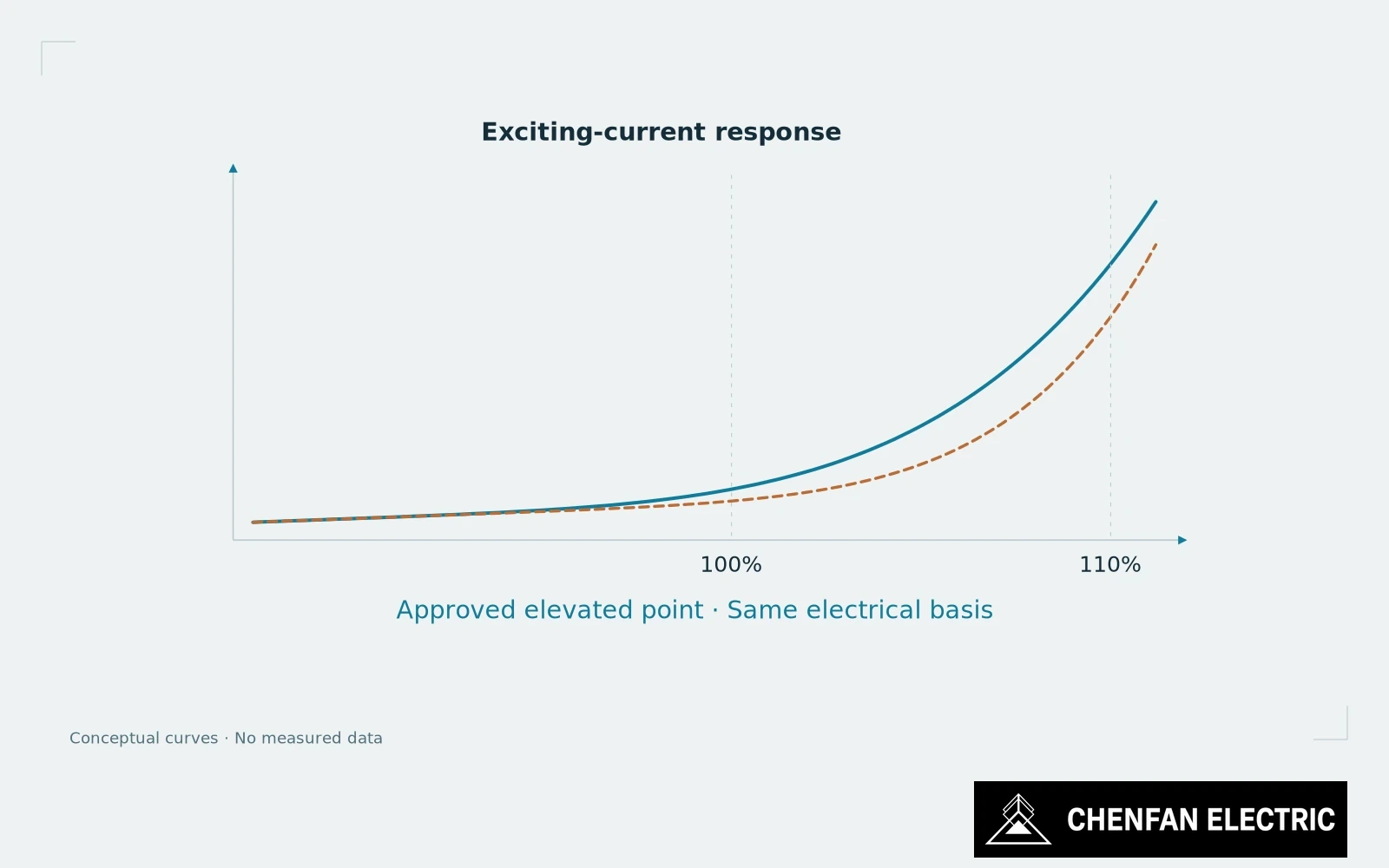
Suppose two cores agree near the reference point, but their current curves separate sharply at the next approved excitation level.
That divergence deserves investigation, but it does not identify a defective joint by itself.
Establish the reference and expected nonlinear response
An elevated point can move part of the magnetic circuit into a region where the required magnetizing force increases rapidly. Differences in local flux transfer, stress or effective section may then become more visible than they were at the lower point.
The useful evidence is the change in response, not the number “110” printed above a column. State what the percentage refers to. At fixed frequency, turns and area, a controlled voltage increase can represent a corresponding increase in flux excursion under the stated waveform assumptions. A different frequency or voltage interpretation breaks that simple comparison.
Compare the shape of the response with an appropriate design baseline. A steep rise may be expected for that operating region. It becomes a manufacturing concern when the result departs from a justified reference under comparable conditions, not merely because the current rises nonlinearly.
Check the source before diagnosing the core
Check the test source before interpreting the curve. At increased excitation, source capability and waveform distortion may change. Instrument range, current waveform and connection details can also influence the apparent difference between two assemblies.
Where the divergence is repeatable, use it to narrow the investigation. Examine whether it is common to comparable cores or isolated to one assembly, and whether the affected response matches a plausible difference in geometry or mechanical state. Do not turn a sensitive symptom into a unique diagnosis.
The elevated point must be authorized for the actual core and setup. Test duration, equipment capability and applicable design limits are part of that authorization. A 110% point is not a universal requirement for every finished-core test, nor is it permission to exceed a specified operating boundary.
Authorize elevated testing for a defined engineering question
For purchasing, an agreed multi-point response can provide more insight than demanding a single additional pass/fail value. The specification should explain how the information will be compared and what would trigger further review.
The result may confirm adequate headroom, expose an assembly-sensitive response or reveal a measurement limitation. Those are different outcomes with different next actions.
An elevated excitation point earns its place in the test plan when it answers a defined question about the design’s response. It should not become a ritual number that everyone records and nobody interprets.
Practical takeaway
A divergence above the reference point can expose sensitivity without uniquely identifying its cause.
Chenfan Electric manufactures custom transformer cores according to customer drawings. Where applicable to the specified material and core design, agreed process controls include burr height below 0.02 mm and stacking factor above 97%. Measurement methods and acceptance conditions are defined for each order.