

Every dimension on the inspection sheet is green. The assembled geometry is still wrong.
That can happen without a single inspector making a measurement error.
Work backwards from the functional interface
An assembly requirement is often a relationship among several features, while individual tolerances are assigned locally. If contributing dimensions move in the same unfavourable direction, the combined result can exceed the functional allowance even though each feature remains within its own limit.
Large cores add long spans, repeated interfaces and support-dependent geometry to that problem. The relevant chain may run through limb positions, yoke seating, clamps and the winding interface rather than through one simple linear sum.
Start at the functional endpoint. Which final clearance, alignment or position must be achieved? Work backwards to the dimensions and physical states that determine it. A list of tight tolerances is not a substitute for that relationship.
Account for shared datums and support conditions
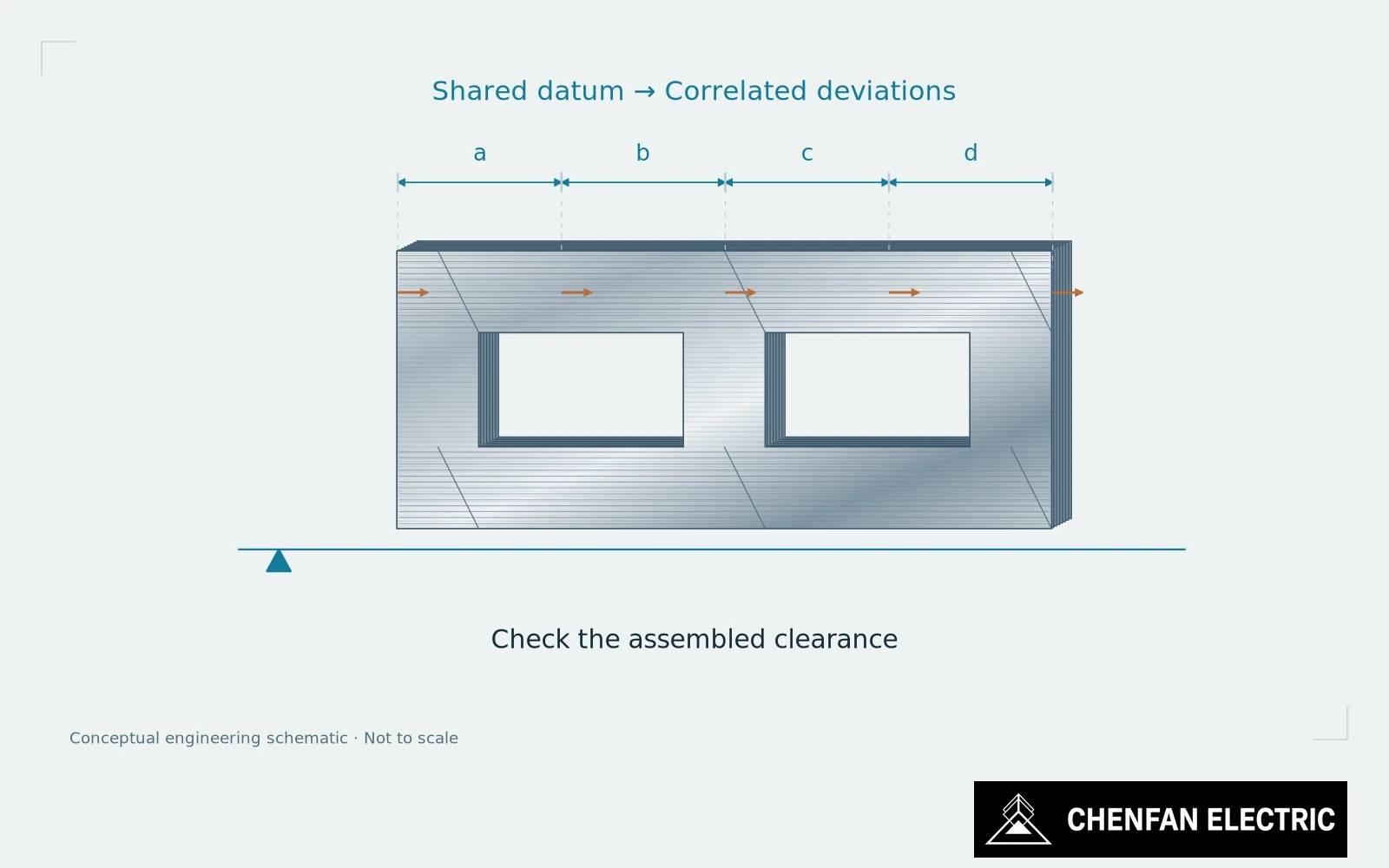
Pay particular attention to common datums. If several measurements share a shifted reference, their errors may be correlated. Treating them as independent random quantities and combining them by root-sum-square can understate the assembly risk.
Worst-case and statistical analyses answer different questions. Select the method according to the functional requirement and the evidence for the variation model. A statistical calculation needs credible distributions and dependence assumptions, not merely a spreadsheet function.
Support condition is part of the chain. Measurements taken on a building fixture may not directly establish the released or standing geometry. State which configuration controls acceptance and which intermediate checks are used to guide manufacture.
Then choose inspection locations that reveal the relationship. Measuring only component widths may miss a progressive alignment drift. Measuring the completed interface from a common datum can expose it, provided the method has adequate repeatability.
Verify the assembled relationship, not only local dimensions
The corrective action should target the contributor that controls the final result. Tightening every local tolerance can add cost without resolving an unstable datum or an inappropriate assembly sequence.
For supplier qualification, ask to see one completed dimensional chain tied to a real interface requirement. The useful evidence is the link from design allowance to process control and final verification, not the number of decimal places on the drawing.
A large-core geometry is accepted as an assembly. Its dimensional evidence should be organized as an assembly too.
Practical takeaway
Individually conforming features can combine into a nonconforming functional interface.
Chenfan Electric manufactures custom transformer cores according to customer drawings. Where applicable to the specified material and core design, agreed process controls include burr height below 0.02 mm and stacking factor above 97%. Measurement methods and acceptance conditions are defined for each order.