

The right core delivery format is the one that fits the factory’s constraint, not the one with the most assembly already completed.
A useful make-or-buy decision starts at the receiving plant.
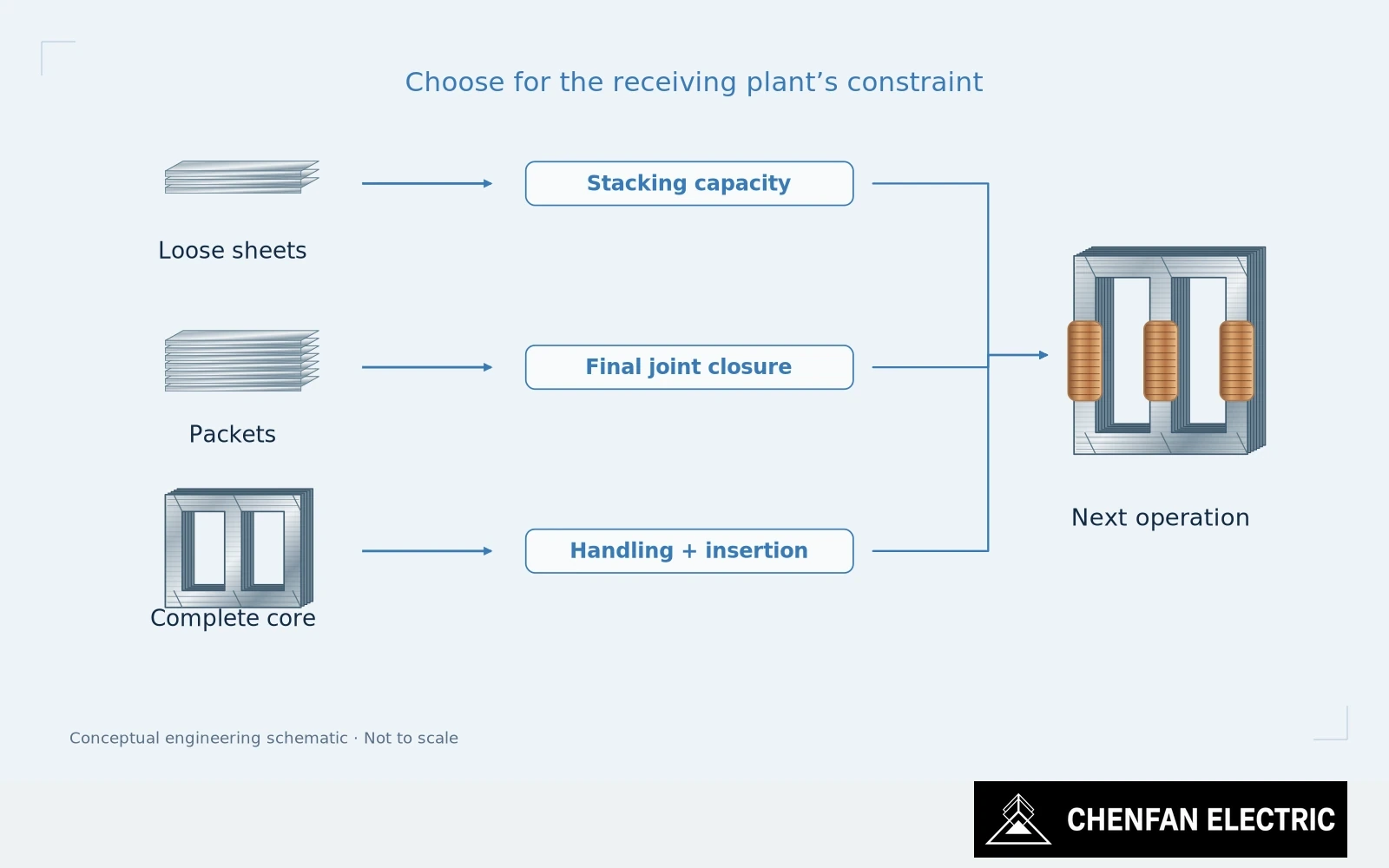
Start with the receiving factory’s constraint
If skilled stacking capacity and suitable fixtures are available, loose laminations may preserve scheduling flexibility and local control of assembly. The buyer then owns packet discipline, joint build, clamping, handling and the relevant finished-core verification. Those activities belong in the cost and capacity comparison.
Pre-stacked supply can shift part of that workload without transferring the whole integration task. Its value depends on exactly what arrives: identified packets, pre-stacked limbs, partial assemblies or another defined configuration. The term alone does not tell production which operations have disappeared.
A complete assembled core may remove a substantial stacking bottleneck. But check the downstream route. Does winding insertion require a yoke to be opened again? Can the receiving equipment handle the delivered orientation and envelope? Is protected storage available before the scheduled assembly slot?
Allocate the remaining assembly and acceptance work
The answer can differ between factories buying the same transformer design. One plant may be constrained by skilled labour, another by floor space, another by handling equipment. A delivery format that solves one constraint can create another.
Evaluate the interfaces explicitly. Who supplies temporary fixtures? Who owns the final joint closure? Which party verifies the assembled geometry after the last planned disturbance? Where is magnetic acceptance established, and what condition does it cover?
Commercial comparison should use the same endpoint, such as a verified core ready for the buyer’s next operation. Include the work retained by the buyer and avoid charging that work twice when it is genuinely included in the supplier’s scope.
Trial the delivery format through the real production route
There is also a resilience question. If the usual receiving operation is unavailable, can the factory use an alternative route without improvising a new process? This matters more than a small theoretical labour saving that depends on one irreplaceable setup.
A trial order should therefore run through the intended production route, not stop at unloading or at a supplier test certificate. The format has demonstrated its value only when the receiving factory can use it as planned.
Choose the degree of pre-assembly by the capability you need to transfer and the interfaces you can control. There is no technically superior format independent of the plant that must build the transformer around it.
Practical takeaway
More pre-assembly can solve the wrong bottleneck or recreate work at the receiving factory.
Chenfan Electric manufactures custom transformer cores according to customer drawings. Where applicable to the specified material and core design, agreed process controls include burr height below 0.02 mm and stacking factor above 97%. Measurement methods and acceptance conditions are defined for each order.