

Selling a complete core means accepting responsibility for relationships that a lamination invoice does not contain.
The product is no longer just a set of correctly cut parts.
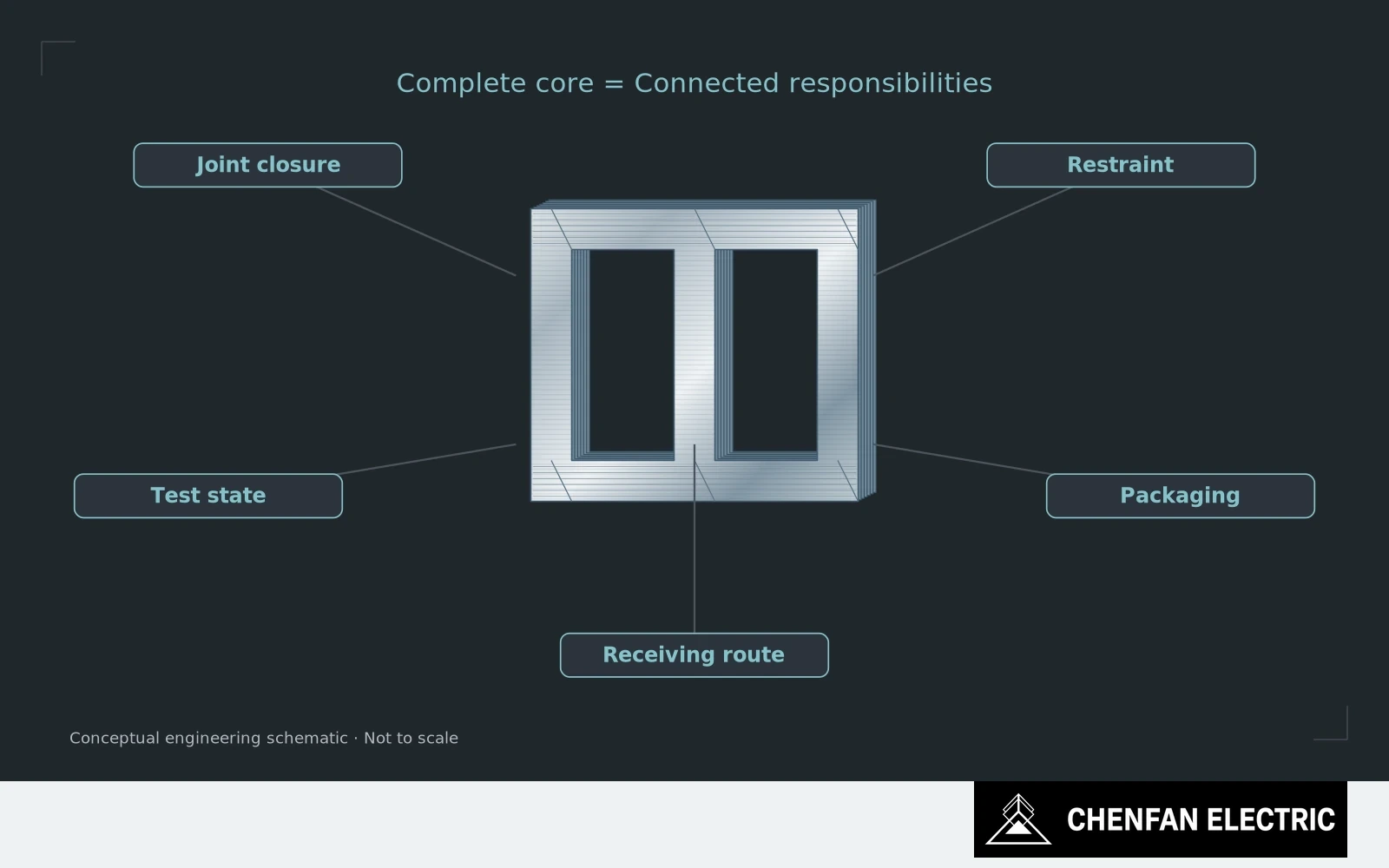
Control magnetic, mechanical and winding interfaces
Its joint sequence, assembled geometry, mechanical restraint and test configuration must work together. A supplier can make every individual lamination within tolerance and still fail to control the delivered assembly if those interfaces are left to informal adjustment.
Consider the handoff to winding installation. The supplier must understand which structures remain, which are removed and whether the receiving route requires opening a yoke. “Complete assembled” is not a sufficient description if the buyer expects a configuration that cannot reach its next manufacturing stage without substantial reconstruction.
Testing adds another interface. The report should identify the mechanical and magnetic condition actually tested, and the changes made afterwards for packing or transport. Otherwise, a valid result may be attached to an incompletely described delivery state.
Connect drawing changes to testing and packaging
Packaging cannot be developed independently. Supports and restraints need to protect the assembled geometry without treating thin laminations as arbitrary load-bearing surfaces. The receiving factory also needs a defined way to remove transport protection without losing the intended support condition.
These obligations are connected. A late packaging change can affect the handling route; that route can alter which dimensions require verification; a changed assembly interface can make the original delivery promise misleading.
This is why a supplier evaluation should follow the connections between departments. Ask how a drawing revision reaches stacking, test, fixture selection and packing. Check who resolves a conflict when each department’s local instruction appears correct but the complete route is not.
Deliver an executable receiving configuration
The higher capability requirement is not that assembled-core suppliers must own every possible machine. It is that they can control the interfaces they have agreed to deliver, including any qualified subcontracted operation.
Loose-lamination supply can be entirely appropriate when the buyer owns those integration tasks. Complete-core supply can remove substantial work from that buyer when the supplier genuinely owns them instead.
The scope distinction should be visible in the acceptance package: a defined configuration, verified interfaces and an executable receiving route. Without those elements, “complete” describes how the core looks at dispatch rather than what the customer can reliably do with it next.
Practical takeaway
Complete-core supply transfers integration responsibilities, not just more assembly labour.
Chenfan Electric manufactures custom transformer cores according to customer drawings. Where applicable to the specified material and core design, agreed process controls include burr height below 0.02 mm and stacking factor above 97%. Measurement methods and acceptance conditions are defined for each order.