

Where is the sign-off between “stacking complete” and “core turned”?
If turning is absent from the manufacturing route, the factory may be recording two acceptable endpoints without controlling the transition between them.
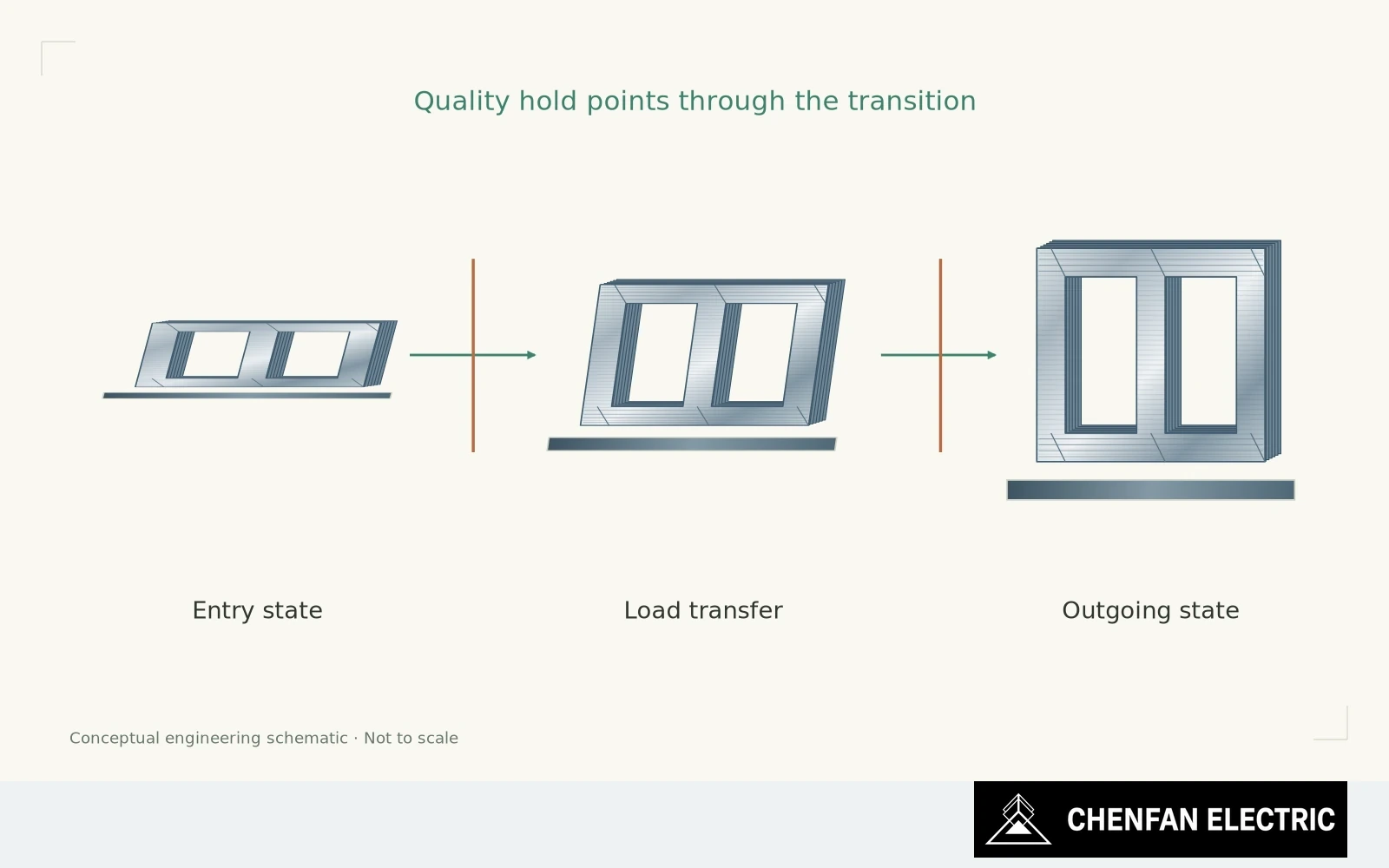
Define entry conditions and engineering hold points
The quality value of a turning operation is not a second crane checklist. It is a defined entry condition, an approved configuration change and evidence that the intended core state was preserved.
Before the operation, confirm that the assembly matches the qualified arrangement: correct fixture identity, required restraints, verified core identity and completion of the relevant upstream inspections. An unapproved substitute support is a process change even when its rated capacity looks sufficient.
Specify the hold points that matter to the design. These may concern a restraint becoming inaccessible, a support being released or an interface taking load. The actual sequence belongs in the engineered work instruction; it should not depend on an operator reconstructing intent from a general assembly drawing.
Inspect the outgoing state and record deviations
The outgoing inspection should be different from the incoming one where the risks differ. Features vulnerable to movement during the transition need checks in the final support condition. Rechecking an easily accessible overall dimension while ignoring a disturbed joint does not close the operation.
Record deviations as events, not just final defects. Unexpected movement, a required pause or an unplanned support adjustment can be relevant even if the visible geometry is subsequently restored. Without that record, a later test anomaly loses a potentially useful part of its manufacturing history.
This is also where automation needs limits. A programmed turning device can repeat a motion; it cannot establish that the particular core, fixture and restraint configuration were the approved combination unless those conditions are verified.
Qualify the assembly family and release transition
Qualification should cover the intended family of assemblies and its justified limits. A successful turn of one compact core does not automatically validate a taller, less stiff arrangement with different support points.
For purchasing, the evidence to request is a controlled process step and its release record, not simply confirmation that the supplier owns suitable lifting equipment.
Treating turning as manufacture gives it an owner, a revision-controlled method and a defined acceptance state. That is what keeps a necessary handling operation from becoming an undocumented experiment between stacking and test.
Practical takeaway
A missing turning sign-off leaves an important configuration change outside the quality record.
Chenfan Electric manufactures custom transformer cores according to customer drawings. Where applicable to the specified material and core design, agreed process controls include burr height below 0.02 mm and stacking factor above 97%. Measurement methods and acceptance conditions are defined for each order.