

A stack that is stable on a building table has not thereby been qualified to stand upright.
The weight is unchanged. The way that weight travels through the assembly is not.
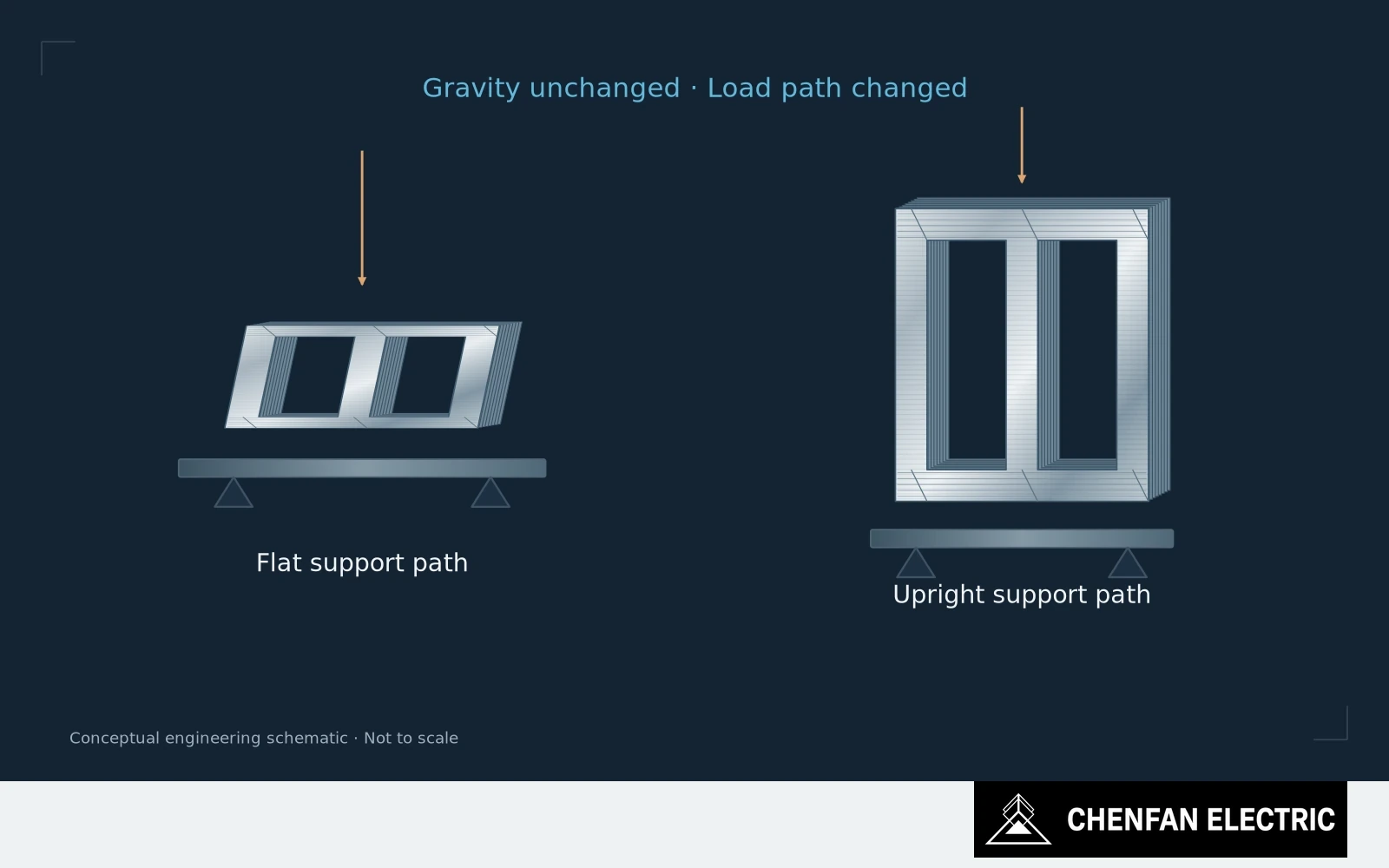
Treat the core as a laminated assembly
A laminated core should not be treated as a solid steel block with the same outer envelope. Its response depends on sheet direction, interlaminar contact, joints, clamps and supports. Restraints that work in one orientation may not provide equivalent control after the load direction changes.
Flat handling can expose a different span and support pattern from standing handling. Turning introduces intermediate states that neither endpoint drawing fully describes. The mechanical review therefore needs the complete transition, not simply a photograph of the finished upright core.
Start with the approved load path in each state. Which structure carries the assembly? Which features locate the laminations? Which restraints prevent relative movement? A magnetic joint should not silently become a structural attachment because a lifting arrangement is convenient.
Define load paths and inspection states
The geometry to verify also depends on orientation. A dimension measured while the stack is supported may change after release or repositioning. The drawing and inspection plan should state the relevant support condition so that supplier and receiver are not comparing different mechanical states.
For large cores, support deflection and local contact conditions deserve attention alongside overall stability. A fixture can keep an assembly upright while still introducing an unwanted local load. Conversely, a small elastic movement during an approved transition is not automatically permanent damage.
Use engineering-approved equipment and a qualified handling plan for the actual assembly. There is no transferable sling arrangement or universal restraint pressure that can be selected from core mass alone.
Qualify the actual orientation change and receiving route
After the transition, verify the features that could have moved and investigate any departure from the expected response. Whether further magnetic testing is needed depends on the event, the affected configuration and the agreed qualification plan, not on a blanket assumption that every lift changes loss.
Procurement can make this manageable by specifying the delivery orientation and the receiving operation before manufacture. A supplier cannot validate an unspecified final support arrangement.
The useful comparison between standing and flat delivery is therefore the controlled mechanical route each factory can execute, not which orientation appears more robust in a shipping photograph.
Practical takeaway
Unchanged mass can conceal a completely different load path when a laminated core changes orientation.
Chenfan Electric manufactures custom transformer cores according to customer drawings. Where applicable to the specified material and core design, agreed process controls include burr height below 0.02 mm and stacking factor above 97%. Measurement methods and acceptance conditions are defined for each order.