

A grade designation defines requirements.
It does not promise that every coil will produce an identical measured value.
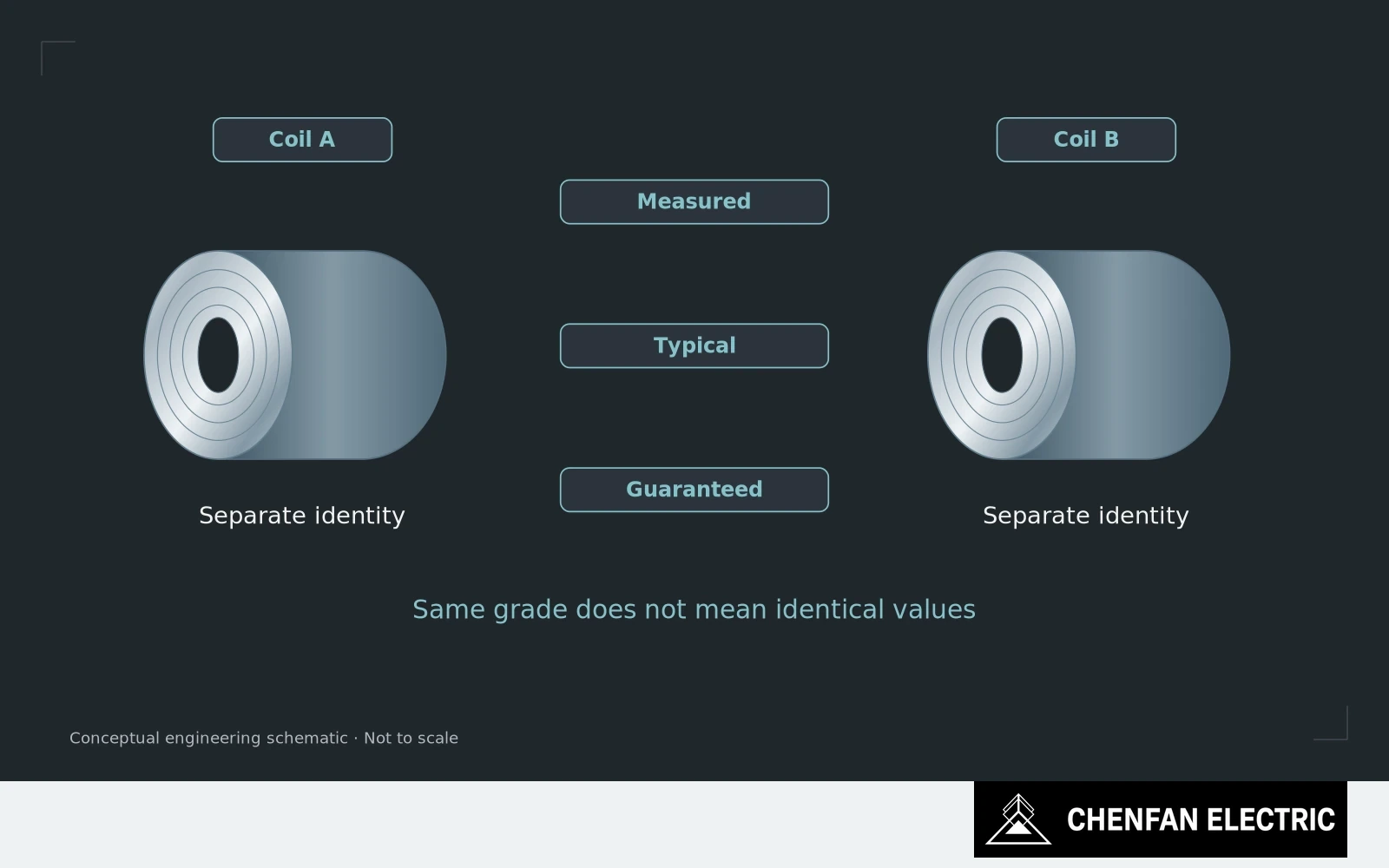
Distinguish guarantees from measured material values
That distinction becomes important when a transformer design uses most of the available magnetic margin.
First establish what the material record actually reports. A guaranteed maximum, a typical catalogue value and an actual test result are different information. Comparing them as though they were equivalent can create a false impression of either consistency or variation.
For coils within the same approved grade, review the characteristics relevant to the design operating point. A common designation does not eliminate the need to understand the declared thickness, magnetic test basis and material treatment.
Separate coil variation from simultaneous process changes
The purpose is not to reject every difference. It is to decide whether the variation remains within the assumptions used for the core design and qualification.
If the design is sensitive to a particular characteristic, the supplier may need an incoming verification or allocation rule. That rule should be based on relevant evidence, not on selecting the most attractive number from whichever test happens to be available.
Keep material variation distinct from manufacturing variation. If a new coil enters production at the same time as a tool change or a revised stacking operation, a later change in core loss cannot be assigned to the coil merely because the dates coincide.
Use comparable test conditions and preserve the sequence of events. Where a difference matters, a matched comparison or targeted retest can help separate the input characteristic from the processing route.
Define an approved and traceable allocation rule
Controlled use of more than one approved batch is not automatically a defect. The design and quality plan should determine whether mixing is permitted, how the inputs are identified and what evidence is required. Unrecorded substitution is a different issue from an approved allocation strategy.
For purchasing, a useful material consistency review asks how the supplier handles variation before it becomes a finished-core surprise. Does it identify unusual input results, understand the design sensitivity and maintain traceability through the affected cores?
The answer should not be an unsupported claim that every coil is the same. It should be a controlled method for keeping the delivered core within its intended performance range when the material inputs are not numerically identical.
Practical takeaway
Grade compliance does not imply numerically identical coil characteristics.
Chenfan Electric manufactures custom transformer cores according to customer drawings. Where applicable to the specified material and core design, agreed process controls include burr height below 0.02 mm and stacking factor above 97%. Measurement methods and acceptance conditions are defined for each order.