

“Ecodesign compliant” on a core quotation leaves the most important calculation unfinished.
The core buyer still needs to know which transformer requirement is being allocated, under which conditions, and with what remaining margin.
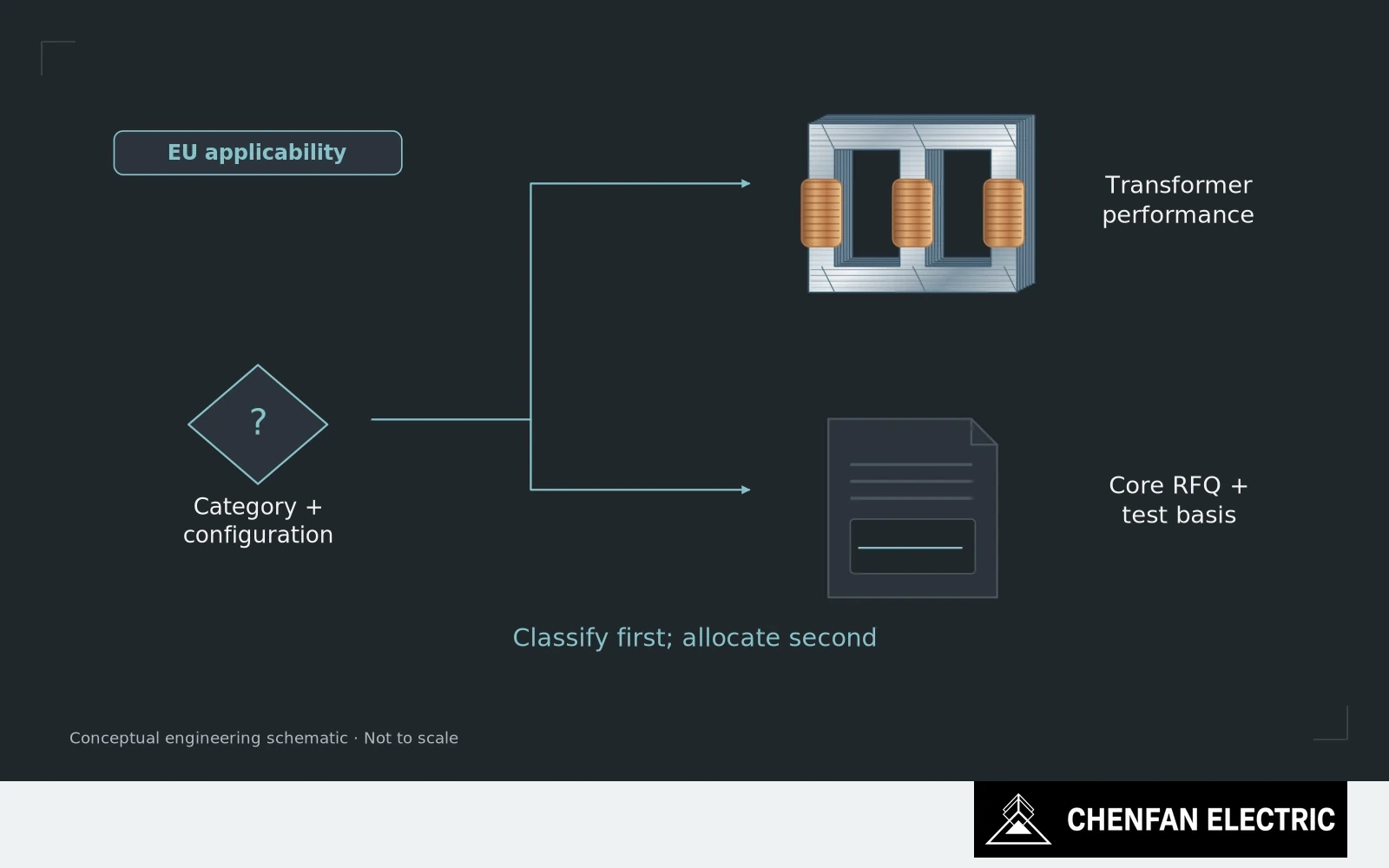
Identify the applicable transformer requirement
As checked on 4 October 2026, Regulation (EU) No 548/2014, as amended by Regulation (EU) 2019/1783, remains the applicable transformer framework. Tier 2 requirements have applied since 1 July 2021, subject to the regulation’s scope and specific provisions. The Commission’s dedicated review page reports a proposal not to proceed with further revision, leaving the applicable legal text unchanged. This proposal is not an adopted new efficiency tier.
For a specific project, establish the applicable transformer category, rating, configuration and any relevant provisions before setting the internal core target. A general claim about “European efficiency” is not a substitute for that classification.
The engineering translation then matters more than the label. The transformer has an overall efficiency or loss requirement, while the supplier is delivering a particular core geometry in a particular state. Those are different objects of acceptance.
Allocate losses across the complete design
No-load loss is strongly connected to the core design and operating induction. Load-related losses involve additional transformer design choices. The designer must evaluate the relevant requirements together rather than allocating every efficiency improvement to a material upgrade.
A defensible RFQ therefore states the core contribution the design can accept, the excitation and measurement basis, the delivered assembly state and the handling of the interface to final transformer testing. Material requirements remain useful, but they support that allocation rather than replacing it.
Reserve margin for identified uncertainties. Do not use an unexplained percentage to cover material variation, manufacturing variation and measurement uncertainty if some of those effects have already been included elsewhere in the calculation.
Specify measurable core performance and margin
Procurement also needs comparable evidence. A supplier offering a lower nominal W/kg at an unrelated induction has not necessarily offered more usable margin. A supplier reporting repeatable results for a relevant design family may provide better information about the production allocation, but comparability must be checked.
The practical question at quotation review is not whether the supplier recognizes the name Ecodesign. It is whether the offered core has a documented, verifiable place in the customer’s compliant transformer design.
That is the point where a regulatory requirement becomes an executable purchase specification.
Practical takeaway
A compliance label does not identify the core contribution required by the transformer design.
Chenfan Electric manufactures custom transformer cores according to customer drawings. Where applicable to the specified material and core design, agreed process controls include burr height below 0.02 mm and stacking factor above 97%. Measurement methods and acceptance conditions are defined for each order.