

The watts are acceptable. The exciting current is not.
Do not average those two findings into a pass.
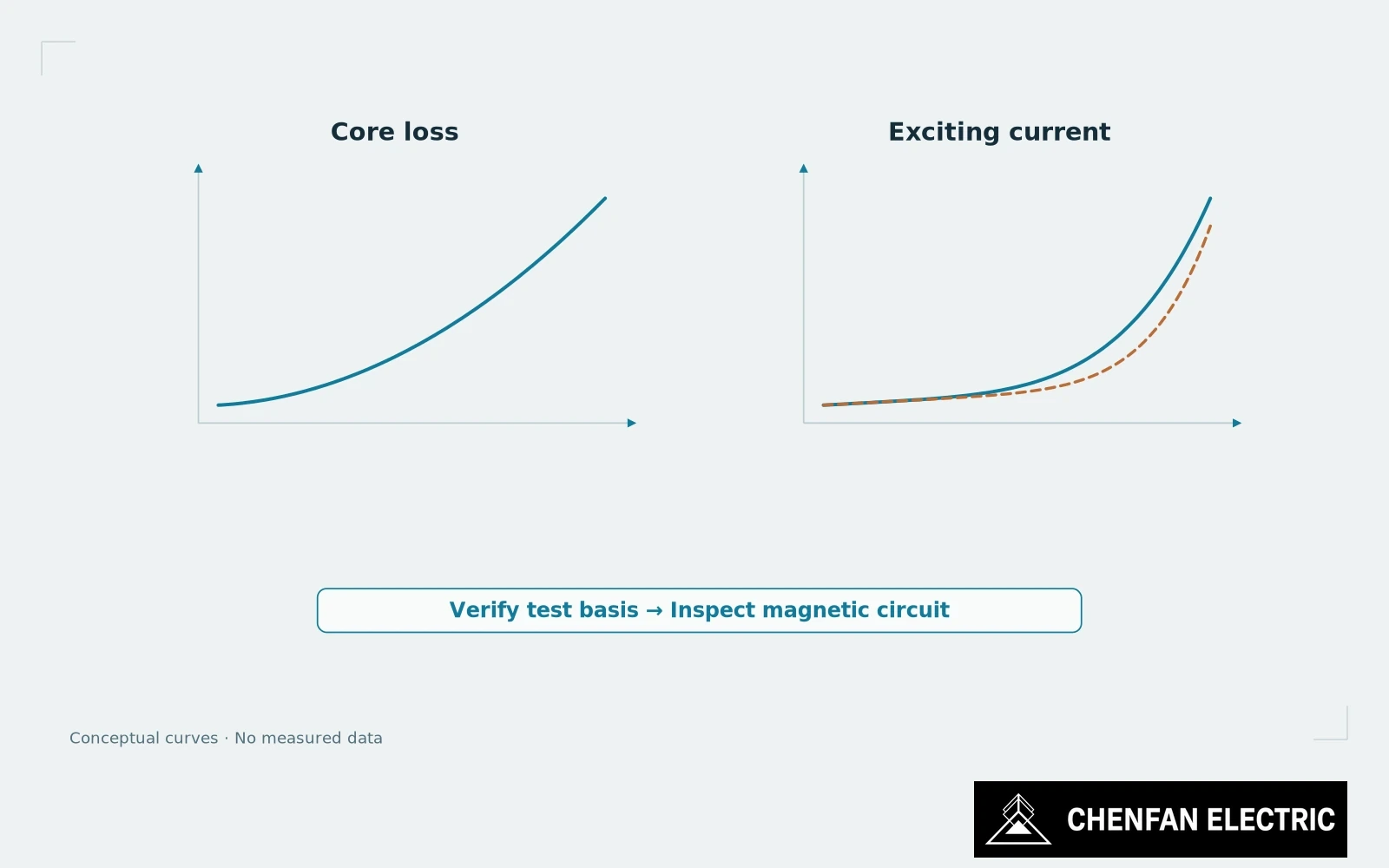
Confirm the current and excitation basis
No-load power and exciting current describe different aspects of the energized magnetic circuit. The current includes the magnetizing requirement and waveform-related components as well as the component associated with real power. A change in current therefore need not produce a proportionate change in measured loss.
First establish that the comparison is valid. Confirm frequency, winding turns and connection, voltage measurement basis and the denominator used for any percentage current. A current from a temporary core-test winding cannot be compared directly with the percentage no-load current of a completed transformer.
Check magnetic history and supply conditions next. Residual magnetization can influence diagnostic excitation measurements, particularly at reduced test levels. Voltage distortion, unbalance or a changed neutral arrangement can also complicate interpretation. Use the applicable procedure rather than correcting the result by intuition.
Read the magnetic response and phase pattern
If the excess current is repeatable under comparable conditions, examine the magnetic circuit. An unintended gap, disturbed step-lap sequence or local restriction can increase the magnetizing requirement. An operating point close to a nonlinear region can make a small geometric or excitation change more visible in current than in total watts.
Look at the pattern, not only the sum. Phase observations can help direct an investigation, but expected patterns depend on core topology and test connection. Unequal readings do not automatically identify a defective limb in a three-phase core.
An agreed excitation curve is useful here. Does the difference exist throughout the tested range, or develop sharply near its upper end? The shape can distinguish candidate explanations, although it is not a unique fingerprint for a particular joint defect.
Document the core before a controlled intervention
Avoid dismantling the core before documenting its as-tested state. Record the joint arrangement, support and clamp condition, and retain the original electrical readings. If an approved intervention is made, change one relevant variable and repeat under the same conditions.
A normal loss result remains good evidence for that measured quantity. It does not cancel an independently specified current requirement or prove that the magnetic circuit has adequate margin.
Treat the disagreement as diagnostic information. The two measurements are useful precisely because they do not always move together.
Practical takeaway
Acceptable watts do not cancel a separate current anomaly.
Chenfan Electric manufactures custom transformer cores according to customer drawings. Where applicable to the specified material and core design, agreed process controls include burr height below 0.02 mm and stacking factor above 97%. Measurement methods and acceptance conditions are defined for each order.