

A hole is a missing piece of the magnetic path, not merely a fastening detail.
That does not mean every hole is a design mistake.
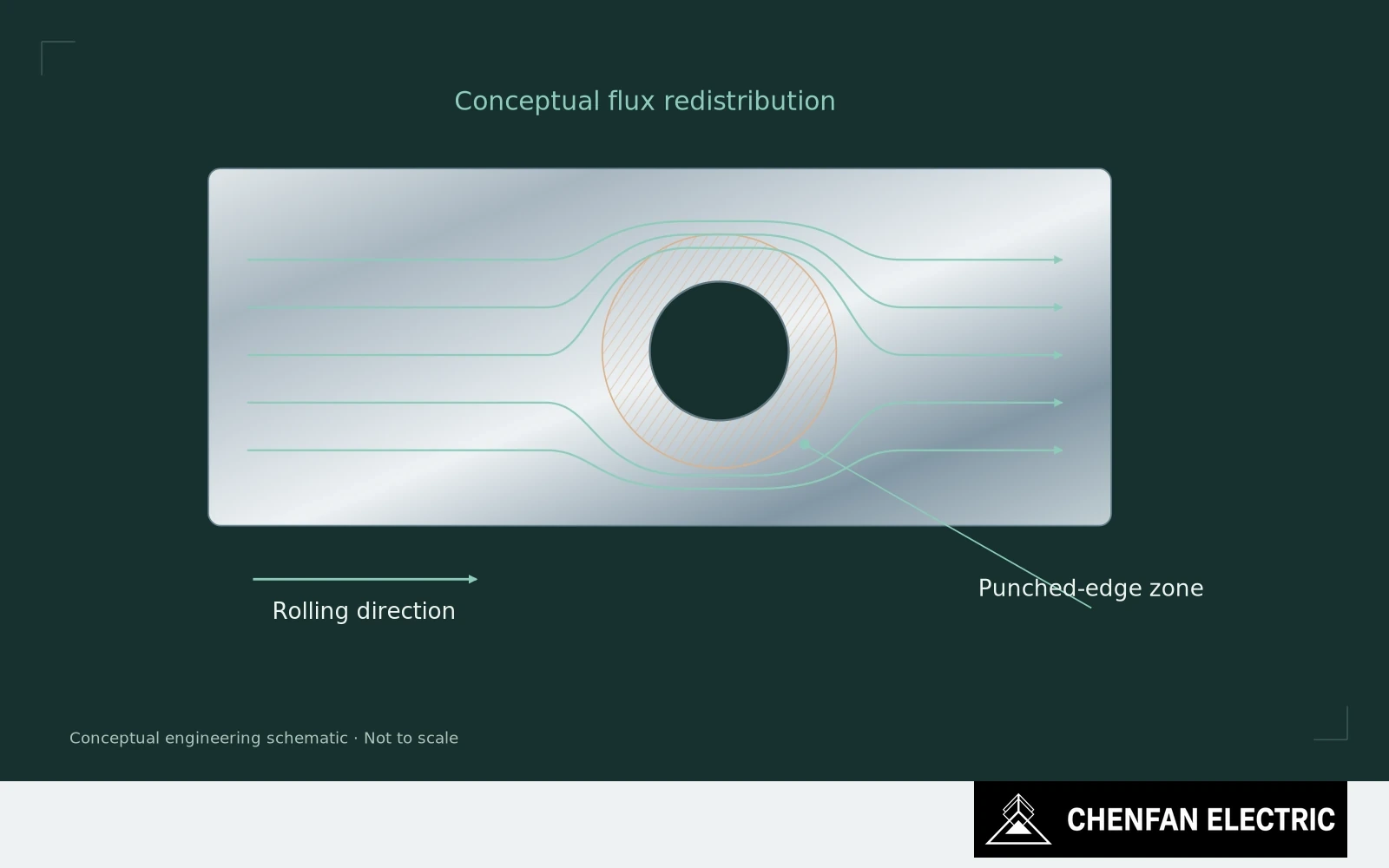
Assess local section and punched-edge condition
Its effect depends on location, size, surrounding section and the flux that must pass through that region. A hole away from a highly stressed magnetic region may have a different consequence from one that constricts an already demanding flux path.
There are two separate effects to consider. Removing steel changes the available local cross-section and redirects flux around the opening. Punching also introduces deformation and residual stress near the edge. Combining both effects into a universal percentage loss penalty is not technically defensible.
The appropriate design question is whether the local geometry and excitation leave adequate margin. Average limb induction cannot fully describe a constricted region. Where the feature is magnetically significant, local field analysis or a representative physical comparison is more informative than a calculation based only on the overall removed mass.
Check tooling and fastener insulation separately
The manufacturing question is different: can the hole be produced without unacceptable edge damage, distortion or loss of positional control? Inspect the relevant tool station and material condition. A burr check on the external shear edge does not qualify the punched edge.
Fastener insulation creates another boundary. The hole may be dimensionally correct while the assembled hardware creates an unintended electrical connection. Verify the designed insulation system and contact arrangement; do not assume that a coated sheet alone insulates every through-fastener condition.
For a drawing change, retain the old and proposed hole geometry, identify the mechanical function and assess the magnetic path before moving the feature. Removing a hole to improve a magnetic calculation may create a structural or assembly problem elsewhere.
Review the feature before changing the drawing
Similarly, replacing punching with another cutting method is not automatically an improvement. The alternative needs qualification for edge condition, dimensional capability, thermal or mechanical influence and the actual GOES product.
The sourcing consequence is straightforward: holes belong in the technical review before the quotation is frozen. Their position, tolerance and insulation interfaces can affect tooling, assembly and verification scope.
Accept or reject the feature on its function and evidence. “Only a small hole” is not an analysis, and “holes always ruin the core” is no better. What matters is the local magnetic and mechanical condition the finished assembly will create.
Practical takeaway
The removed area and the punched-edge condition are separate magnetic variables.
Chenfan Electric manufactures custom transformer cores according to customer drawings. Where applicable to the specified material and core design, agreed process controls include burr height below 0.02 mm and stacking factor above 97%. Measurement methods and acceptance conditions are defined for each order.