

Adding steps changes a joint design. It does not add quality by arithmetic.
Before comparing step counts, define the arrangement: displacement between steps, overlap length, sheets per step, sequence through the packet and the geometry at the T-joint or corner. Two descriptions that both say “five-step” can still describe different magnetic circuits.
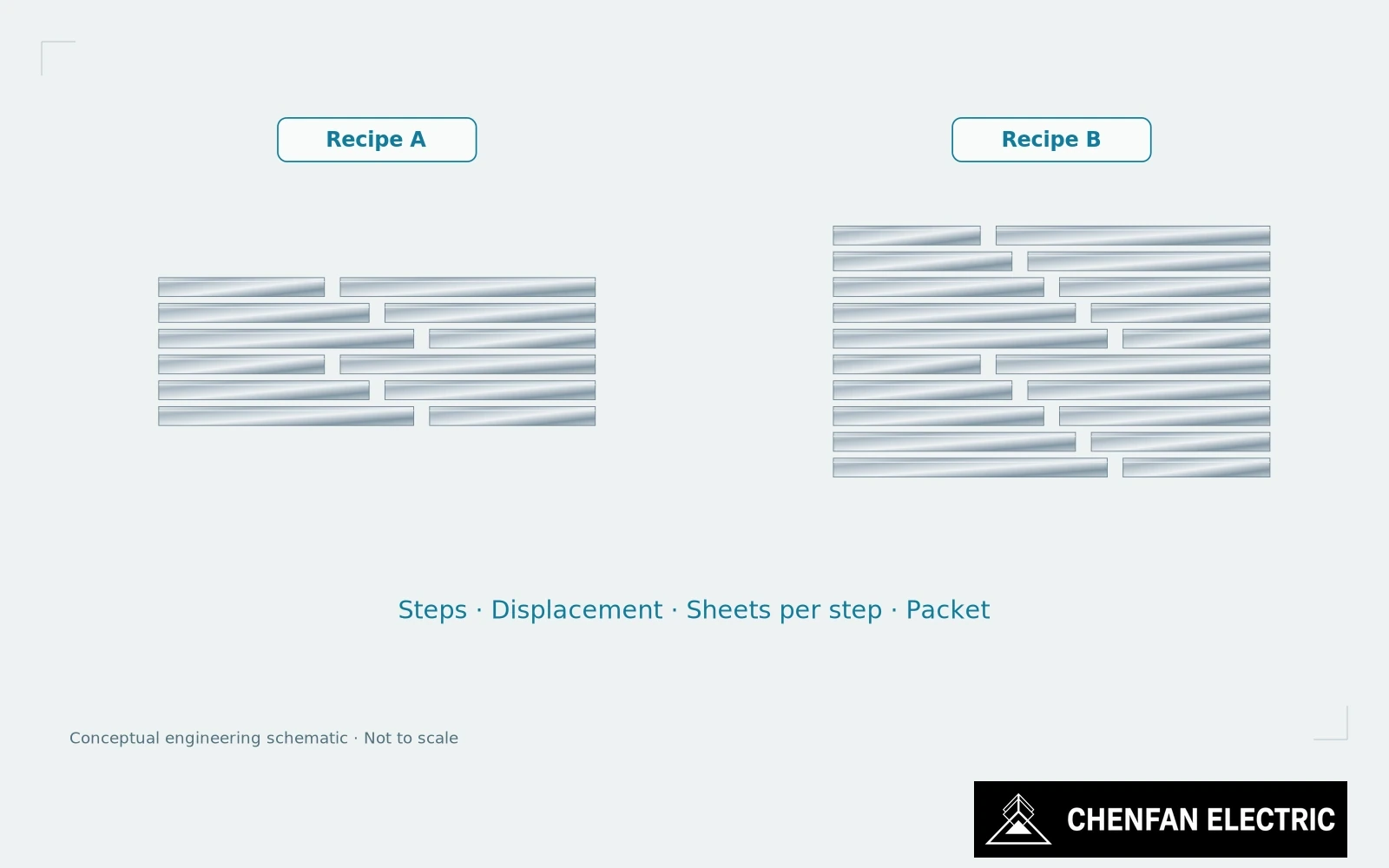
Define the complete joint arrangement
Step-lap construction distributes joint discontinuities through the build and provides paths for flux transfer between neighbouring laminations. The effectiveness depends on the geometry and operating induction. It cannot be inferred from the count while the other dimensions remain unspecified.
An increase in step count may improve a particular design, have little benefit in another, or demand a different balance of overlap and packet organization. The correct comparison holds the intended constraints visible rather than changing several variables and assigning the entire result to one number.
Manufacturing tolerance is part of that comparison. Each distinct sheet position must be cut, identified and placed correctly. An arrangement with more positions is valuable only if the production route reproduces it. That does not mean complex joints are inherently unreliable; it means their control requirements must be qualified.
Compare nominal performance and tolerance sensitivity
A development trial should compare complete arrangements at the required excitation points. Record loss and exciting current, and inspect whether the intended geometry was actually achieved. A simulation of an ideal joint and a measurement of a misassembled alternative do not establish a fair design ranking.
Examine tolerance sensitivity as well as nominal performance. An arrangement that has a small theoretical advantage but reacts strongly to the actual cutting or stacking variation may need better process control before it becomes the preferred production choice.
Qualify the sequence through reassembly
The winding-assembly route also matters. If the upper yoke will be removed, the sequence must be recoverable and verifiable at reassembly. The assembly instructions should describe the pattern, not leave the receiving factory to reverse-engineer it from loose sheets.
For procurement, request the approved joint definition and its qualification evidence. Avoid specifying a higher step count merely to make the RFQ appear more demanding. A supplier should be able to explain why its proposed arrangement suits the core family and how it verifies the build.
The engineering decision is between qualified joint systems. Step count is a descriptor of those systems, not a standalone performance grade.
Practical takeaway
Step count is a descriptor, not a magnetic-performance rating.
Chenfan Electric manufactures custom transformer cores according to customer drawings. Where applicable to the specified material and core design, agreed process controls include burr height below 0.02 mm and stacking factor above 97%. Measurement methods and acceptance conditions are defined for each order.