

“We guarantee the material” and “we guarantee the finished core” are different obligations.
Neither sentence is complete enough to sign on its own.
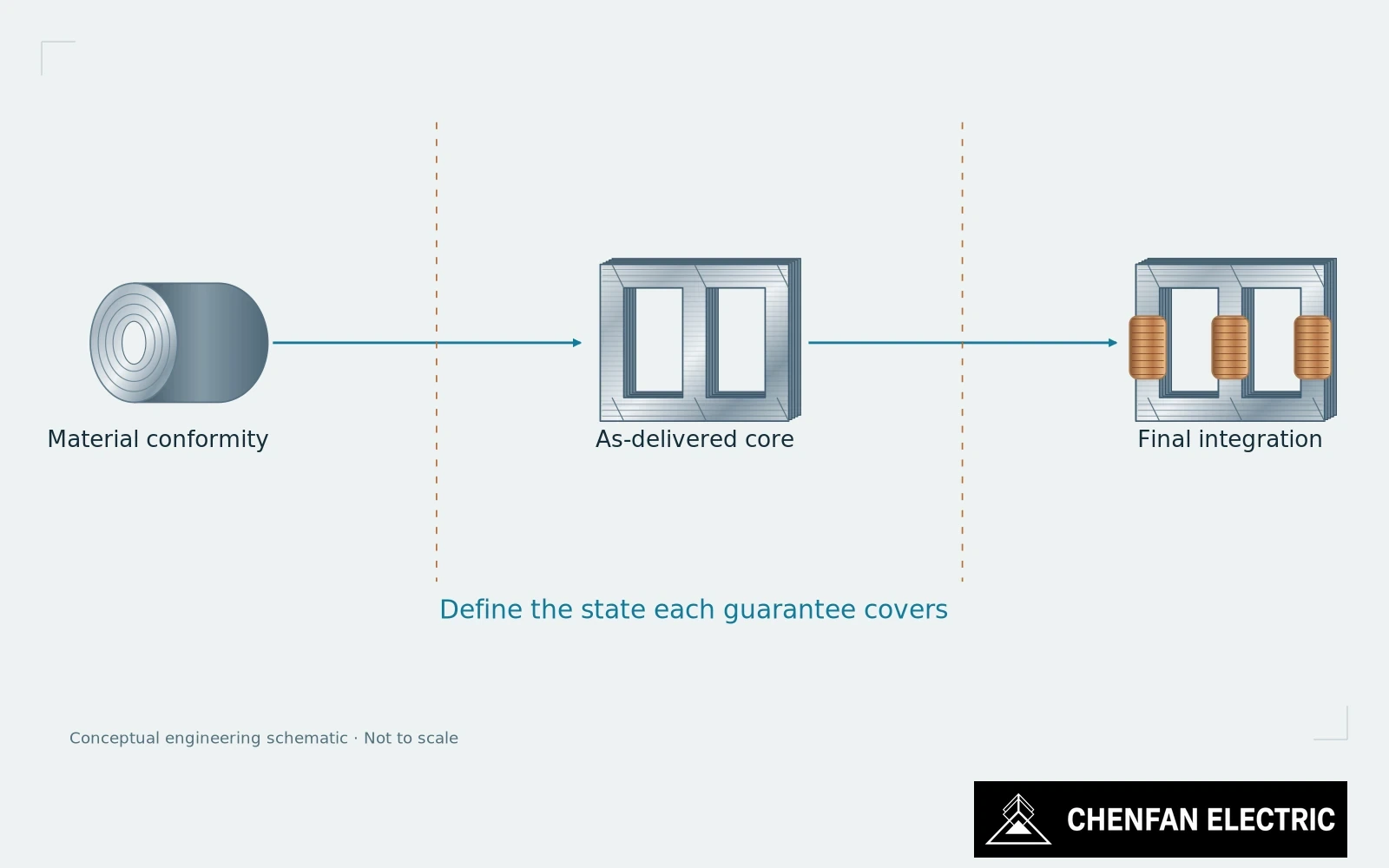
Distinguish material and assembled-core obligations
A material guarantee can establish grade, gauge, coating and magnetic properties on an agreed specimen basis. That is appropriate when the purchased product is steel or identified laminations and the buyer controls the subsequent magnetic assembly.
An assembled-core purchase needs an additional performance boundary. The guarantee should identify the core, its configuration, the test conditions and the accepted quantities. It should also identify which operations occur after that acceptance test and who controls them.
Blanket promises become difficult at this handoff. A supplier may deliver a tested, closed magnetic circuit. The transformer factory may then remove the upper yoke, insert windings and rebuild the joints. The final transformer test also includes components and measurement conditions absent from the core supplier’s test.
Define responsibility after the handover
That does not eliminate supplier responsibility. It means responsibility needs evidence at the interfaces.
I would separate the agreement into material conformity, as-delivered core conformity and post-handover integration. For each, identify the party controlling the operation, the retained records and the method for investigating a discrepancy. Avoid treating an entire transformer no-load loss allocation as an unconditional guarantee on a component tested under a different boundary.
The same discipline protects the buyer from a guarantee that is impossible to enforce. “Low loss” without an excitation point is not an acceptance limit. A promised percentage without a stated denominator is not a comparable current requirement. A test report without the delivered serial number is not evidence for that shipment.
Correlate supplier testing with final assembly
A useful agreement also distinguishes correction from root-cause determination. Replacing an assembly may restore the schedule, but it does not establish whether the original issue came from steel, manufacturing, handling or integration. Preserve the records needed to answer that question before the evidence is dismantled.
There is room for shared validation. A first-order correlation between supplier core testing and the buyer’s final assembly test can define a realistic performance allocation for later orders. The correlation must remain specific to the design and manufacturing route that were qualified.
The strongest guarantee is not the broadest sentence. It is the obligation whose product state, measurement and responsibility boundary are clear enough for both parties to demonstrate compliance.
Practical takeaway
A guarantee becomes meaningful only when the product state and responsibility boundary are defined.
Chenfan Electric manufactures custom transformer cores according to customer drawings. Where applicable to the specified material and core design, agreed process controls include burr height below 0.02 mm and stacking factor above 97%. Measurement methods and acceptance conditions are defined for each order.