

Look at two cores made to the same drawing.
The outline may match while the process that created the joints does not.
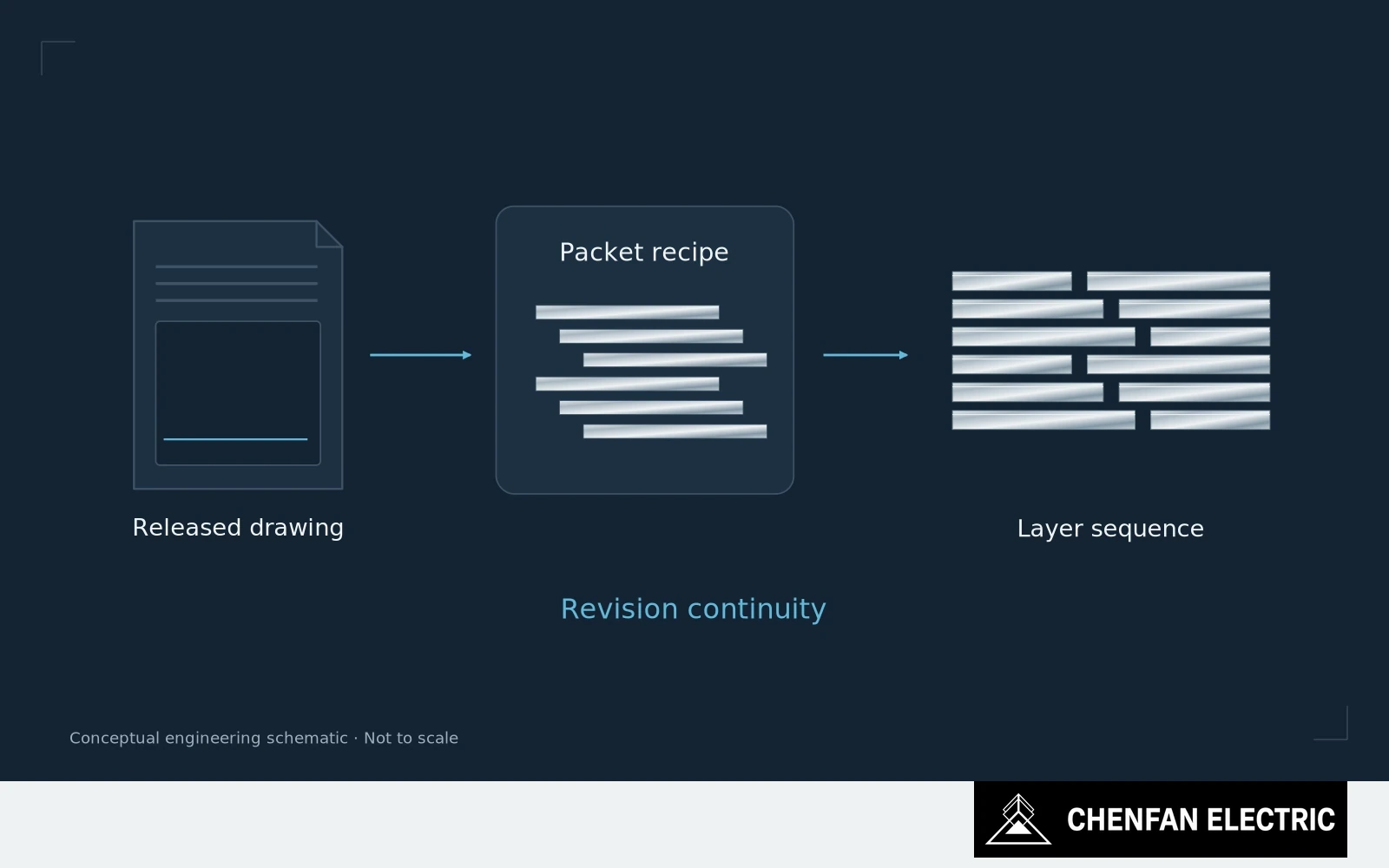
Link drawing revisions to the production recipe
A drawing can define sheet lengths, widths, angles, packet heights and nominal step-lap arrangement. It usually cannot show every condition that exists between cutting the first sheet and releasing the assembled core.
For example, a nominal joint gap does not tell you how the operator distributes an accumulated length error across a packet. A clamp dimension does not establish the pressure distribution under its bearing surfaces. A note specifying a lamination sequence does not prove that the sequence survived a production interruption.
These are not arguments for adding hundreds of notes to the drawing. They are arguments for connecting the drawing to a controlled manufacturing recipe.
Verify changes beyond the nominal dimensions
I would expect that recipe to identify the approved cutting program, packet sequence, assembly datums and checks at the stages where deviations become difficult to see later. The drawing revision should be linked to the program revision. Otherwise the CAD file can be correct while the machine produces an earlier arrangement.
Changes deserve particular attention. Replacing a tool, transferring the job to another line or changing a packet-handling method may leave every nominal dimension unchanged. Yet the edge condition, fit-up or repeatability can change. The response should be an appropriate first-off verification, not an assumption that the unchanged drawing proves an unchanged process.
The magnetic reason is local. Flux distribution depends on the assembled joint geometry and the state of the steel near it. Those conditions can differ inside the same external tolerance envelope. A final outline inspection is therefore a poor substitute for checks on the features that establish the magnetic circuit.
Qualify the transfer to another core supplier
There is a practical sourcing consequence. When transferring a core family to a second supplier, issue the functional requirements and interface definitions, then ask the new supplier to demonstrate its own qualified route. Copying another factory’s process notes without understanding its tooling can create a different set of errors.
The right transfer package contains the drawing, the acceptance basis and the manufacturing characteristics that must remain controlled. It does not need to prescribe every movement on the shop floor.
Before approving the first article, ask which manufacturing decisions remain outside the drawing and how they are verified. That answer explains why identical geometry on paper does not guarantee identical behaviour under excitation.
Practical takeaway
An unchanged drawing can conceal a changed manufacturing recipe.
Chenfan Electric manufactures custom transformer cores according to customer drawings. Where applicable to the specified material and core design, agreed process controls include burr height below 0.02 mm and stacking factor above 97%. Measurement methods and acceptance conditions are defined for each order.