

What does a building factor of 1.15 actually tell you?
Without its denominator, almost nothing about supplier quality.
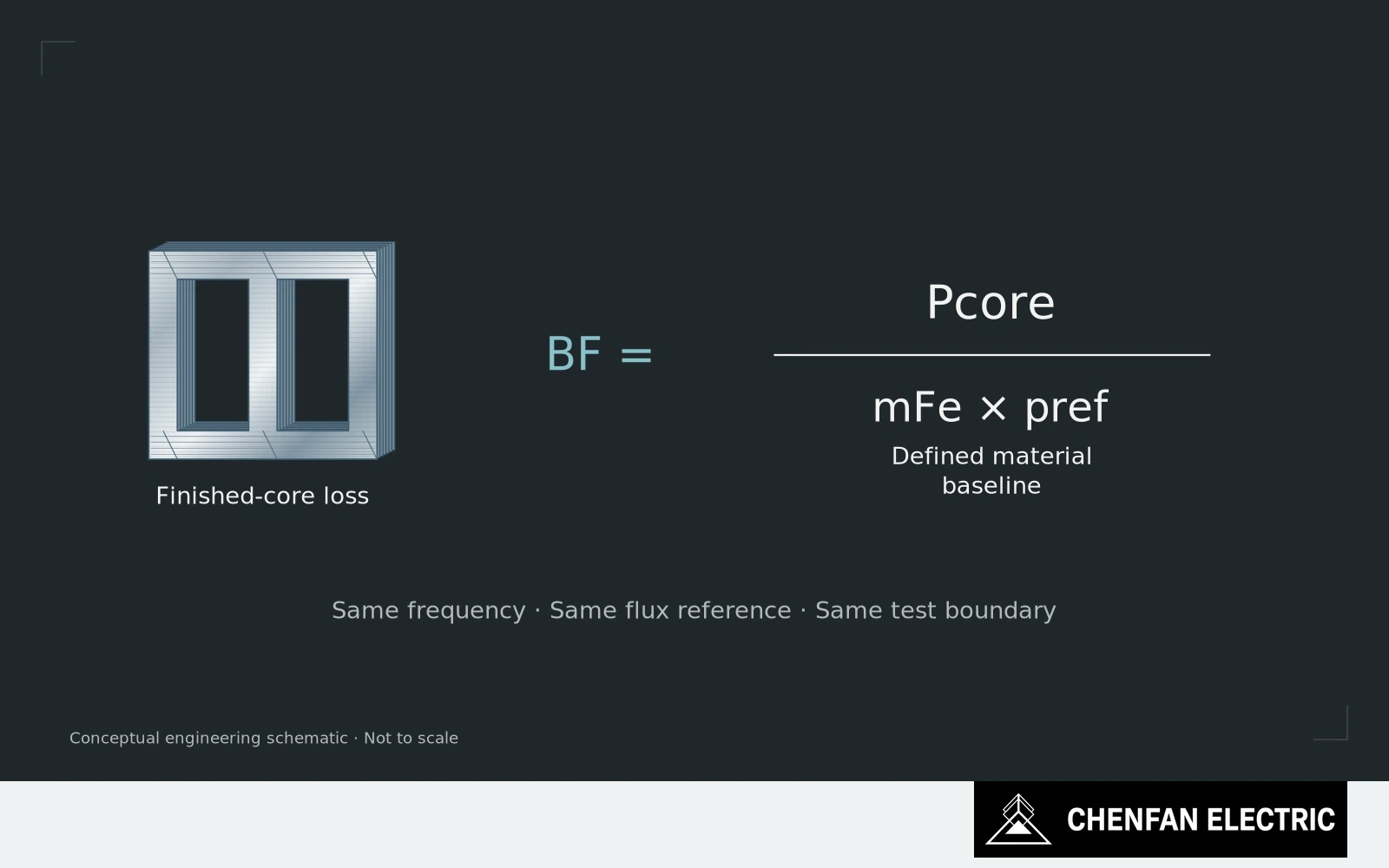
Establish the denominator and its material basis
For a stated operating point, a common formulation is finished-core loss divided by the material-based loss estimate for that core. The estimate may be core mass multiplied by a specific material loss, or a more detailed sum over different regions and materials.
Those definitions cannot be mixed casually. A factor calculated from guaranteed catalogue maxima is not directly comparable with one calculated from measured coil data. A conservative denominator can make the same finished core appear to have a better factor.
JFE’s transformer analysis describes joint-related flux redistribution and interlaminar flux among the mechanisms behind increased building factor. That makes the ratio useful for connecting material selection with the assembled magnetic circuit. It does not make the ratio a diagnosis of one manufacturing defect.
Compare equivalent core families
Geometry already contributes. A different joint arrangement, operating induction or proportion of joint region can change the relationship between material and core loss even when both factories control their processes well. Comparing unrelated core families can punish design differences as though they were workmanship differences.
I would first group results by design family and excitation condition. Within each group, use the same material-test convention, iron-mass boundary and finished-core test method. Then examine the factor over successive builds, alongside absolute watts and exciting current.
A rising trend deserves investigation. It could reflect material selection, a changed joint recipe, tool condition, assembly stress or a measurement issue. The ratio tells you where a prediction is no longer tracking production; it does not choose the explanation.
There is also a commercial trap in guaranteeing the factor alone. A favourable ratio can coexist with an unacceptable absolute loss if the baseline material loss is high. Conversely, a demanding material baseline can produce an unflattering ratio while the finished core meets the transformer’s loss allocation.
Use absolute loss as the acceptance requirement
Specify the required finished performance first. Use building factor to explain and improve how the design reaches it.
For a sourcing review, the strongest evidence is a consistently calculated series tied to traceable cores and a known design family. A single impressive factor, detached from its calculation sheet, should remain a discussion point rather than an award criterion.
The first question is not whether the factor is low. It is whether both parties have divided the same quantities.
Practical takeaway
The denominator can make a building factor look better without improving the core.
Chenfan Electric manufactures custom transformer cores according to customer drawings. Where applicable to the specified material and core design, agreed process controls include burr height below 0.02 mm and stacking factor above 97%. Measurement methods and acceptance conditions are defined for each order.