

A workable CRGO enquiry must define each finished width and its quantity—not only the grade, gauge and total tonnes. It should also state the width-tolerance source, camber limit and measuring length, coil dimensions, mass limits, packaging and whether the order is for material or finished laminations.
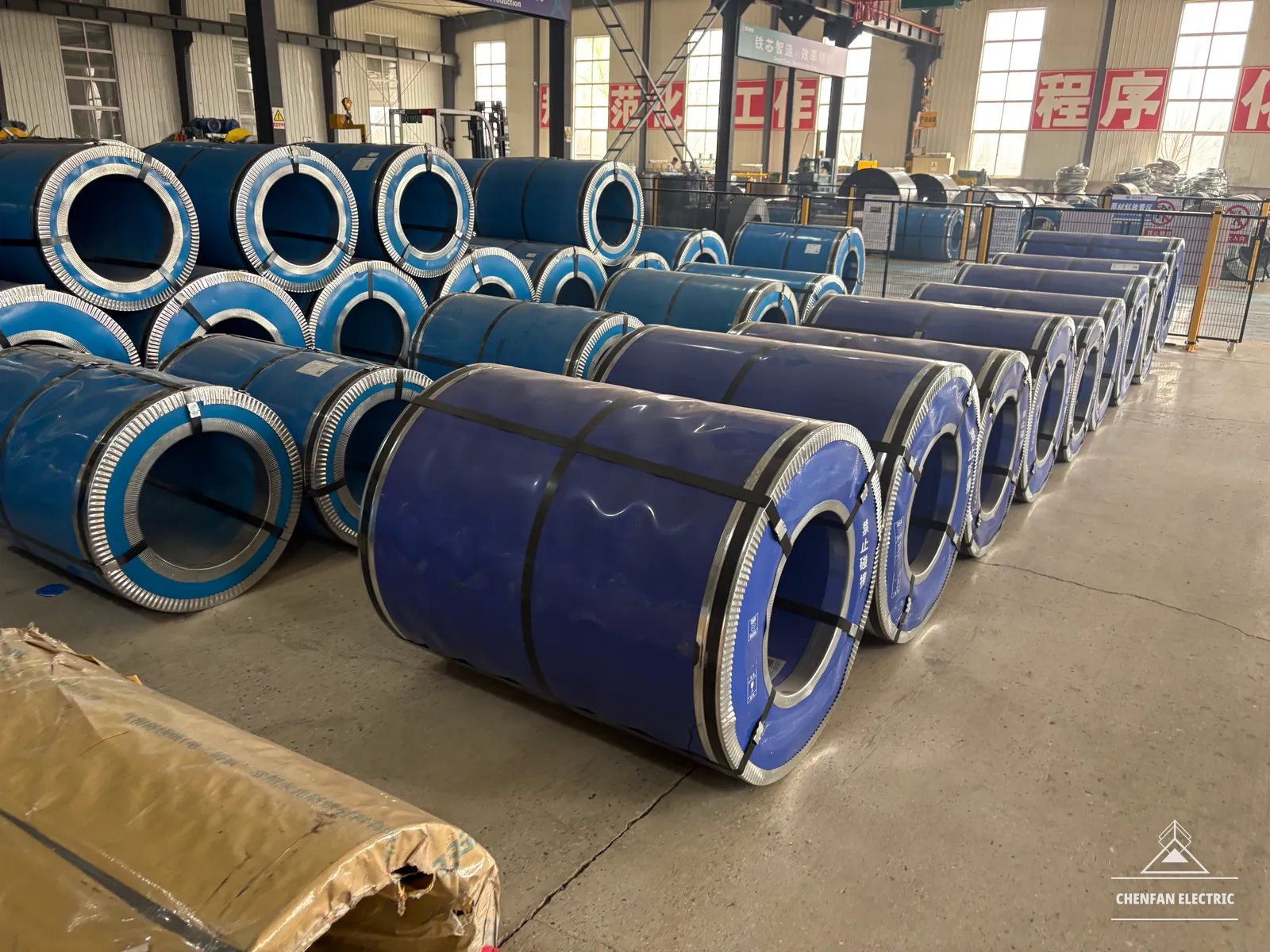
Producer catalogues do not present thickness and width as universal CRGO values. JFE ties each grain-oriented grade to a nominal thickness, available-width range and inside coil diameter [1]. POSCO likewise publishes grade-specific standard sizes and tells purchasers to confirm non-standard sizes separately [2]. Availability must therefore be confirmed against the exact producer grade and quotation rather than inferred from a generic gauge list.
| Field | What to state | Why it matters |
|---|---|---|
| Material | Producer, grade designation, governing specification, coating and domain-refinement condition where applicable | A family name such as conventional, high-permeability or domain-refined GOES does not identify one interchangeable grade. |
| Nominal gauge | One nominal thickness per line, plus the applicable tolerance document | The same commercial family may contain several thicknesses and grades. |
| Width schedule | Finished width, width tolerance and required mass or coil count for every width | Total order mass alone does not define the slitting lanes or output split. |
| Camber | Maximum permitted deviation, measuring length, referenced method and strip condition | A numerical limit without its measuring basis is not reproducible. |
| Coil handling | Inside diameter, maximum outside diameter, minimum and maximum coil mass, winding orientation and packaging | These values determine whether the receiving equipment can unload and run the coil. |
| Traceability | Coil ID, grade, thickness and agreed inspection document | The received slit coils must remain linked to the supplied material record. |
| Delivery stage | Master coil, slit coil, cut laminations or assembled packet | Material supply and core manufacture require different drawings and acceptance information. |
Give each width its own quantity
The width schedule controls the nominal lane balance. After agreed edge trims are deducted from the mother-coil width, the combined finished lanes must fit within the remaining width. For lanes cut to a common length from the same material, their nominal mass shares follow their combined widths.
Illustrative example: assume a 1,000 mm mother coil, 5 mm agreed trim at each edge, three 300 mm lanes, one 90 mm lane and 20 t of finished material. These figures illustrate the handover calculation; they are not Chenfan production limits or test results.
| Output | Lane calculation | Combined width | Allocated mass |
|---|---|---|---|
| 300 mm strip | 3 × 300 mm | 900 mm | 18.18 t total |
| 90 mm strip | 1 × 90 mm | 90 mm | 1.82 t |
| Total finished lanes | 900 + 90 mm | 990 mm | 20.00 t |
The usable width is 1,000 − 5 − 5 = 990 mm, and the scheduled lanes also total 990 mm, so the nominal residual is zero. The 300 mm lanes occupy 900/990 of the finished width and therefore receive 20 × 900/990 = 18.18 t; the 90 mm lane receives the remaining 1.82 t. This proportional mass result assumes common length, thickness and density. It does not establish acceptable trim, tolerance accumulation or whether a specific mill can run the layout.
The conclusion is practical: “20 t total” leaves the output undefined, while “18.18 t at 300 mm and 1.82 t at 90 mm,” together with tolerances and handling limits, gives the supplier a reproducible target.
Define camber on a stated measuring length
JFE’s grain-oriented dimensional table reports camber “in any 2 meters” and states that its camber stipulation applies to strips at least 75 mm wide [1]. POSCO’s grain-oriented dimension tables also identify camber on a 2 m length [2]. These are producer-specific published conditions, not a universal limit for every order.
Accordingly, do not write only “camber ≤ X mm.” State the maximum deviation, measuring length, referenced standard or agreed method and the strip condition used for inspection. The allowable value should come from the governing specification and confirmed quotation; this article assigns no new camber or width tolerance.
Separate slit-coil supply from cut-to-length processing
If a quotation separately states a cut-to-length processing limit of 890 mm, keep that figure on the processing line. It is not evidence that every slit-coil width up to 890 mm is available, and it does not mean a material-only order requires a complete core drawing.
Material-only orders can be released by grade, gauge, coating, finished widths, quantities, tolerances and coil-handling limits. If shaped laminations or pre-stacked packets are required, add the released drawing and joint schedule, identify responsibility for stacking and clamping, and link each supplied group to its assembly position.
The purchase specification is complete only when the material identity, width allocation, dimensional basis, coil interface and delivery stage all describe the same deliverable.
References
- [1] JFE Steel Corporation. Electrical Steel Sheets: JFE G-CORE, JFE N-CORE. F1E-001-08, 2020. Grain-oriented “Dimensions and Tolerances,” printed p. 11; “Relations among Coil Weight, Outside Coil Diameter and Slit Width,” printed p. 25.
- [2] POSCO. Electrical Steel: Grain-Oriented. 2022. Grade standard-size and dimension-and-shape-tolerance tables, printed pp. 10, 12, 14 and 16; packaging and marking, printed p. 18.