

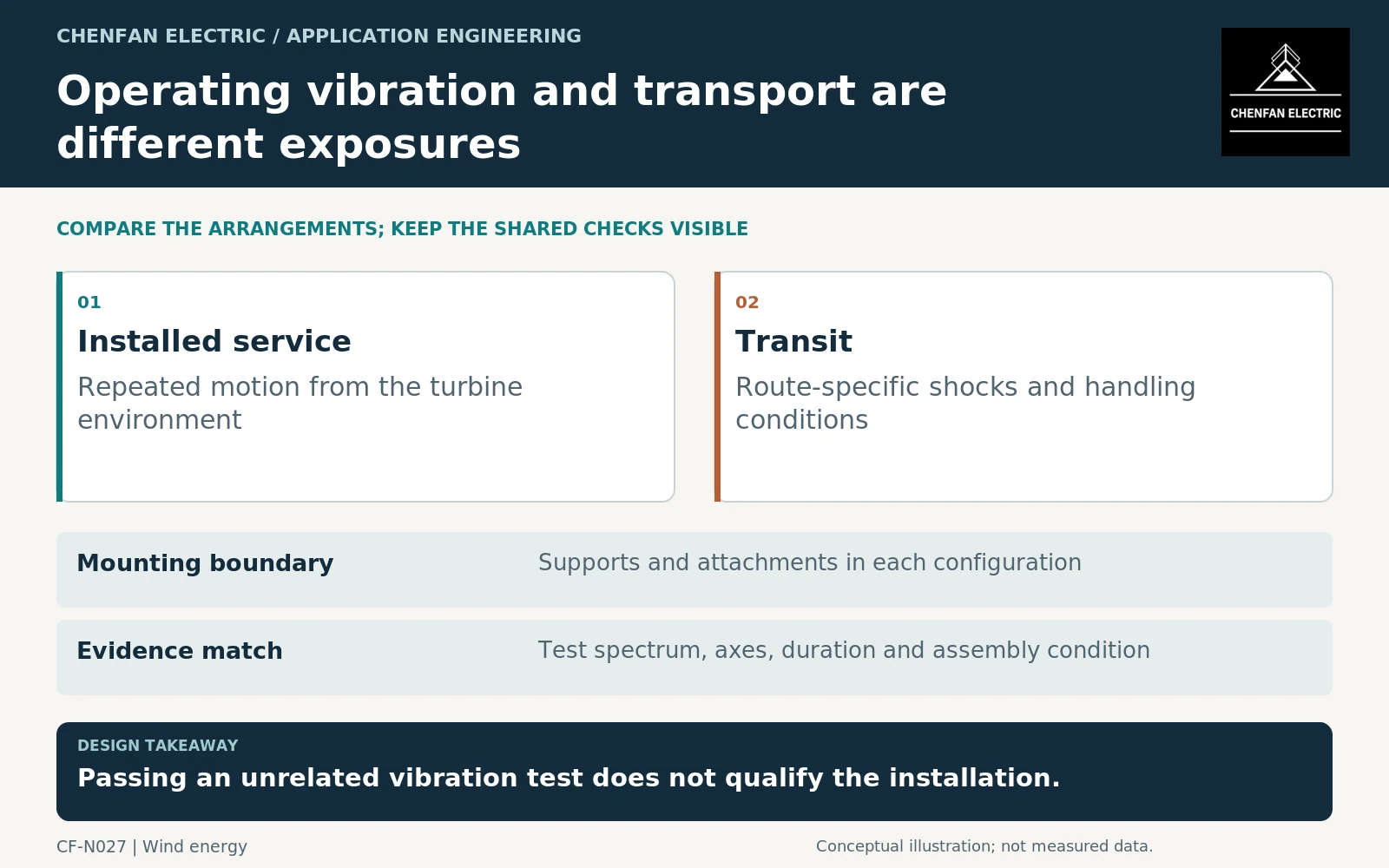
Operating vibration and transport loads should be specified separately for a wind-turbine transformer. They can differ in frequency content, duration, direction, support conditions and repetition. Passing a transport test does not automatically demonstrate suitability for repeated turbine operation, and an installed-service assessment does not establish that the shipment can tolerate an undefined route.
Start with the installed location
A nacelle, tower-base and external transformer can experience different mechanical environments. Obtain the relevant load description from the turbine or structural designer, including the support interface and operating configurations. Do not assign one generic vibration label to every transformer in the wind farm.
Wind-turbine transformer requirements have a defined application scope. Their use does not remove the need for location-specific mechanical inputs from the turbine design. [1]
Record whether the supplied loads are measured, simulated or specified design envelopes. The transformer supplier needs to know what the data represent before deciding how to use them.
Describe the load, not only a peak acceleration
A single peak acceleration omits frequency content, duration and the way load is transmitted through the supports. The engineering assessment should identify the relevant directions, spectra or time histories, repeated exposure and any exceptional events.
The mounting arrangement matters. A test assembly on one support configuration may not represent equipment installed on a different structure. Include attachment locations, boundary stiffness assumptions and the mass configuration used for the assessment.
| Load description | Information to retain |
|---|---|
| Repeated operating vibration | Frequency content, axes and exposure basis |
| Exceptional turbine event | Event definition and applicable load envelope |
| Transport shock | Route or handling basis and transit configuration |
| Support interface | Attachment geometry and boundary assumptions |
| Test evidence | Configuration, method and demonstrated functions |
This is a data specification, not a structural calculation or a transport-handling procedure.
Keep test standards within their intended scope
A railway rolling-stock vibration standard is not a universal turbine-transformer qualification. IEC 61373 addresses railway equipment shock and vibration; its scope should not be transferred merely because both applications involve moving structures. The current publication history also needs attention when an edition is named. [2]
Similarly, a component-level test on a fan or instrument does not demonstrate the complete transformer assembly. Connections, supports and internal structures can introduce different failure mechanisms or response paths.
Require a clear statement of what evidence demonstrates: structural integrity, continued operation, retention of specified electrical characteristics, or another agreed outcome. A test certificate without the configuration and acceptance basis can be difficult to apply to the purchased equipment.
Build two coordinated mechanical schedules
The operating schedule should identify installed loads, mounting conditions and required evidence. The transport schedule should identify the shipping configuration, route assumptions, handling interfaces and any inspection requirements after arrival. Keep responsibility for each schedule explicit.
General transformer requirements provide the equipment framework, but unusual mechanical service conditions must be communicated and agreed. [3] The supplier should list limitations rather than assuming that unspecified vibration falls within an undefined standard duty.
The final acceptance review should compare the delivered assembly and mounting arrangement with the assessed configuration. Changes to support brackets, accessory locations or removal configurations may require reassessment. The useful claim is that a specific assembly has evidence for a defined exposure—not that the transformer is generically “vibration resistant.”
Core procurement checkpoint: Identify the assembly covered by mechanical requirements
Vibration requirements should name the actual core, clamps, supports and surrounding transformer assembly to which they apply. For a drawing-based order, define the supplied components and interfaces before discussing evidence of qualification. A rail vibration reference does not automatically qualify a wind-turbine installation, and a steel certificate does not cover transport restraints or the completed equipment’s mechanical response.
For the core enquiry: Operating and transit load references; core and clamp drawings; supplied component boundary; restraint and qualification responsibilities.