

Cable transformer water-blocking boundaries must follow the possible water paths through the installed system. Water can migrate along a cable, penetrate its layers, pass through an accessory interface or enter the transformer compartment from another opening. A water-blocked cable addresses its stated construction and test scope. It does not, by itself, make a termination, connector, cable entry or complete transformer waterproof.
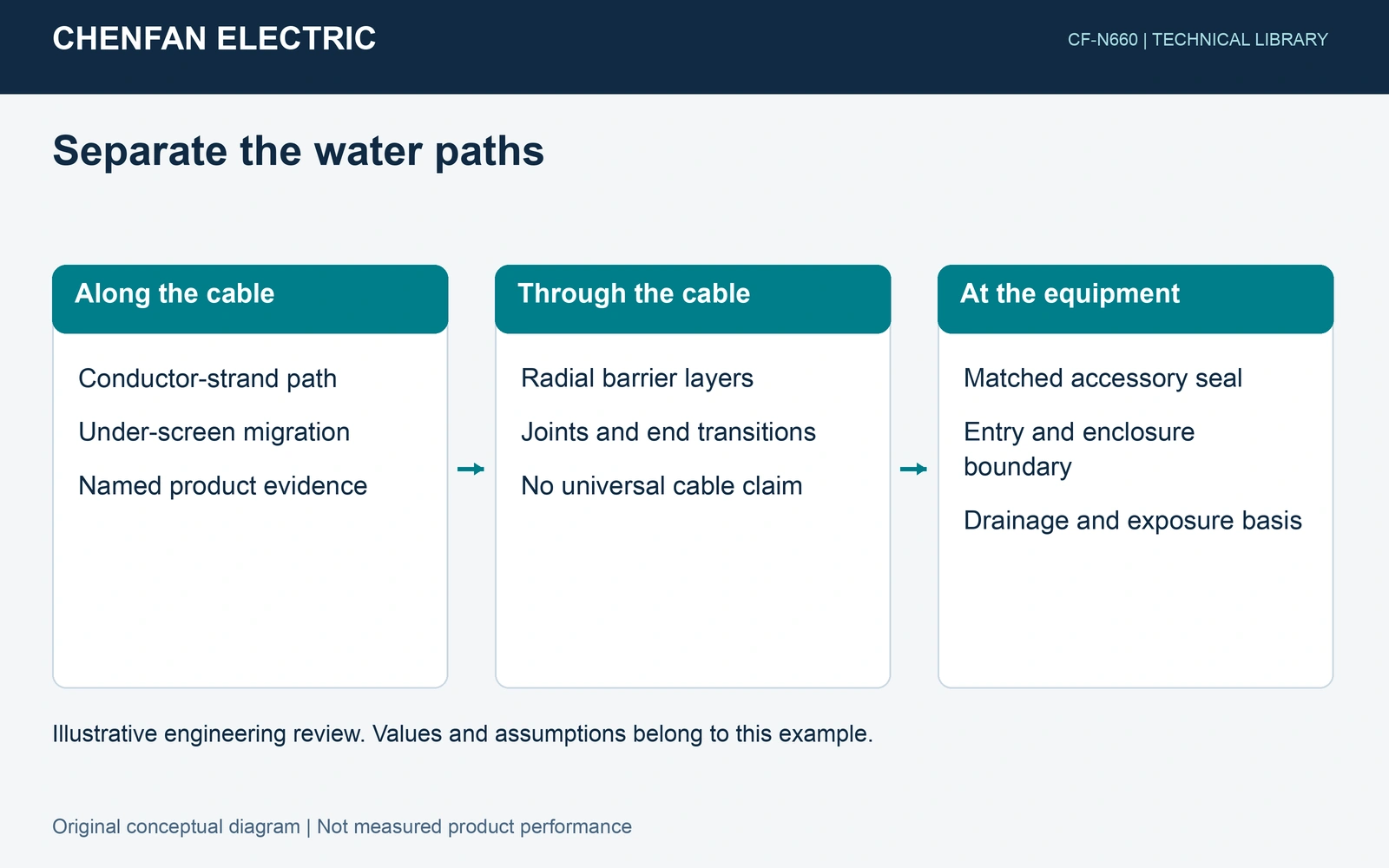
Identify the cable’s distinct water paths
Prysmian’s named EPR TRIPLESEAL cable example uses filled stranded conductors, a water-swellable layer beneath the metallic shield and a sealed shield construction. The manufacturer assigns these features to different paths, including migration along the cable and ingress through the cable layers. This is evidence about that particular cable design; its materials, temperature ratings or water-performance claims must not be transferred to every medium-voltage cable. [1]
Ask the cable supplier which layers are blocked and what the stated tests represent. A barrier around the insulation does not automatically describe the conductor-strand path, and a longitudinal barrier is not the same claim as radial protection. Record the treatment of cable ends, joints and transitions because the installed route contains more interfaces than the continuous cable sample.
Continue the boundary through the accessory
Eaton’s transformer guidance separates deadfront connector categories and shows that the transformer interface is an identified equipment arrangement. Confirm the loadbreak or deadbreak function independently of any sealing claim. For the selected accessory, request its permitted environment, mating components and installed sealing evidence. Cable water-blocking information cannot substitute for those product requirements. [2]
At the compartment, identify doors, ventilation openings, cable-entry plates, conduits and any designed drainage route. Obtain the enclosure claim for its actual installation conditions. Do not reinterpret a rain or ingress test as indefinite submersion approval. The civil, cable and equipment drawings should meet at the same reference boundary, with responsibility for seals, inspection access and water management assigned explicitly.
| Path | Evidence required | Separate boundary |
|---|---|---|
| Along conductor or screen | Named layer and test scope | Cable ends and joints |
| Through cable layers | Barrier construction evidence | Damage and termination interfaces |
| Through connector interface | Matched installed accessory data | Electrical operating function |
| Into compartment | Enclosure and site drawings | Doors, entries, ventilation, drainage |
Use water head as an input, not a guarantee
For an illustrative fresh-water head of 0.50 m, assume density 1,000 kg/m³ and gravity 9.81 m/s². Static pressure is Δp = ρgh = 4,905 Pa, or 4.905 kPa. This describes pressure at that depth relative to the free surface. It predicts neither leakage rate nor service life, and excludes capillary effects, transient pressure, damage and ageing. No enclosure rating or energization decision follows from this arithmetic.
Keep evidence and responsibilities aligned
State the possible water level, exposure duration, cable route and compartment geometry in the enquiry. Ask the responsible suppliers to identify what their evidence covers and what remains a site-design interface. Changes to seals, drainage or ventilation require the approved equipment and installation design. The deliverable is a coordinated boundary record, not a general “waterproof transformer” promise or a recommendation to seal every opening.
References and scope
- 15-46kV EPR TRIPLESEAL™ Cable (US) | Prysmian
- Medium-voltage transformers: fundamentals of medium-voltage transformers
Sources support the stated mechanisms and application boundaries. Product data remain specific to the named design; illustrative arithmetic is not a project approval or operating instruction.