

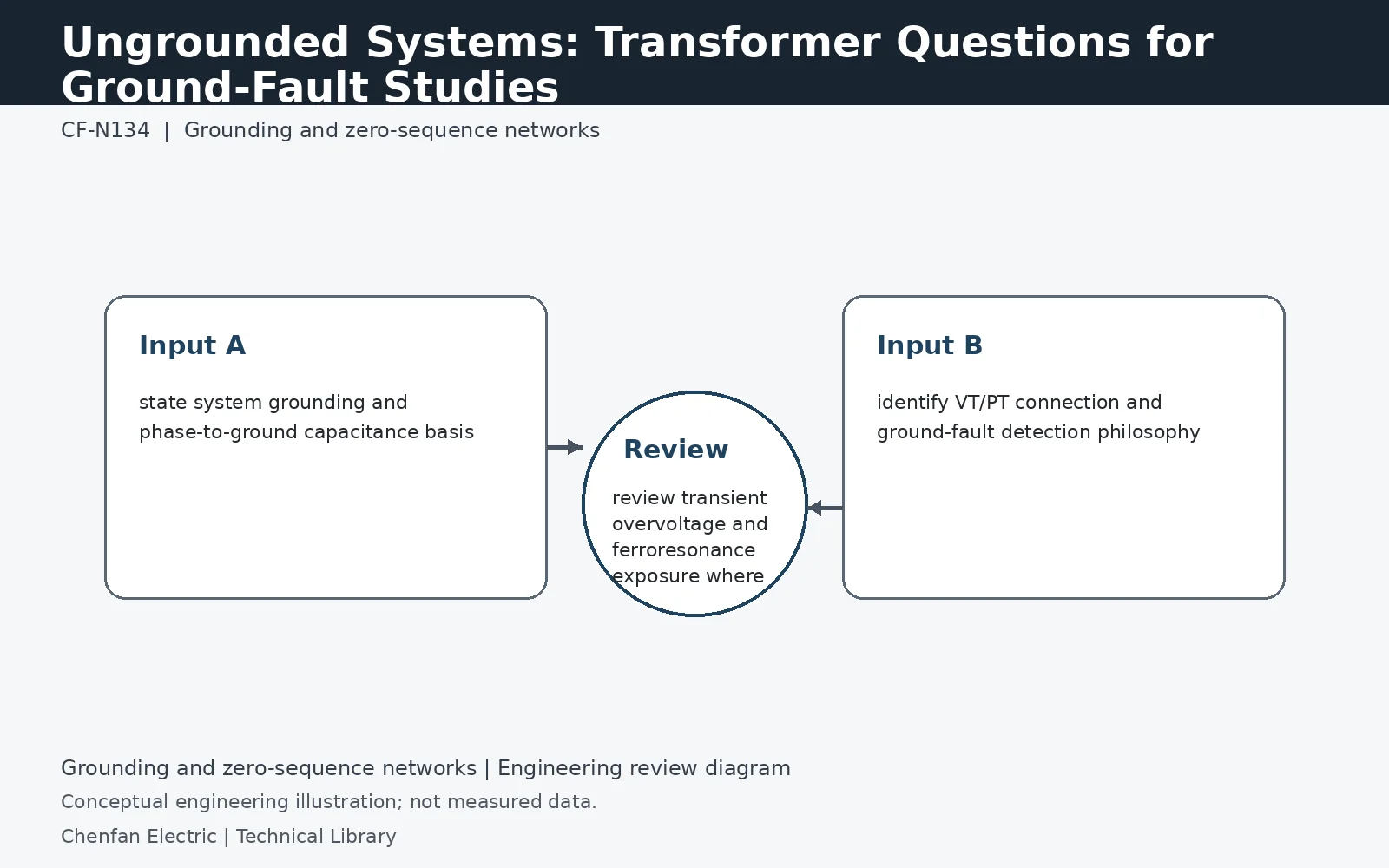
An ungrounded system does not mean ground faults can be ignored. The first ground fault is influenced by system phase-to-ground capacitance and transformer connection, while transient overvoltages and ferroresonant conditions may become relevant in certain networks. Transformer procurement should identify the grounding state, cable/line capacitance environment, voltage-transformer arrangement and the intended ground-fault detection method.
No intentional neutral earth does not mean no return path
Cables, connected equipment and windings have capacitance to earth. Those capacitances provide a return path during the first ground fault even where no intentional neutral-earth connection exists. Consequently, extending a cable network can change its first-fault current without changing transformer kVA. Record connected and disconnected cable lengths, filters and voltage-measurement equipment for each operating state. An equivalent capacitance based on the normal arrangement alone may miss the most demanding expansion or sectionalized-network condition.
Evaluate the healthy phases during the first fault
In an ideal isolated-neutral system with a solid fault on one phase, the healthy phases approach line-to-line voltage relative to earth rather than their normal phase-to-neutral value. That is approximately a √3 increase in their fundamental phase-to-earth voltage. This simplified result is not a limit on transient peaks. The insulation assessment must also address fault duration, neutral displacement and any switching or resonant behavior supported by the actual network. The line-to-line operating voltage need not rise by the same factor.
Distinguish continuity of service from permission to ignore faults
Some installations are engineered to continue operating after a first insulation fault, subject to their applicable safety and monitoring requirements. That does not justify indefinite operation with an unlocated fault. A second fault on another live conductor can create a much larger current path. Procurement should therefore preserve the insulation-monitoring interface, fault-location provisions and second-fault protection assumptions. These are operating-system requirements, not benefits that can be guaranteed merely by purchasing a transformer without an earthed neutral.
Technical reference framework
[1] IEC 60076-8:1997 — Application guide.
[2] IEC 60076-1:2011 — Power transformers, General.
[3] Schneider Electric — IT system: Principle.