

Without an oil inventory, the underground room still needs separate thermal, electrical-fault and gas-release assessments. Wu et al. study heat dissipation in a particular C4F7N/CO2 gas transformer [1], not the ventilation or personnel-access qualification of this room.
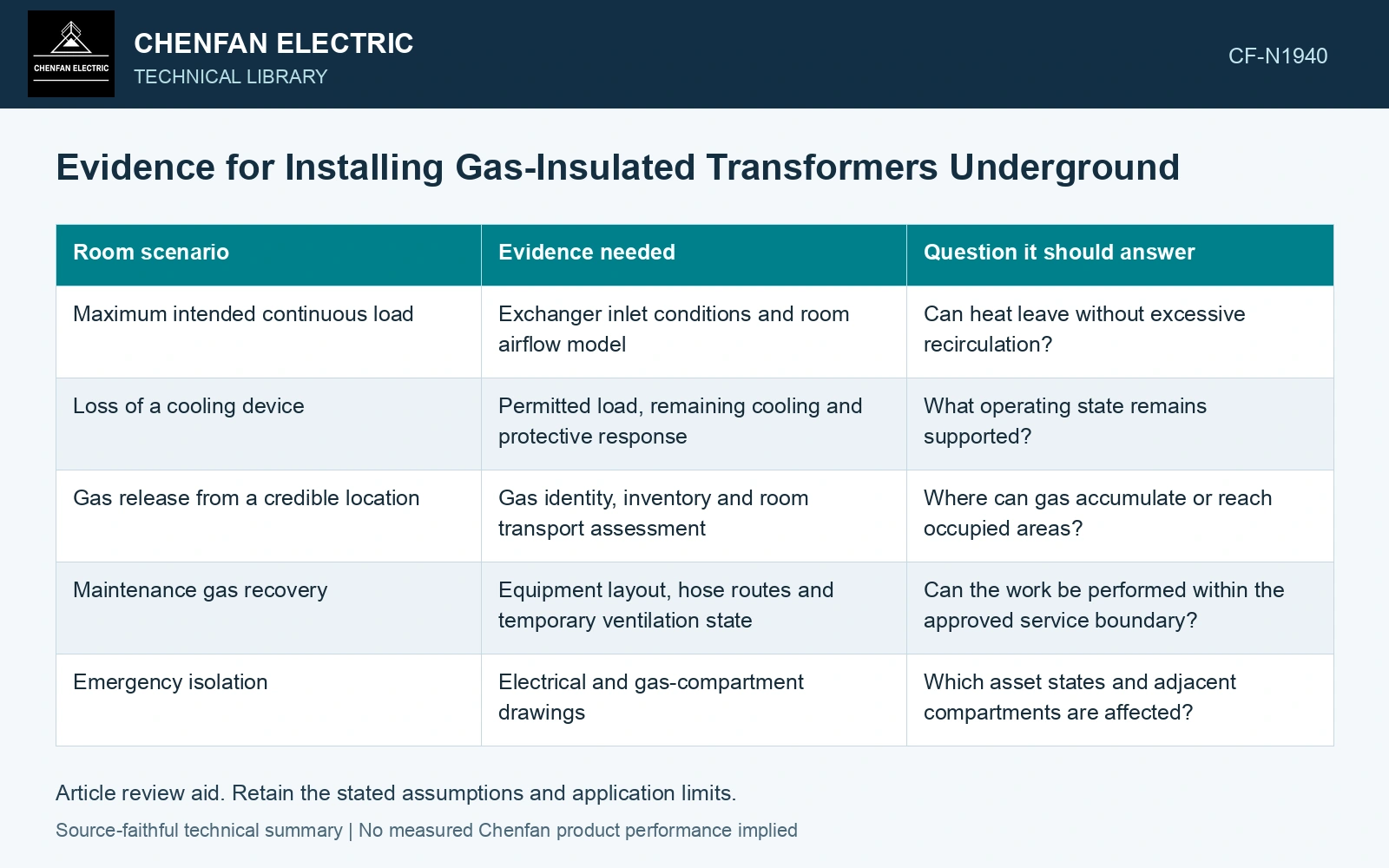
Review the room under distinct conditions
Normal ventilation serves a thermal purpose. Ventilation following an accidental gas release serves a different purpose, potentially with different flow paths and controls. The two cases can share equipment without sharing the same acceptance basis. State which case each calculation addresses.
| Room scenario | Evidence needed | Question it should answer |
|---|---|---|
| Maximum intended continuous load | Exchanger inlet conditions and room airflow model | Can heat leave without excessive recirculation? |
| Loss of a cooling device | Permitted load, remaining cooling and protective response | What operating state remains supported? |
| Gas release from a credible location | Gas identity, inventory and room transport assessment | Where can gas accumulate or reach occupied areas? |
| Maintenance gas recovery | Equipment layout, hose routes and temporary ventilation state | Can the work be performed within the approved service boundary? |
| Emergency isolation | Electrical and gas-compartment drawings | Which asset states and adjacent compartments are affected? |
Put the airflow model around the installed equipment
A room model needs transformer and exchanger positions, inlet and outlet openings, nearby walls and obstructions. A clear floor area is not necessarily a clear airflow route. Temporary storage or later equipment additions can also alter recirculation.
For gas-to-water cooling, examine the supporting water system and its heat-rejection destination. Moving heat from the transformer into water does not establish that the underground installation can continuously dispose of it. Include the consequences of lost flow or unsuitable inlet temperature.
Identify what a monitor can actually observe
Compartment density and room atmosphere are different measurements. For SF6 specifically, NIOSH identifies an inhalation/asphyxia hazard [2]; that entry cannot characterise every alternative mixture. Locate room sensors and define response from the actual gas/release/airflow assessment, separately from internal gas-condition monitoring.
Fault-related gas condition and by-products require a separate handling assessment. The absence of visible oil leakage does not establish that an enclosed area or opened compartment is suitable for personnel access. Those decisions belong to qualified site procedures and verified measurements.
Test the maintenance layout on the drawing
Show recovery equipment positions, component withdrawal paths, lifting clearances and access to compartment interfaces. A compact transformer can still require substantial service space. Check that recovery equipment can reach the intended compartment without blocking escape routes or essential ventilation.
Assume transformer room heat rejection is 30 kW, supply-air heat capacity 1,005 J/(kg·K) and allowable room-air rise 10 K for this screen. From the sensible-heat balance [3], required air mass flow is 30,000/(1,005 × 10) = 2.985 kg/s, about 2.49 m³/s at an assumed density of 1.2 kg/m³. If the verified ventilation path supplies only 2.0 m³/s, its ideal sensible removal at that rise is 24.12 kW, a 5.88 kW deficit. Resolve ventilation and cooler placement before approving the underground installation; replacing liquid insulation does not remove room heat.
The installation review should resolve these actual scenarios with the site geometry. A general statement about gas-transformer suitability underground cannot establish the cooling capacity, monitoring coverage or maintainability of the proposed room.
References
- Y. Wu et al., Research on Heat Dissipation Performance of Eco-friendly Gas insulated Transformer with i-C4F7N/CO2 as the Insulation Medium, Journal of Physics: Conference Series 2527, 012011, 2023. DOI: 10.1088/1742-6596/2527/1/012011.
- NIOSH, Pocket Guide to Chemical Hazards: Sulfur hexafluoride, page reviewed October 2019.
- U.S. Department of Energy, DOE-HDBK-1012/2-92, Thermodynamics, Heat Transfer, and Fluid Flow, Volume 2, 1992.