

Compare drying-sequence revisions through the material and interface history they create. Moisture removal, adhesive bonding, compressed-part dimensions and intermediate exposure can respond differently even when endpoint measurements agree.
Draw the old and new sequences on one timeline
Identify the material and assembly condition at each transition, including intermediate handling, storage and the interval before subsequent processing. Record what was measured, where it was measured and which population it represents. A process endpoint inferred from an accessible witness specimen may not represent the most difficult region of the winding. [1]
Separate deliberate process changes from uncontrolled interruptions. If the proposed route changes the order of assembly, heating or intermediate exposure, retain that order as an input. A final timestamp alone cannot reconstruct which surfaces were exposed or which interfaces formed earlier.
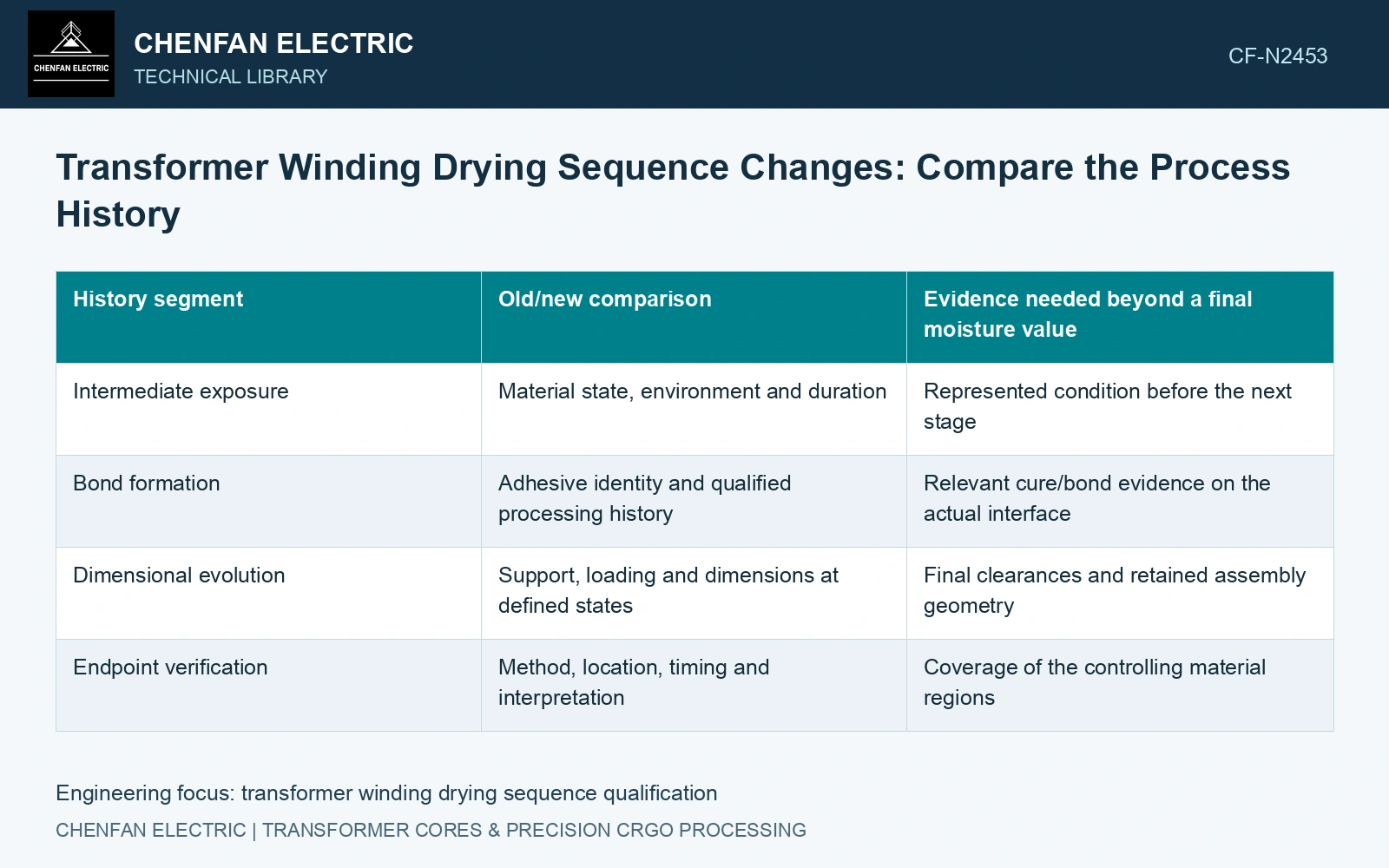
| History segment | Old/new comparison | Evidence needed beyond a final moisture value |
|---|---|---|
| Intermediate exposure | Material state, environment and duration | Represented condition before the next stage |
| Bond formation | Adhesive identity and qualified processing history | Relevant cure/bond evidence on the actual interface |
| Dimensional evolution | Support, loading and dimensions at defined states | Final clearances and retained assembly geometry |
| Endpoint verification | Method, location, timing and interpretation | Coverage of the controlling material regions |
Account for coupled material changes
Where compressed parts are involved, compare dimensions and contact after the represented sequence. A material certificate does not show how the processed stack fits its original restraints. Record any assembly adjustment required to recover the intended dimensions; that adjustment becomes part of the qualified revision. [1]
Define what an equal endpoint actually supports
Compare endpoint measurements using the same interpretation basis and relevant uncertainty. Similar results support similarity in the measured quantity for the represented locations. They do not by themselves establish equal adhesion, mechanical support or dielectric interface condition. [1]
Choose confirming specimens and assembly evidence for those remaining dependencies. Preserve an unchanged process control only where its governing condition is still represented. If a test cannot see a consequential region, record that gap rather than treating an accessible result as complete coverage.
Reconcile the water balance without treating it as a moisture map
Assumptions: dry cellulose mass is 500 kg, initial water content is 0.50% of dry mass and the intended final value is 0.10% on that same basis. The water inventory changes from 2.5 kg to 0.5 kg, requiring 2.0 kg removal. Collecting that mass does not prove uniform residual moisture: it may include water from another part or leave a difficult winding region wet. Use representative final-state diagnostics and retain sampling conditions [1]; control the revised sequence and specimen identity together [2].
Link the revised sequence to verified final material state, dimensions and interface behavior. Explain which old controls retain their represented conditions and identify the confirming specimen or assembly result used to close each changed process dependency.
References
- U.S. Bureau of Reclamation, FIST Volume 3-31, Transformer Diagnostics, June 2003.
- NASA, NASA Systems Engineering Handbook, section 6.5, Configuration Management, official online text.