

A multilayer coating needs enough time for the underlying layer to reach its specified condition, yet some systems also have a maximum interval before additional surface preparation is required. These are different limits. A calendar time without temperature and product identity cannot establish either. [1]
Use the approved data for the exact primer, intermediate and topcoat combination. Record product batch, application time and the temperature basis used by the recoat requirement. Air temperature and coating/substrate temperature need reconciliation where the method requires it.
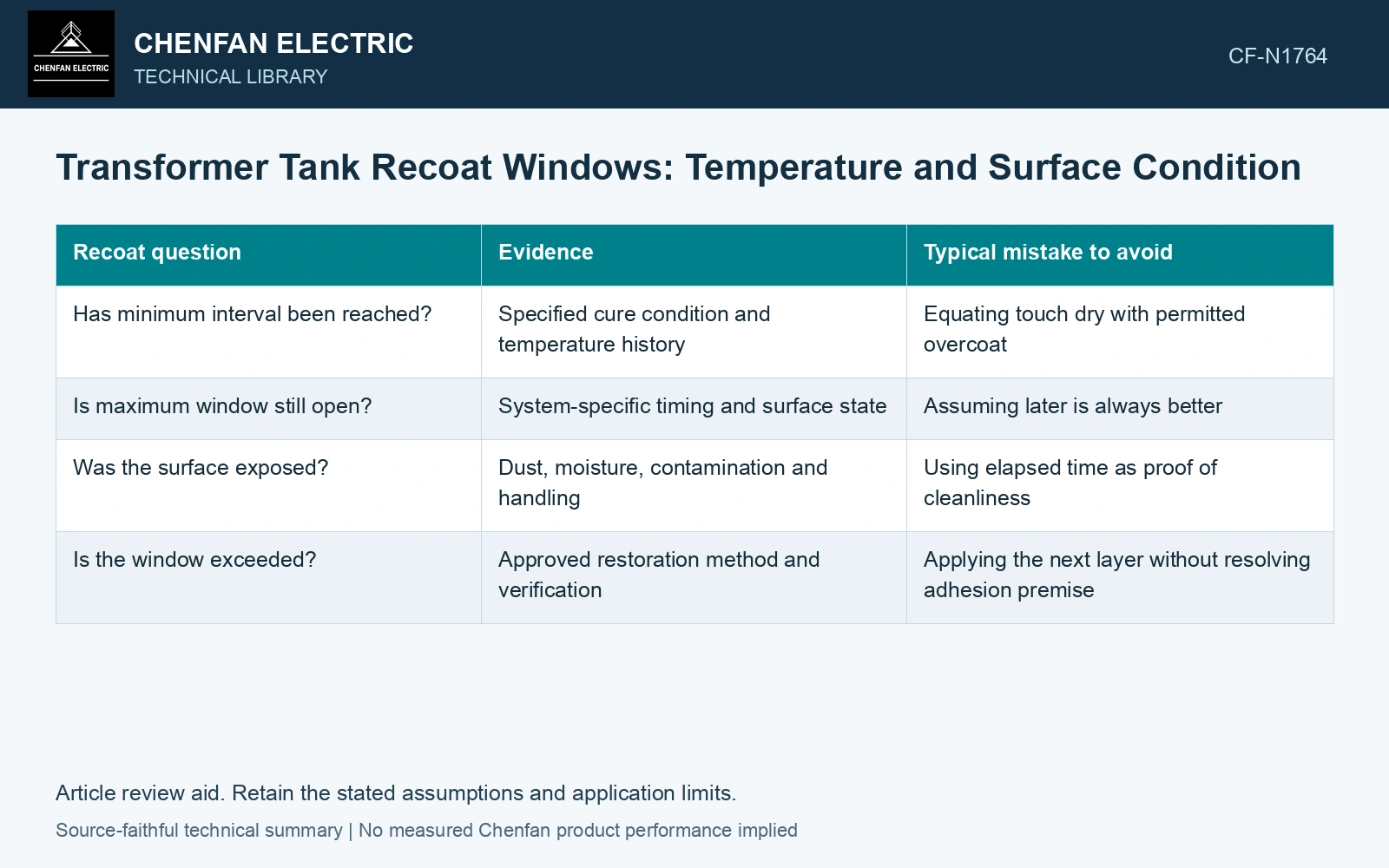
| Recoat question | Evidence | Typical mistake to avoid |
|---|---|---|
| Has minimum interval been reached? | Specified cure condition and temperature history | Equating touch dry with permitted overcoat |
| Is maximum window still open? | System-specific timing and surface state | Assuming later is always better |
| Was the surface exposed? | Dust, moisture, contamination and handling | Using elapsed time as proof of cleanliness |
| Is the window exceeded? | Approved restoration method and verification | Applying the next layer without resolving adhesion premise |
Temperature history needs a qualified interpretation
Product data may list intervals at defined temperatures. A variable workshop trace is not automatically equivalent to its average temperature. Use the coating manufacturer’s accepted interpretation or qualification rather than inventing a time-temperature conversion.
When the approved recoat route requires renewed preparation, establish the actual substrate and contamination condition before applying that route. A later coat does not restore missing preparation evidence. [2]
Use the actual product time window
Assume a validated product instruction at constant 20 °C defines a 6–24 h recoat window. An actual elapsed 30 h exceeds that assumed maximum by 6 h. Follow the specified renewed preparation and inspection route; do not replace a variable-temperature history with its average or borrow the example window for another coating.
References
- ISO, ISO 12944-7:2017, Paints and varnishes — Corrosion protection of steel structures by protective paint systems — Part 7: Execution and supervision of paint work.
- ISO, ISO 12944-4:2017, Paints and varnishes — Corrosion protection of steel structures by protective paint systems — Part 4: Types of surface and surface preparation.