

Build the root-cause report around claims and the observations that distinguish them. Weight the evidence by relevance, preservation and independence, and show the alternative explanation each item supports or weakens. [1]
Separate levels of explanation
State the observed failure mechanism, the proposed initiating condition and the contributing conditions separately. A demonstrated arc path may not establish the defect that first created it. A maintenance gap may contribute to risk without proving the physical cause of this event.
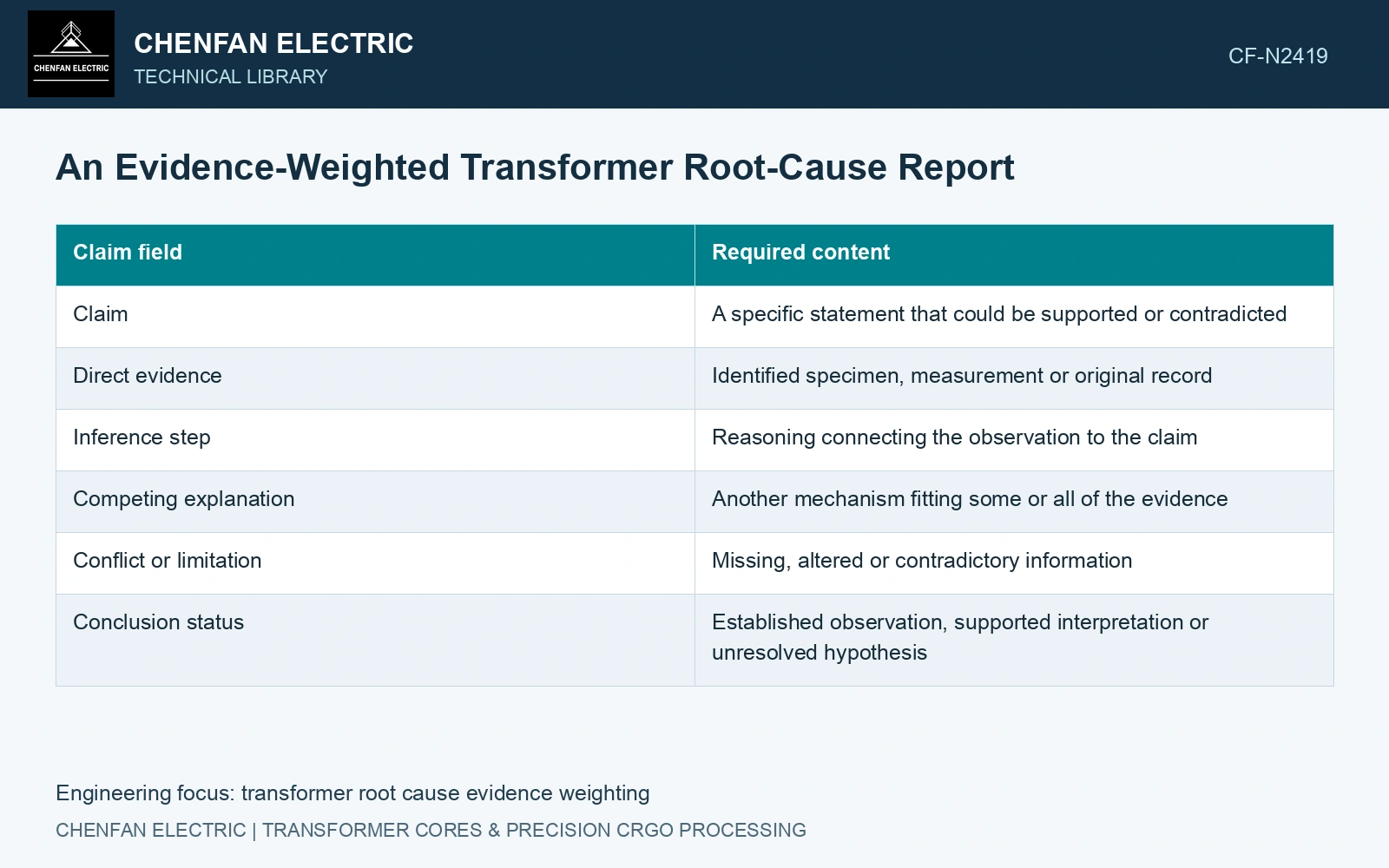
Build a claim-evidence map
| Claim field | Required content |
|---|---|
| Claim | A specific statement that could be supported or contradicted |
| Direct evidence | Identified specimen, measurement or original record |
| Inference step | Reasoning connecting the observation to the claim |
| Competing explanation | Another mechanism fitting some or all of the evidence |
| Conflict or limitation | Missing, altered or contradictory information |
| Conclusion status | Established observation, supported interpretation or unresolved hypothesis |
Weight evidence by what it can distinguish
Consider relevance, preservation and independence. An undisturbed interface that distinguishes two event sequences can carry more causal weight than several images of the same burned area. A copied statement from another report is not independent corroboration of the original statement.
Describe these judgments in words. Do not assign an invented percentage to causation or add arbitrary points until one explanation wins. Numerical confidence requires a justified statistical model and data, not a formatted matrix.
Make conflicts visible
Record evidence that weakens the preferred explanation in the same map. A timeline conflict, incompatible load path or normal test sensitive to a required persistent defect should not disappear into an appendix.
Explain whether the conflict is resolved by a supported state change, remains uncertain or makes the explanation untenable. Each resolution needs its own evidence; an assumed extra event is not a free repair.
For each photographed or measured feature, retain the physical item identity and applicable configuration/change record [2]. In the claim map, link reproduced images to their single original record so a revised caption does not become independent evidence.
Count independent records rather than repeated descriptions
Assume one original photograph is reproduced in three reports with different captions. The independent physical observation remains one, not three. If a separate pre-fault resistance trace contradicts the preferred chronology, keep that conflict in the claim map. Resolve the surviving mechanism with provenance and discriminating evidence, rather than accumulating arbitrary causal scores.
References
- L. Ochs, NASA Goddard Space Flight Center, Basics of Failure Analysis, NASA Parts 101, December 4, 2024.
- NASA, NASA Systems Engineering Handbook, section 6.5, Configuration Management, official online text.