

A table of voltage harmonic magnitudes leaves part of the waveform unspecified. Relative phases determine when the components reinforce or oppose. If the magnetic and magnetostrictive response is nonlinear and history-dependent, that timing can change the mechanical source spectrum.
Record the harmonic phases against a defined fundamental reference. Also record whether magnitudes are peak or RMS values. A phase table without a trigger convention cannot reconstruct a reproducible waveform.
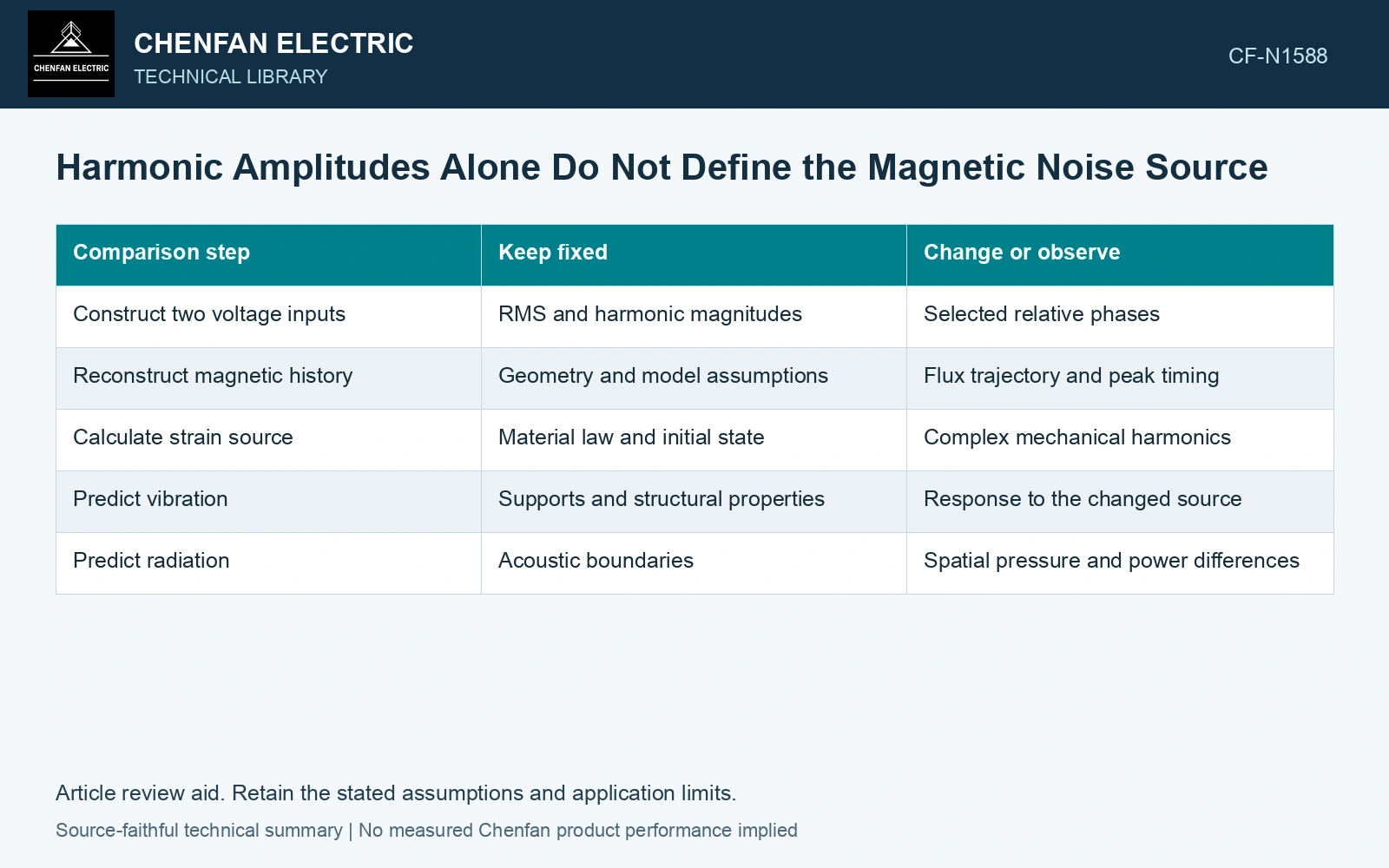
Carry phase through the source chain
Under the explicit approximation that applied winding voltage equals induced voltage, v(t) = NA dB/dt for uniform flux density B, turn count N and effective area A. A voltage harmonic Vₙ cos(nωt + φₙ) gives a flux component Vₙ/(nωNA) sin(nωt + φₙ), plus the integration constant.
The higher-frequency voltage components are weighted by 1/n in flux. Their phases still affect the waveform shape. In an actual reconstruction, winding resistance, leakage effects and initial magnetic state may require treatment; the approximation should not conceal them.
For illustration only, suppose strain λ = aB² with constant a in inverse tesla squared. Squaring a sum of flux components creates cross products at sum and difference frequencies. Their phases depend on the original φ values. Real GOES requires measured directional, stress- and history-dependent behavior rather than this simple law.
| Comparison step | Keep fixed | Change or observe |
|---|---|---|
| Construct two voltage inputs | RMS and harmonic magnitudes | Selected relative phases |
| Reconstruct magnetic history | Geometry and model assumptions | Flux trajectory and peak timing |
| Calculate strain source | Material law and initial state | Complex mechanical harmonics |
| Predict vibration | Supports and structural properties | Response to the changed source |
| Predict radiation | Acoustic boundaries | Spatial pressure and power differences |
Compare like operating states
Allow the model or measurement to reach the defined periodic condition before extracting spectra. Otherwise differences in initial magnetization can be mistaken for phase sensitivity. Check the reconstructed voltage and flux waveforms directly instead of comparing only their total RMS values.
Retain strain harmonic phases as well as magnitudes. Several source regions can radiate coherently, so a phase change can alter the sound field even when a particular strain amplitude barely changes.
For a measurement study, use synchronized voltage and vibration channels and keep loading, temperature and restraint controlled. A change in vibration does not establish its magnetic origin if an auxiliary source or structural state also changed. Directional strain under DC-biased and harmonic excitation requires its own source characterization [1].
When the available input contains only harmonic magnitudes, evaluate a stated phase range or report the limitation. Choosing all phases as zero is one illustrative waveform, not a worst-case guarantee. A noise prediction should describe the voltage history it actually used, because that history is part of the mechanical source definition.
Reconstruct two flux waveforms with identical harmonic magnitudes
Use catalogue 0.23 mm nominal thickness [2]. Assume a 1,000-sheet, 100 mm wide section of 0.0230 m² and 100 turns at 50 Hz. Using the 4.44 sinusoidal approximation, a 1.0 T fundamental requires approximately 510.6 V RMS induced voltage. A third-voltage harmonic at 30% of that magnitude produces only a 0.10 T third-flux harmonic because integration divides by harmonic order. In one common cosine time reference, B = cos θ + 0.10 cos 3θ peaks at 1.10 T; reversing the third-flux phase gives B = cos θ − 0.10 cos 3θ with peak 0.90 T. Peak differs by 22.2% while harmonic magnitudes and RMS flux are unchanged. Carry phase into the magnetic source model before comparing noise [1].
Sheet section and orientation, joint gaps and overlap, cut-edge stress and clamp preload set the material and geometric state for that waveform comparison. Verify these inputs before attributing a changed mechanical harmonic to voltage phase alone. A catalogue loss value at sinusoidal excitation cannot predict strain under the reconstructed harmonic waveform.
References
- Zhao, X., Du, Y., Liu, Y., Du, Z., Yuan, D., and Liu, L., Magnetostrictive Properties of the Grain-Oriented Silicon Steel Sheet under DC-Biased and Multisinusoidal Magnetizations, Materials 12, 2156, 2019. DOI: 10.3390/ma12132156.
- Nippon Steel Corporation, Grain-Oriented Electrical Steel Sheets, catalogue D004je_03_202004, 2020, Specifications; Size and Form Tolerances.