

Audit magnetic-model energy with input work, stored-energy change and dissipation. A negative interval can be legitimate storage return; unexplained gain can instead reveal a sign error, state reset or time-discretization defect.
Calculation basis. Unless a value is explicitly attributed to a cited source, numerical inputs in the demonstrations are assumptions for the stated model. Normalized variables are dimensionless. The examples define their own geometry, excitation and measurement boundary.
Check the energy balance for the declared system, rather than accepting or rejecting a model from instantaneous power alone. The useful distinction is between returned storage, dissipated energy and an unexplained numerical source.
Define the work convention first
For a fixed magnetic material volume under the chosen constitutive assumptions, define input work density as W_in = ∫H·dB. H is in A/m and B in T, so the result is J/m³. Positive work enters the modeled magnetic subsystem. In a scalar case, retain the signed H dB integral; in a vector case, retain every component contribution.
For a lumped magnetic branch, an analogous input-port convention uses voltage and current with current entering the positive-voltage terminal. The product vi is then positive input power. Relate the port and material-volume balances using the model’s actual geometry and included mechanisms. Do not silently equate total terminal work to one local material integral.
A paper can use the opposite external-port convention without being wrong. Translate its signs before comparing that equation with an input-positive implementation.
Include storage and every relevant port
For a declared passive subsystem, use an admissible storage function S(x), with a chosen lower bound normalized to zero, and a nonnegative dissipation D. Over an interval the balance is W_in = S_final − S_initial + D when no other energy ports are present.
The corresponding passivity inequality is W_in ≥ −S_initial. A subsystem may return energy that it already holds. Negative instantaneous vi or H·dB/dt therefore does not, by itself, prove artificial generation.
If the model includes thermal, mechanical or other energy exchange, include those ports before applying this simplified balance. Fixing temperature in a simulation does not automatically remove the thermal exchange used to maintain it. State which storage or thermodynamic potential and boundary assumptions the formulation uses.
Compare a model’s energy accounting with its prediction accuracy separately. A passive realization can still predict the wrong loop, field or dissipated energy.
Close the internal state, not only the picture
For a periodic test with the complete storage-relevant state restored, ΔS = 0 and W_in = D ≥ 0. A B–H trace returning to its starting coordinates may still conceal different internal hysteresis, thermal or coupled states. Verify the state closure needed by the claimed cycle balance.
For a transient, calculate the storage change separately when the model supplies a justified storage function. If it does not, a trajectory test can detect some failures, but a set of positive loop areas is not a general proof of passivity for all possible histories.
Do not reset internal state at the cycle boundary simply to make the bookkeeping close. A reset that removes or inserts storage needs its own accounting and can alter the constitutive history being tested.
Audit a signed cycle with exact arithmetic
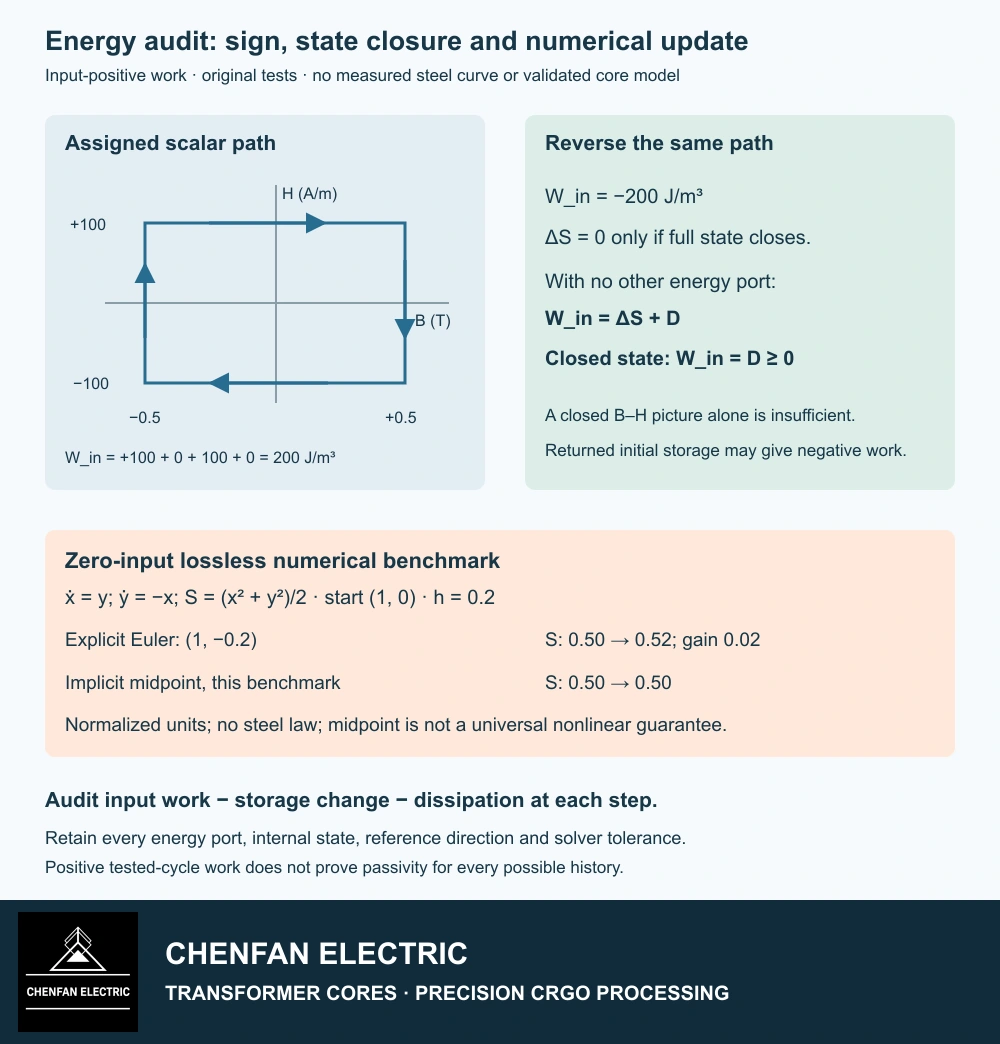
An original rectangular scalar-work illustration uses B limits −0.5 and +0.5 T and H limits −100 and +100 A/m. Travel from the upper-left point to upper-right, then lower-right, lower-left and back to upper-left. The horizontal contributions are +100 and +100 J/m³; the vertical segments have ΔB = 0. Total work is +200 J/m³.
Reverse the same trajectory and the integral becomes −200 J/m³. These are assigned test paths, not measured steel loops or outputs of a validated material model. If a claimed passive, fully state-closed implementation produced the negative result with no other energy port, the energy claim would fail.
The example also exposes a reference-direction trap. Reversing only the H channel changes the signed work. A consistent reversal of the scalar axis changes both H and B and preserves H dB. Channel polarity, axes, time ordering and vector transformations must therefore be checked together.
Check the discretization independently
A continuous passive model can lose its energy property after time discretization. Validate the transformer implementation against its own excitation and core data.
A separate original numerical test uses a normalized, isolated two-state lossless system: ẋ = y, ẏ = −x and S = (x² + y²)/2. It is a storage benchmark, not a hysteretic steel law. Continuous differentiation gives Ṡ = xy − yx = 0.
From x = 1, y = 0, one explicit Euler step of h = 0.2 gives x_new = 1 and y_new = −0.2. Storage rises from 0.5 to 0.52 despite zero input and zero dissipation. The unexplained gain is 0.02 in normalized energy units. Algebraically, each step multiplies storage by 1 + h².
For this linear quadratic benchmark, the implicit midpoint update preserves the norm and thus S = 0.5 exactly in exact arithmetic. This comparison does not prove that midpoint preserves every nonlinear hysteresis model’s dissipation law. It supplies a simple implementation test that can reveal a numerical source before a complex core simulation is trusted.
Locate the defect before changing the material fit
Retain a stepwise ledger of input work, storage change, declared dissipation and balance residual. Inspect intervals with unexplained gain, then check sign conventions, state resets, constitutive updates, solver residuals and numerical quadrature.
Repeat with smaller time steps and tighter nonlinear tolerances while retaining the same excitation and preparation. A shrinking residual supports a numerical-error explanation; a persistent violation needs further investigation. A time-step reduction does not repair a constitutive law that is intrinsically inconsistent with its declared storage and dissipation.
Challenge the implementation with reversible, biased, minor-cycle and relevant vector histories under the declared passive boundary. Pair the energy ledger with separate current, loss and assembly comparisons to establish both consistency and prediction accuracy.
Audit cycle work on the same mass basis
At 1.7 T and 50 Hz, the M-3X catalog limit converts to 0.998694 W/kg. [1] Dividing by 50 Hz gives 19.973881 mJ/kg per repeated cycle. An assumed 100 kg material region therefore corresponds to 1.997388 J per cycle at that reference. An assumed numerical storage gain equal to 2% of this cycle energy is 0.039948 J; retain it as an energy-balance error rather than subtracting it silently from material loss. Reconcile input work, storage change and dissipation on the same mass, cycle and state boundary.
Control grade, steel mass, rolling direction, stress state and joint construction in the loss record. Core manufacturing changes the physical cycle to be validated; an integration error belongs to the numerical ledger and needs a separate correction. IEC 60404-8-7 provides the delivery-specification framework for fully processed grain-oriented steel. [2]
References
[1] Cleveland-Cliffs, Grain-Oriented Electrical Steels — LITE CARLITE and Mill-Anneal, October 2023, Tables 1 and 5; Stress-Relief Annealing.
[2] IEC, IEC 60404-8-7:2020, Magnetic materials — Part 8-7: Specifications for individual materials — Cold-rolled grain-oriented electrical steel strip and sheet delivered in the fully-processed state.