

Thick transformerwood needs a moisture profile across the material volume governing use. Locate interior retention and exposed-edge pickup through the storage and protection sequence to define release evidence. [1]
Calculation basis. Project-specific values and gates in the illustrative screens below are assumptions; cited catalogue values retain their source test conditions.
Start with the material construction and history. Veneer direction, densification, resin system, machining and the drying or storage route belong with every profile. Röchling’s L X-2-E3-HQ handling note identifies edge moisture uptake and construction-dependent hygroscopic response [2]. That separate grade’s handling context supplies no core-moisture profile or acceptance limit for the part being assessed.
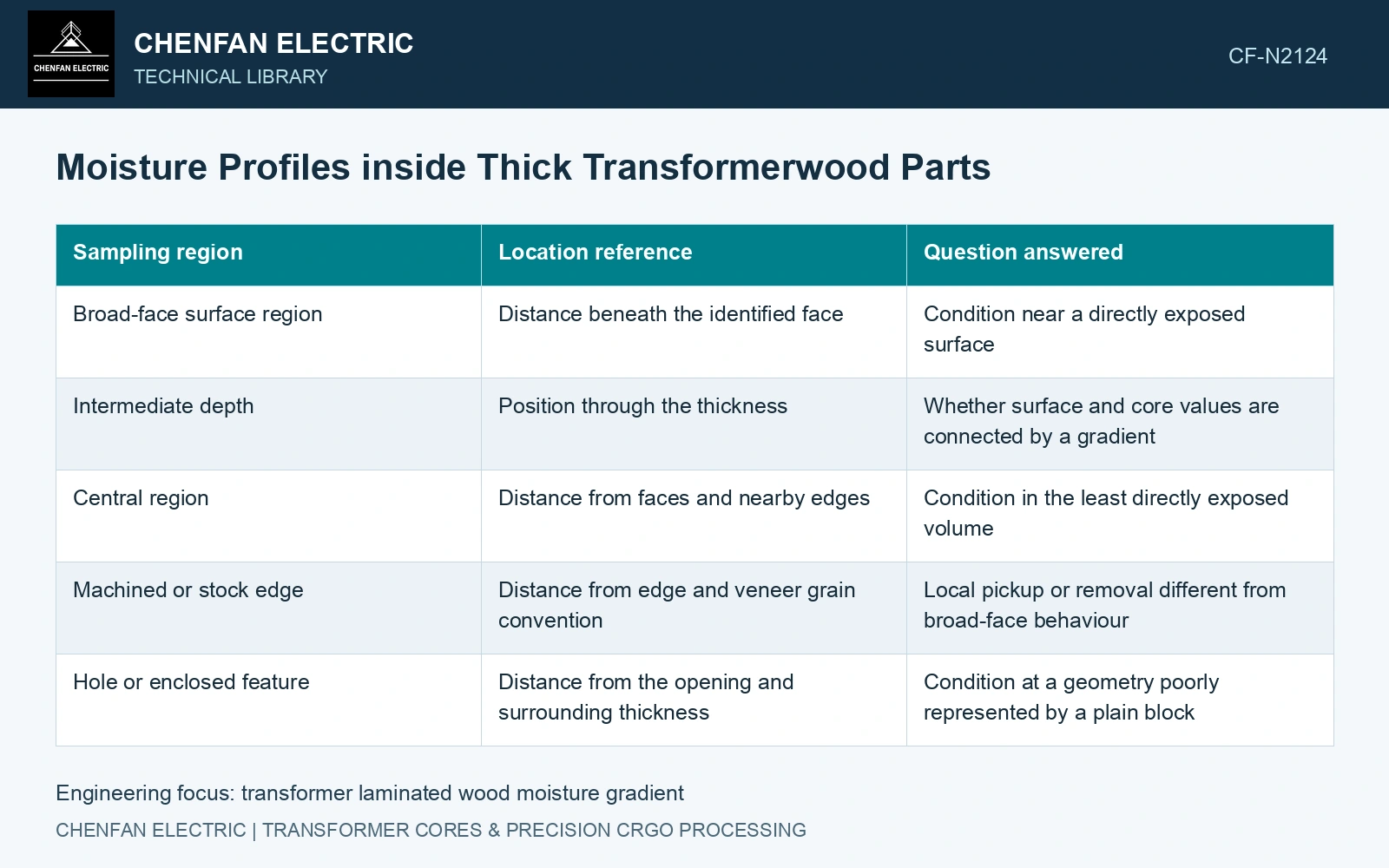
A profile that keeps location visible
| Sampling region | Location reference | Question answered |
|---|---|---|
| Broad-face surface region | Distance beneath the identified face | Condition near a directly exposed surface |
| Intermediate depth | Position through the thickness | Whether surface and core values are connected by a gradient |
| Central region | Distance from faces and nearby edges | Condition in the least directly exposed volume |
| Machined or stock edge | Distance from edge and veneer grain convention | Local pickup or removal different from broad-face behaviour |
| Hole or enclosed feature | Distance from the opening and surrounding thickness | Condition at a geometry poorly represented by a plain block |
Use the same reporting basis for the regions. Combining wet-basis and dry-basis percentages, or combining a surface instrument indication with a laboratory mass fraction, creates a profile that is not quantitatively comparable.
Keep preparation from changing the sample
Take sacrificial witnesses that represent the part’s thickest and relevant closed regions. Record the interval between removal from the process, sectioning, transfer and measurement. Protect separated samples according to the validated method so they do not equilibrate in the shop before analysis.
Sectioning can warm the material or expose new faces. Include preparation controls and identify whether oil or other process material is present. A method validated for untreated wood or plain pressboard may need additional validation for resin-densified, oil-containing material.
Repeat a useful subset of profiles after protected storage as well as immediately after the drying route. This distinguishes an incomplete process from moisture acquired later. Include unprocessed or reference witnesses only where their histories make the comparison meaningful.
A whole-block average may be suitable for one material characterisation but will dilute a small local region. If the design or processing decision depends on the core or an exposed edge, retain those values separately rather than blending every sample into one reported moisture number.
Base acceptance on the qualified material state and examined profile. Revisit moisture-sensitive regions when thickness, layup or protection changes.
Compare moisture profiles with the mass average
Match the material identity and relevant test direction before comparing densified-wood evidence [3].
Assume the outer 20% of a thick part’s dry mass has 0.5% moisture and the inner 80% has 2.0%, on the same dry-mass basis. Average moisture is 1.7%, while the core remains at 2.0%. A surface-only sample would understate that core value by 75%. Define the depth sampling and drying endpoint for the actual thickness.
References
- Röchling Industrial, Lignostone L I/2-E3-HQ (P2R), Technical Data Sheet, version 2.0, released 20 September 2023.
- Röchling Industrial, Product Handling Information Sheet, Lignostone L X-2-E3-HQ, version 4.0, released 30 June 2025, section 5.
- IEC, IEC 61061-2:1992, Specification for non-impregnated, densified laminated wood for electrical purposes — Part 2: Methods of test.