

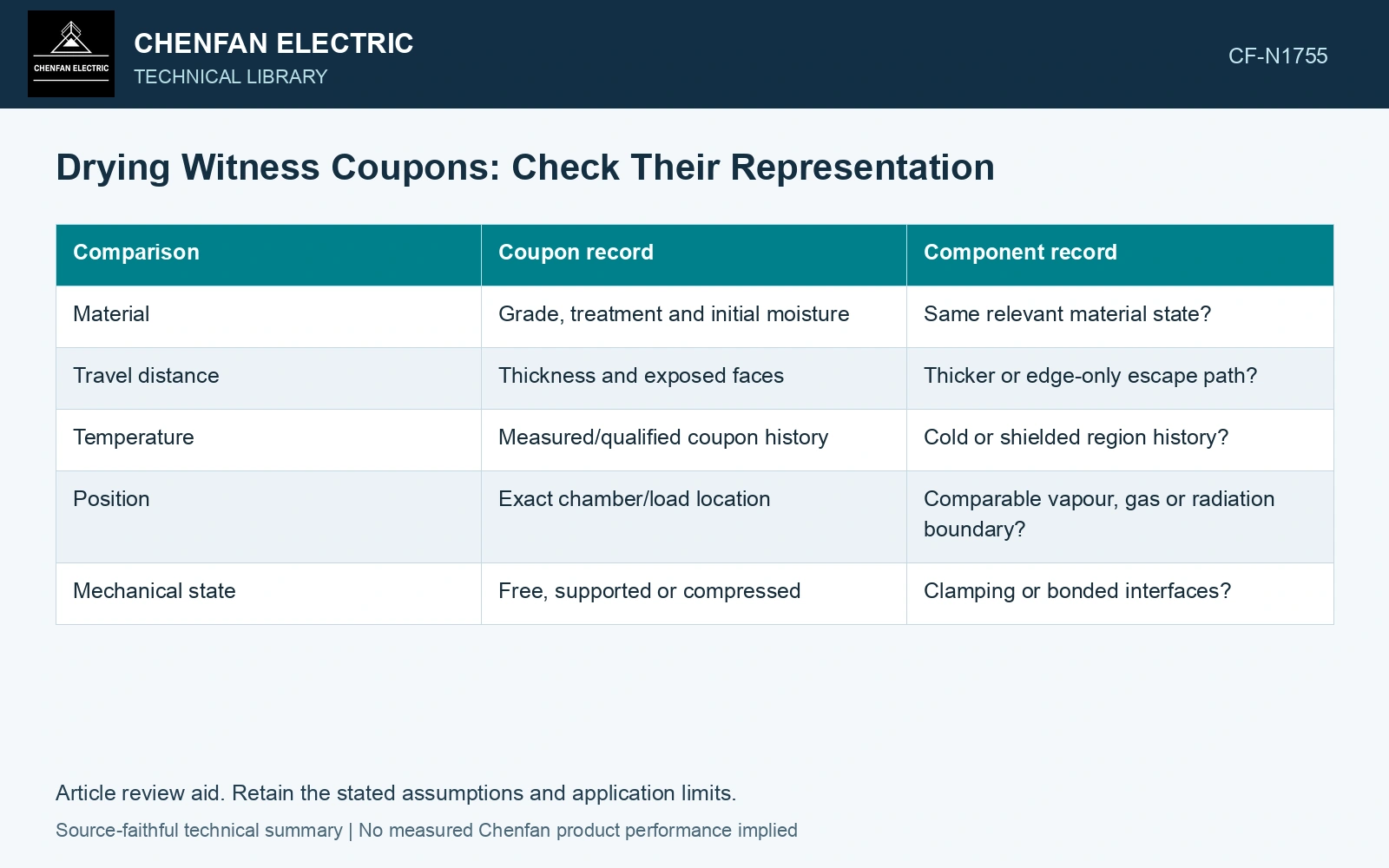
A witness coupon is convenient to sample, but convenience does not make it representative. A thin exposed coupon can dry faster than a thick pressboard block clamped between metal parts. The witness result needs a clear link to the region it is meant to represent. [1]
| Comparison | Coupon record | Component record |
|---|---|---|
| Material | Grade, treatment and initial moisture | Same relevant material state? |
| Travel distance | Thickness and exposed faces | Thicker or edge-only escape path? |
| Temperature | Measured/qualified coupon history | Cold or shielded region history? |
| Position | Exact chamber/load location | Comparable vapour, gas or radiation boundary? |
| Mechanical state | Free, supported or compressed | Clamping or bonded interfaces? |
Identify the assumption behind extrapolation
If the coupon has the same material but a shorter diffusion distance, relate its response to the component through a validated model. Under ideal fixed-diffusivity and comparable boundary conditions, Fickian time scales with distance squared. Different temperature histories or blocked faces invalidate a simple thickness conversion. [1]
A coupon chosen to represent a worst region should demonstrate that premise with geometry and exposure evidence. Placing it in a corner does not automatically make it conservative for every internal insulation path.
Water in oil and water in cellulose are different material inventories; temperature, distribution and sampling determine whether one observation represents another region. [2]
Test whether coupon thickness is representative
Assume the coupon’s effective diffusion distance is 1 mm and the clamped component’s is 5 mm at unchanged diffusivity. Their characteristic time ratio is 25. A passed thin coupon therefore cannot alone validate the thicker region. Demonstrate a qualified correlation using material temperature, exposure and moisture evidence rather than choosing the most accessible sample.
Keep analytical handling in the witness record
Record removal, storage and measurement timing under the qualified method. A coupon can gain moisture after extraction, and an unrepresentative handling history can distort the process conclusion.
References
- A. Betie, F. Meghnefi, I. Fofana and Z. Yeo, Modeling the Insulation Paper Drying Process from Thermogravimetric Analyses, Energies 11, 517, 2018, section 2. DOI: 10.3390/en11030517.
- S. R. Arsad et al., Water Content in Transformer Insulation System: A Review on the Detection and Quantification Methods, Energies 16, 1920, 2023. DOI: 10.3390/en16041920.