

Temperature changes the timing and magnitude of dielectric processes. A shift method can help compare measurements at a reference temperature, but one factor does not necessarily align every process in an oil-paper system. The residual is part of the evidence. [1]
Use actual object temperature, its stability and the method’s temperature basis. A top-oil reading may not represent every insulation region during cooling. Record that uncertainty before applying a reference-temperature correction.
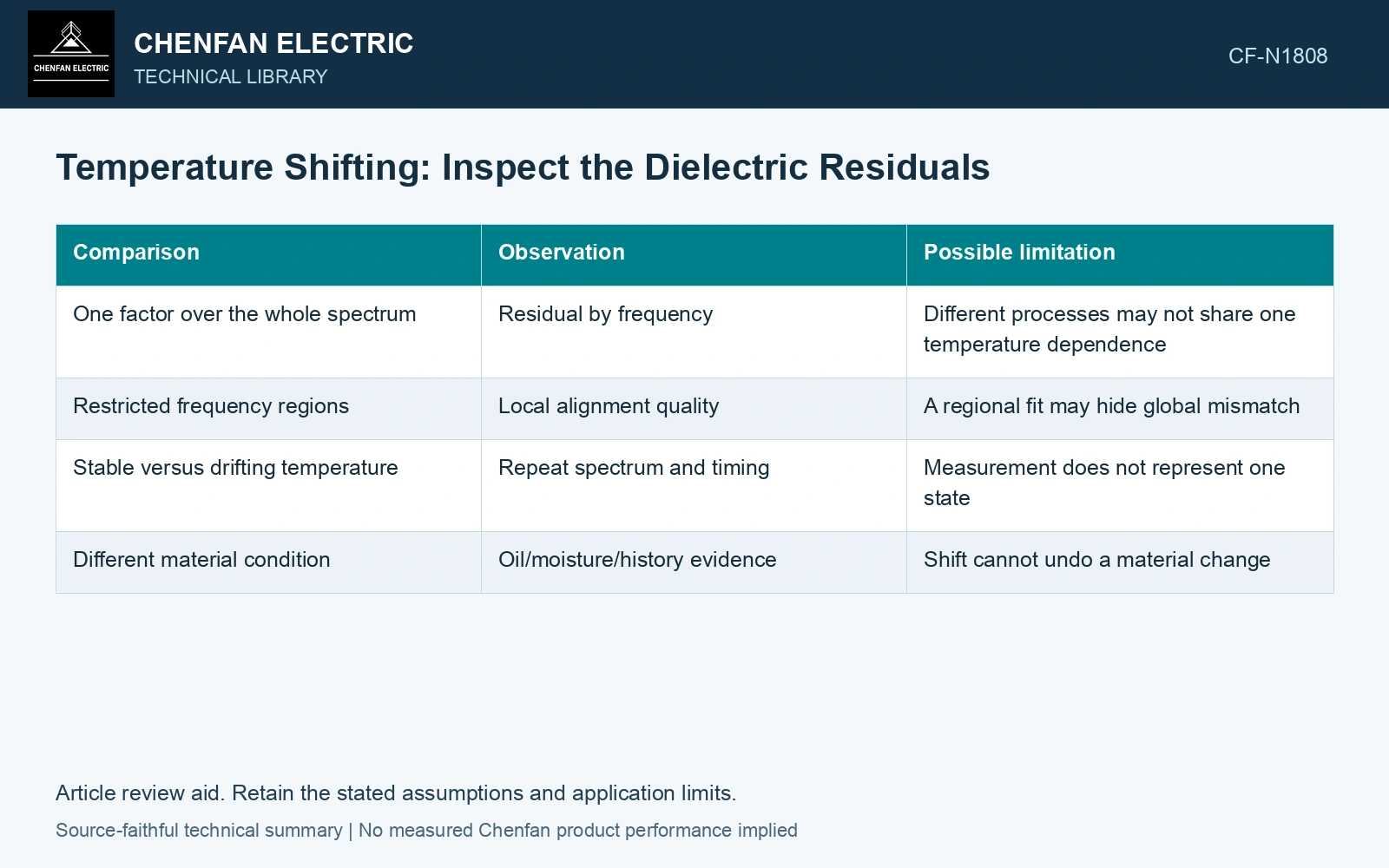
Test a shift instead of assuming it works
| Comparison | Observation | Possible limitation |
|---|---|---|
| One factor over the whole spectrum | Residual by frequency | Different processes may not share one temperature dependence |
| Restricted frequency regions | Local alignment quality | A regional fit may hide global mismatch |
| Stable versus drifting temperature | Repeat spectrum and timing | Measurement does not represent one state |
| Different material condition | Oil/moisture/history evidence | Shift cannot undo a material change |
Keep activation assumptions visible
A model may use an Arrhenius-type temperature dependence for relaxation or conductivity. Its activation parameter must fit the material and range. An empirically successful shift over one range is not evidence that the same parameter applies across all frequencies and temperatures.
Inspect both shape and magnitude after shifting. A purely horizontal adjustment cannot represent every vertical conductivity or geometry effect unless the model establishes that treatment.
An extended Debye representation separates relaxation branches with different time constants. Raxsa and co-authors fit these branches explicitly; a temperature-comparison model must separately justify whether the branches share one shift factor. [2]
Inspect a frequency-dependent shift mismatch
Assumptions: two RC processes have τ₂₀ = 100 s and 1,000 s at 20 °C (293.15 K), with activation energies 0.50 and 0.80 eV. Use the assumed Arrhenius law τ(T) = τ₂₀ exp[(E/k)(1/T − 1/293.15)] and k ≈ 8.61733×10⁻⁵ eV/K. At 40 °C (313.15 K), their cold/hot time-shift factors are 3.53994 and 7.55777, and hot time constants 28.249 and 132.314 s. Shifting both hot processes by the first factor recovers 100 s for the first, but only 468.384 s for the second instead of 1,000 s, a −53.16% residual. Reject one common time shift for this assumed model. Compare the measured regional residuals and actual temperature field before selecting a material-specific shift. [2]
References
- IEEE, IEEE C57.161-2018, IEEE Guide for Dielectric Frequency Response Test.
- J. Raxsa, P. Nimsanong, T. Mai-Eiam and P. Yutthagowith, Determination of Dielectric Models Based on Effective Multi-Exponential Fittings, Energies 16, 4615, 2023. DOI: 10.3390/en16124615.