

A bus transfer may complete electrically while motors take several seconds longer to recover. Their continuing current adds a transformer duty that is easy to miss if the study ends at breaker closure. Delayed restart groups can extend the interval further. [1]
Begin with the transformer’s pre-event thermal state and the actual current trajectory of the recovering load. A cold initial condition is not justified merely because the supply interruption was brief.
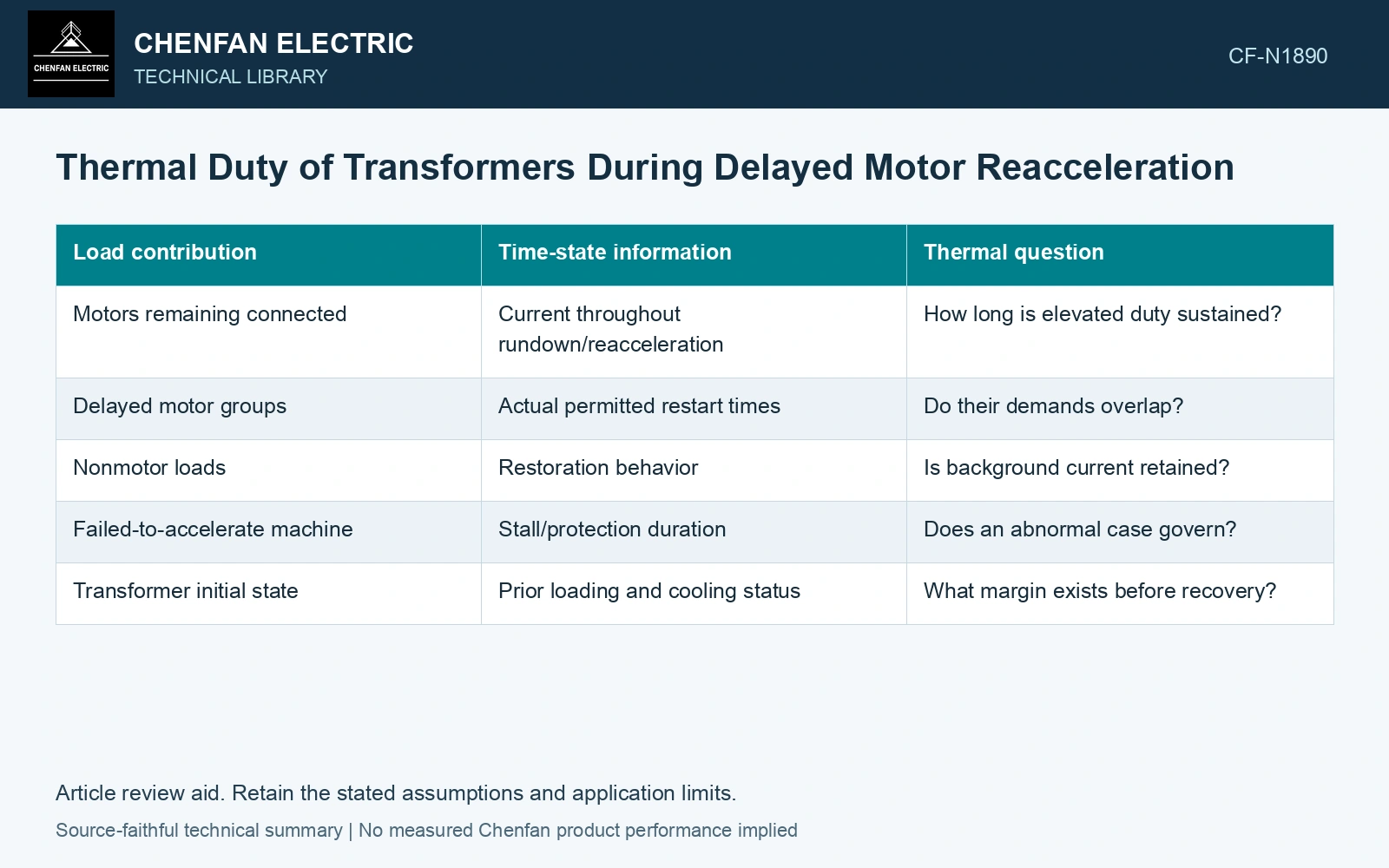
Assemble the current on a common time base
| Load contribution | Time-state information | Thermal question |
|---|---|---|
| Motors remaining connected | Current throughout rundown/reacceleration | How long is elevated duty sustained? |
| Delayed motor groups | Actual permitted restart times | Do their demands overlap? |
| Nonmotor loads | Restoration behavior | Is background current retained? |
| Failed-to-accelerate machine | Stall/protection duration | Does an abnormal case govern? |
| Transformer initial state | Prior loading and cooling status | What margin exists before recovery? |
Use phase waveforms or phasors consistent with the chosen model. Adding individual current magnitudes can misrepresent total phase current when phase relationships differ. Squaring and summing individual magnitudes is not automatically the transformer’s copper-loss duty.
Use the current-squared integral correctly
A screening quantity is integral of I² dt, in ampere-squared seconds. It is not energy until the relevant resistance and current boundary are included. With constant effective resistance R in ohms, the corresponding resistive energy is R times that integral, in joules.
Temperature-dependent resistance, stray losses and nonuniform current distribution can require more detailed treatment. A repeated recovery event also begins from the state left by the previous one. The screening integral does not resolve these effects on its own.
Separate winding and bulk-fluid response
The winding can accumulate heat quickly while bulk oil temperature changes more slowly. A modest oil-temperature movement during a short event does not establish that every conductor or lead remained within its accepted local limit.
Use a transformer model suited to the event duration and loss distribution. A daily-average load model may smooth away the very interval being assessed. Keep cooling status explicit, including equipment already unavailable during the disturbance.
Integrate the recovery heating interval
Assumptions for an adiabatic winding-node screen: initial temperature 120 °C, an illustrative decision gate of 125 °C, effective heat capacity 200 kJ/K and rated-current copper loss 50 kW evaluated at 125 °C. At 1.8 pu RMS current for 6 s, copper input is 50 × 1.8² × 6 = 972 kJ. With heat rejection neglected, the calculated rise is 4.86 K, reaching 124.86 °C. Only 0.14 K remains to the assumed gate, so this coarse model cannot support release without uncertainty and local-temperature checks. A second identical event before cooling gives 9.72 K cumulative rise and 129.72 °C: inhibit that repeat sequence until recovery or a validated transient assessment establishes the required margin.
Include the unsuccessful recovery case
The SEL paper validates motor current and torque dynamics for its transfer example. Use its motor-current trajectory as thermal-model input, and carry stalled or delayed cases through protection clearing rather than retaining only the fastest successful recovery. [2]
References
- IEC, IEC 60076-7:2018, Power transformers – Part 7: Loading guide for mineral-oil-immersed power transformers.
- P. Muralimanohar, D. Haas, J. R. McClanahan, R. T. Jagaduri and S. Singletary, Implementation of a Microprocessor-Based Motor Bus Transfer Scheme, IEEE PCIC, 2016, DOI: 10.1109/PCICON.2016.7589248.