

For an ideal periodic strain waveform satisfying λ(t + T/2) = λ(t), the waveform repeats twice within the electrical period T. Its Fourier expansion relative to that period contains only even harmonic orders, apart from the mean component.
If the two half cycles become unequal, that symmetry no longer holds. Odd mechanical components can appear. DC-biased magnetic excitation is one possible cause, but a measured odd component is not a unique DC-bias detector.
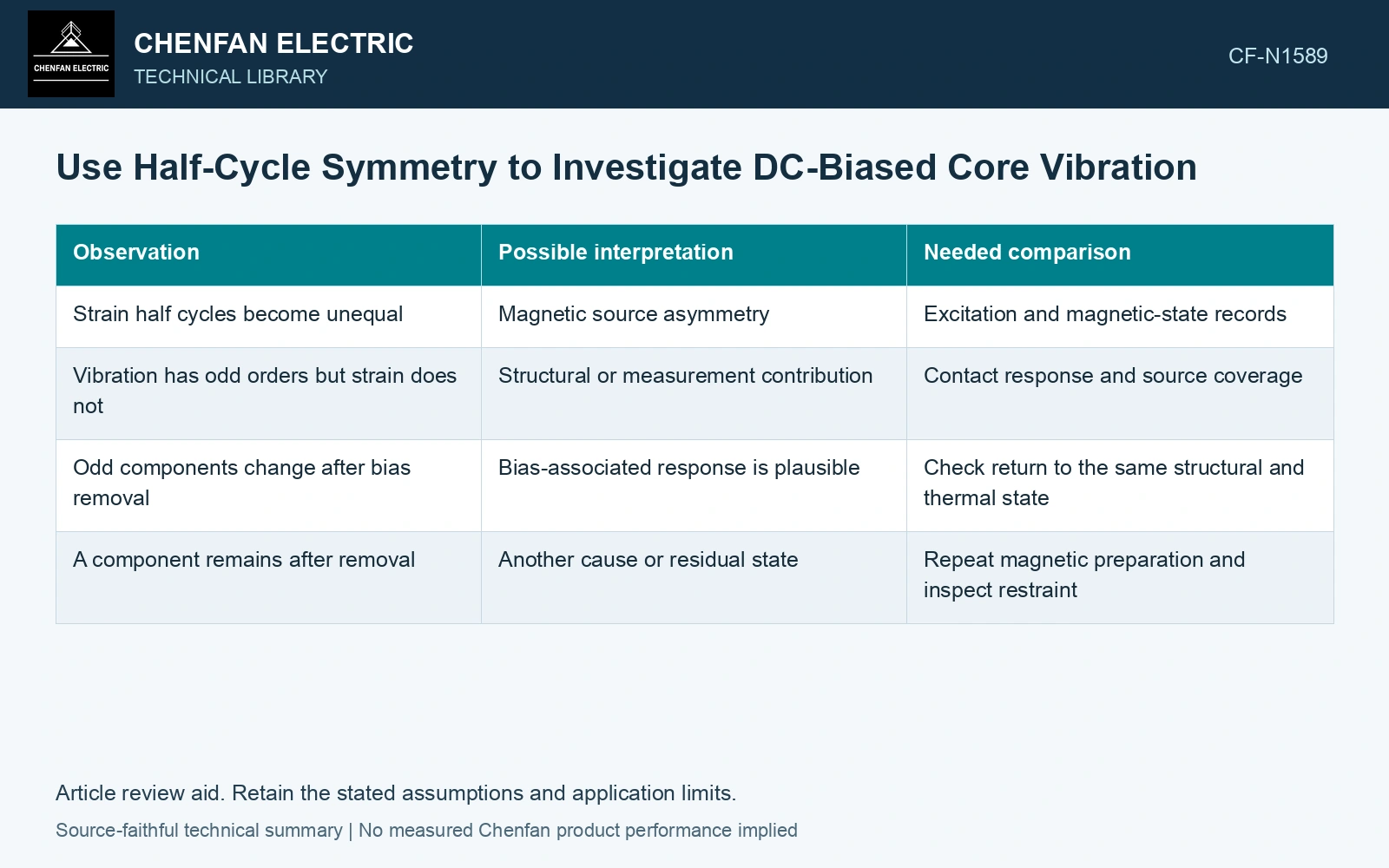
Measure the asymmetry in time as well as frequency
Define a half-cycle difference d(t) = λ(t) − λ(t + T/2), using synchronized strain data over a steady electrical period. Plot d(t) alongside the original waveform. This identifies where symmetry is lost, rather than relying on one spectral amplitude.
Separate mechanical strain or vibration spectra from current spectra. The nonlinear magnetic and mechanical chain can generate, suppress or redistribute harmonics. A current harmonic and a displacement harmonic at the same order do not necessarily represent the same mechanism.
| Observation | Possible interpretation | Needed comparison |
|---|---|---|
| Strain half cycles become unequal | Magnetic source asymmetry | Excitation and magnetic-state records |
| Vibration has odd orders but strain does not | Structural or measurement contribution | Contact response and source coverage |
| Odd components change after bias removal | Bias-associated response is plausible | Check return to the same structural and thermal state |
| A component remains after removal | Another cause or residual state | Repeat magnetic preparation and inspect restraint |
Use a controlled removal comparison
Where an approved test permits controlled bias, compare a baseline, a biased condition and a recovered baseline. Keep the alternating excitation, measurement reference and mechanical setup consistent. Allow each condition to reach its defined steady state.
The recovered baseline is important. Temperature changes, contact seating or residual magnetic history can persist after the DC input changes. Without that check, a difference attributed to bias may include an altered structure or material state.
Avoid converting odd-harmonic vibration directly into DC current. The transfer from source strain to measured motion is frequency-dependent, and a sensor can be near a node for one mode. Multiple source regions and contact nonlinearities further weaken a one-to-one inference.
Check acquisition artifacts too. A trigger error, unequal channel timing or insufficient records can distort the apparent half-cycle comparison. Confirm the electrical period and common clock before interpreting small asymmetries.
Use the symmetry result to select the next investigation: magnetic history when strain itself changes, contact behavior when new output harmonics arise, or measurement configuration when phase is unstable. Its value is a discriminating question about the source chain, rather than a spectral label that declares every odd tone to be DC bias.
Calculate the odd term created by a stated flux offset
Use 0.23 mm catalogue thickness [1]. Assume 1,000 sheets, 100 mm width and 100 turns: steel area is 0.0230 m². A 50 Hz sinusoidal 510.6 V RMS induced voltage gives approximately 1.0 T peak AC flux density. For a deliberately simplified assumed law λ = aB² with a = 1.0 μstrain/T² and B = 0.10 T + 1.0 T cos(ωt), expansion gives a 50 Hz strain term of 2aB₀B₁ = 0.20 μstrain and a 100 Hz term of aB₁²/2 = 0.50 μstrain. Removing the offset removes the odd term in this model. Use the symmetry test to investigate source asymmetry, while retaining the actual GOES history and stress dependence [2].
Effective steel section, sheet orientation and joint closure control the magnetic distribution; cutting stress and clamp preload influence the strain response. Keep these conditions unchanged during a bias-removal comparison. The catalogue thickness anchors area only and supplies no universal coefficient for the assumed quadratic strain law. Directional strain under DC-biased and harmonic excitation requires its own source characterization [2].
References
- Nippon Steel Corporation, Grain-Oriented Electrical Steel Sheets, catalogue D004je_03_202004, 2020, Specifications; Size and Form Tolerances.
- Zhao, X., Du, Y., Liu, Y., Du, Z., Yuan, D., and Liu, L., Magnetostrictive Properties of the Grain-Oriented Silicon Steel Sheet under DC-Biased and Multisinusoidal Magnetizations, Materials 12, 2156, 2019. DOI: 10.3390/ma12132156.