

Build the second-source release dossier around the decision it must support. Link each core configuration and required property to identified evidence, then assign the outstanding engineering questions to their closure data and approval responsibility. [1]
Start with the configuration and intended decision
Identify the core design, steel and processing state, supplier route, delivery form, assembly responsibility and applicable product family. State whether the decision concerns a trial, a defined lot or continuing production. Different release scopes require different represented evidence.
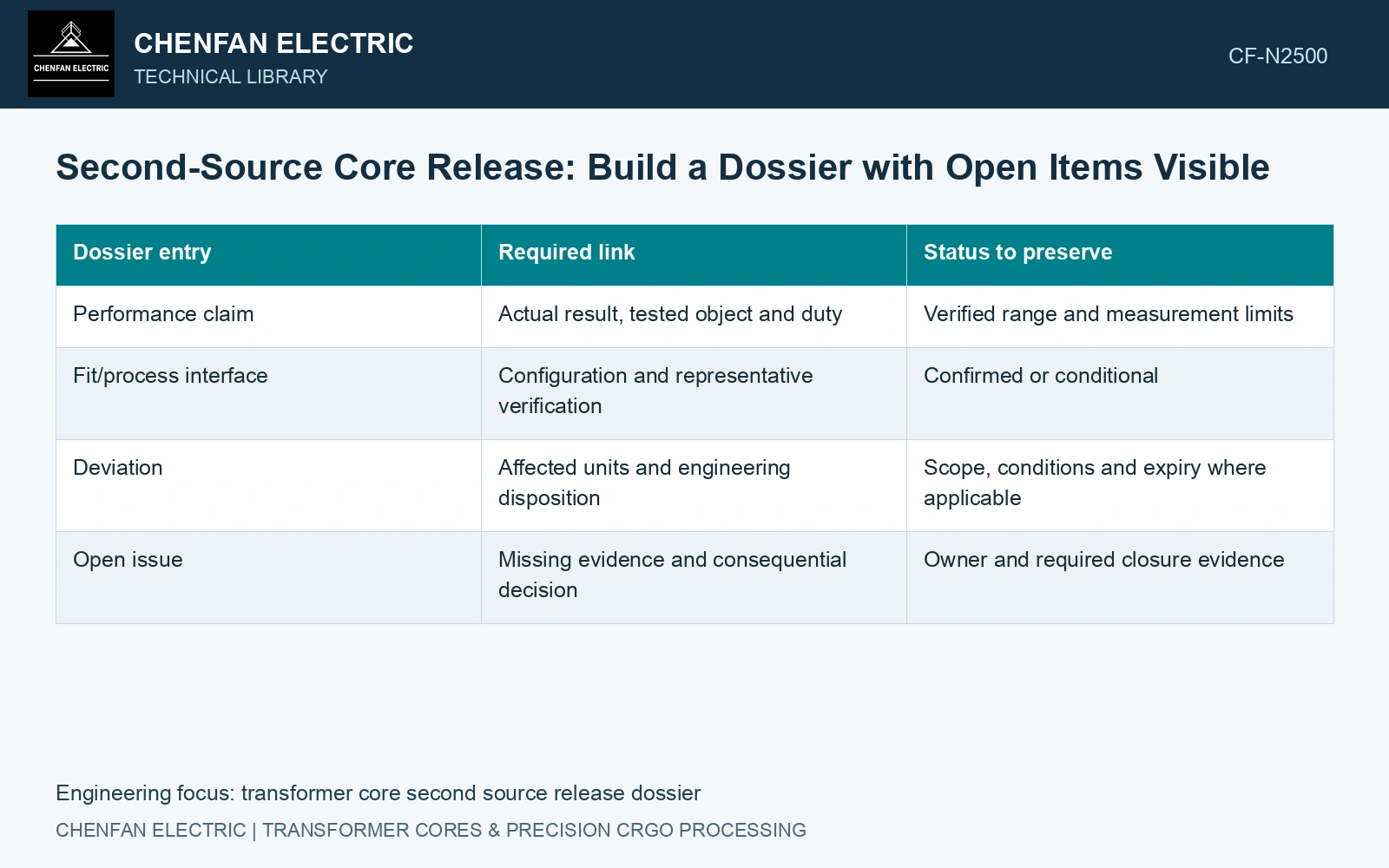
| Dossier entry | Required link | Status to preserve |
|---|---|---|
| Performance claim | Actual result, tested object and duty | Verified range and measurement limits |
| Fit/process interface | Configuration and representative verification | Confirmed or conditional |
| Deviation | Affected units and engineering disposition | Scope, conditions and expiry where applicable |
| Open issue | Missing evidence and consequential decision | Owner and required closure evidence |
Index claims, not only filenames
For each required property, point to the evidence that actually tests it. Identify source declarations separately from measured results. A material certificate supports its stated material population, while a core test represents its assembly and conditions. Neither should be indexed as proof of every requirement.
Keep evidence versions and physical identities aligned. A report from an earlier fixture or a different packet set may be relevant context without verifying the proposed delivered configuration. State any justified inheritance argument beside that report.
Write unresolved items as engineering questions
Replace “documents pending” with the missing fact: for example, the restrained dimension after final reconstruction or the test coverage for a mixed lot. Identify why it matters, what evidence closes it and who must provide or assess that evidence.
Separate a completed administrative action from technical closure. Receiving a revised sheet does not close the issue if the new sheet still lacks the required measurement state.
Bind release to the evidence available
If a limited release is justified under the project’s authority, state its exact units, configuration and conditions. Do not describe it as full approval while consequential items remain open. Conversely, preserve a supported conclusion where the evidence closes the requirement; a longer folder is not inherently stronger.
Record change triggers and the production evidence needed to maintain the accepted source. Connect the decision to work orders and delivered identities so later deviations can be contained.
Keep the material budget separate from core acceptance
For 23ZH90, the catalogue maximum is 0.90 W/kg at 1.7 T and 50 Hz on the specified rolling-direction, stress-relieved specimens [2]. Assume a 1,000 kg electrical-steel mass and a 1,000 W assembled-core contractual ceiling at those nominal excitation conditions. Multiplication gives a 900 W material-limit budget and a 100 W arithmetic difference. That difference is not a verified allowance for joints, cutting stress or clamping. Release the material record against its own limit; require an identified assembled-core result to close the separate 1,000 W obligation.
Cutting stress, joint gaps, coating damage and final clamping affect the assembled result. Link each process record to the core tested rather than inheriting performance from the coil certificate.
For a lot release, give each consequential open requirement identified closure evidence or a bounded disposition tied to the specific units. Index supplied-steel acceptance, supplier-tested assembly and buyer-reconstructed core as separate scopes, with the release conditions and change triggers attached to the scope they support.
References
- NASA, NASA Systems Engineering Handbook, section 6.5, Configuration Management, official online text.
- Nippon Steel Corporation, Grain-Oriented Electrical Steel Sheets, catalogue D004je, April 2020, specification tables, size tolerances and Annealing by Customers.