

Map both steel lots to their actual layers, joints and interfaces before accepting a mixed-lot core. Its measured total loss establishes the tested aggregate response, while local material and assembly evidence determine the margin at the controlling regions.
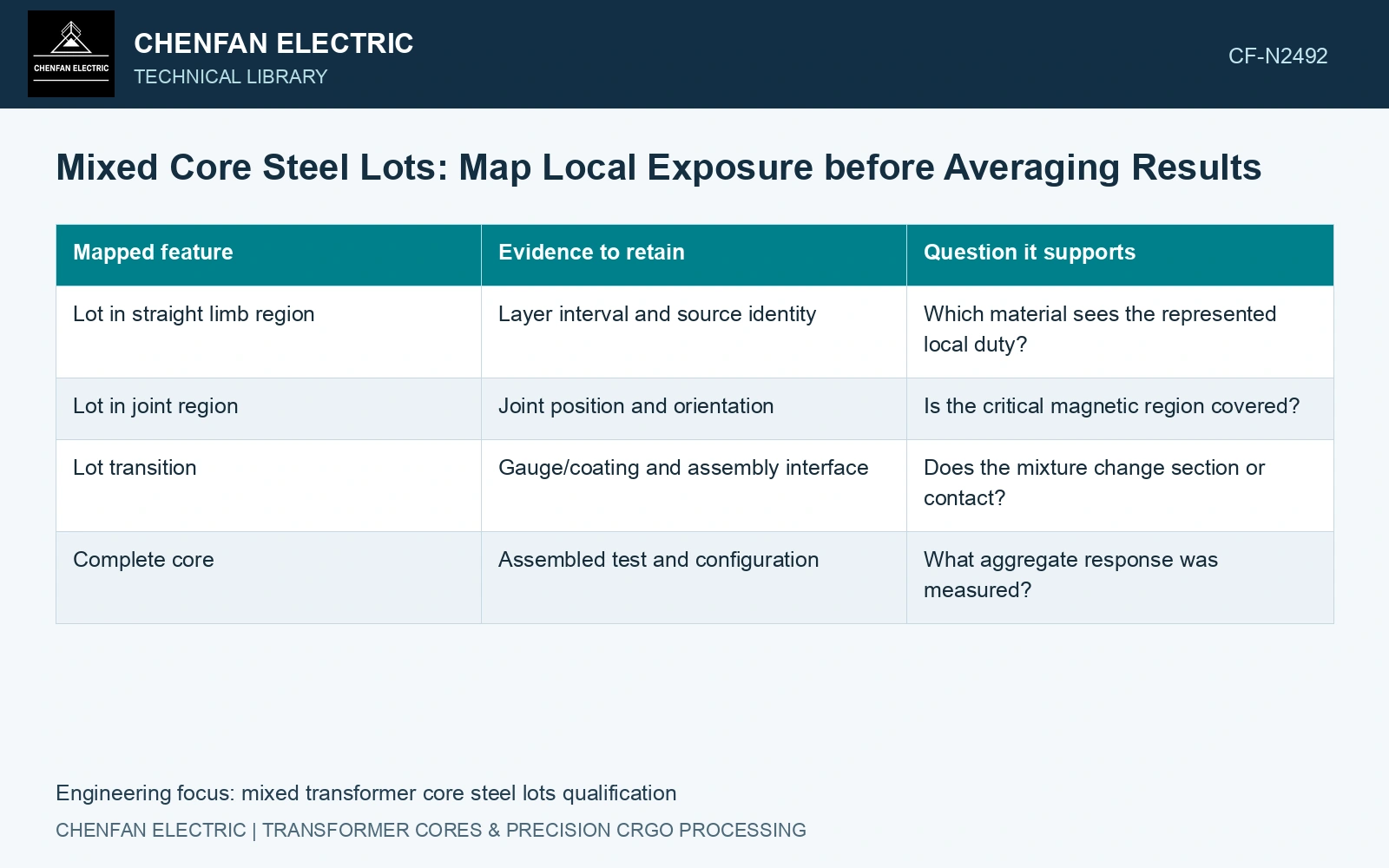
Map the lots into the construction
Identify each lot’s certificate basis, treatment state, gauge and processing history, then map its actual layers and regions. Include changes within a packet. A set-level label listing two lots is insufficient to locate a suspect segment or interpret a local measurement. [1]
| Mapped feature | Evidence to retain | Question it supports |
|---|---|---|
| Lot in straight limb region | Layer interval and source identity | Which material sees the represented local duty? |
| Lot in joint region | Joint position and orientation | Is the critical magnetic region covered? |
| Lot transition | Gauge/coating and assembly interface | Does the mixture change section or contact? |
| Complete core | Assembled test and configuration | What aggregate response was measured? |
Select local evidence for the controlling region
Identify whether the consequential concern is magnetic response, coating/interface integrity, dimensional distribution or local cooling. Choose evidence that represents the actual position and duty. More repeated whole-core watts will not resolve an unobserved local interface by themselves.
For a magnetic concern, keep the material data and relevant assembly representation aligned. For a dimensional concern, preserve effective section and stacking-state measurements. Do not merge these into one “average grade” acceptance category.
Control the qualified mixture
Record the accepted lot arrangement and the bounds of permitted variation. A later substitution that moves the less-characterized material into a controlling joint is a new configuration question, even if the mass fractions remain unchanged.
Calculate the material mixture without concealing its location
Assume 900 kg of 23ZH85 and 100 kg of 23ZH90. Their catalogue maximum specific losses are 0.85 and 0.90 W/kg respectively at 1.7 T and 50 Hz under the stated specimen conditions [2]. The weighted material-limit calculation is 900 × 0.85 + 100 × 0.90 = 855 W, or 0.855 W/kg. The second lot contributes 90 W to that arithmetic, while 1,000 kg all at the 23ZH90 limit gives 900 W. The 45 W difference compares stated material maxima; it does not predict core savings or approve an unverified joint-region substitution.
Keep the same assumed masses but compare two location maps. Assume a controlling joint carries 0.017 Wb peak flux. In map A its effective steel section is 0.010 m², giving 1.70 T; in map B a local 0.0090 m² section gives 1.89 T. The 855 W material account is unchanged, but the catalogue’s 1.7 T loss guarantee does not bound that 1.89 T region. Identify the lot and joint geometry there and obtain the relevant material/local-field evidence before approving map B; another mass-weighted average cannot close that gap.
Control lot position, gauge distribution, step-lap sequence and restraint. A compliant mass fraction does not establish local joint flux or coating contact at a mixed-lot interface.
Release the qualified mixture with its physical lot map, permitted substitutions, aggregate test and local evidence. Keep packet and core-set containment traceable, and review any substitution that moves less-characterized material into a controlling region even when the overall mass fractions stay the same.
References
- NASA, NASA Systems Engineering Handbook, section 6.5, Configuration Management, official online text.
- Nippon Steel Corporation, Grain-Oriented Electrical Steel Sheets, catalogue D004je, April 2020, specification tables, size tolerances and Annealing by Customers.