

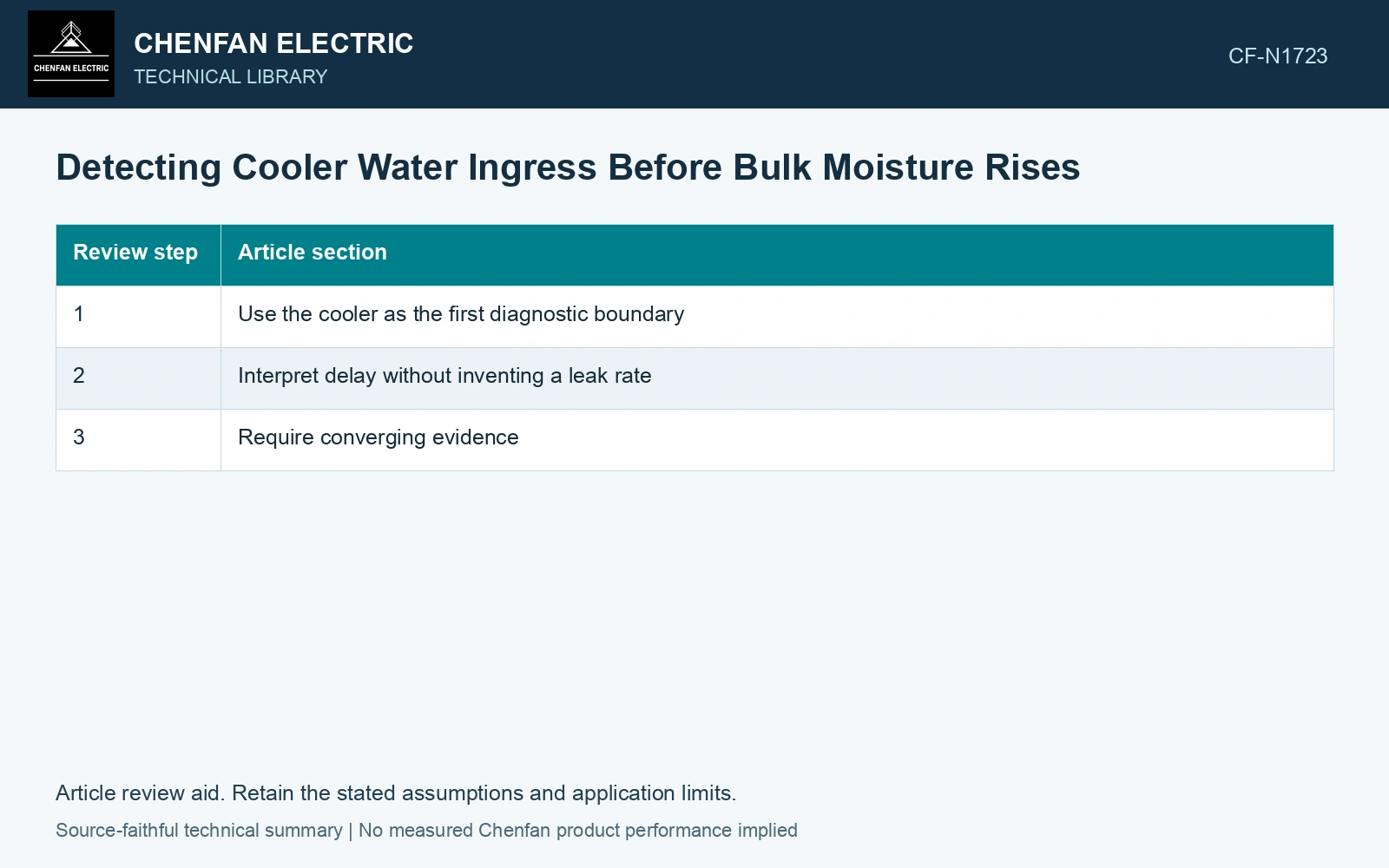
A small cooler leak may introduce water into a local oil stream before a tank-wide moisture sample shows a clear rise. Oil circulation, mixing and temperature affect when that evidence appears. Waiting for one bulk moisture threshold can miss the early source information. [1]
Use the cooler as the first diagnostic boundary
Identify oil inlet and outlet sample points that are approved and representative for the operating circuit. Compare them under matched temperature, flow and sample handling. A local outlet change can help locate a source, but it must be distinguished from sampling contamination and pre-existing moisture redistribution.
Confirm any leak-space indication and identify the collected fluid where the construction permits.
Review local oil-water pressure difference through the period when the indication began.
Compare cooler inlet/outlet moisture evidence with a bulk-tank sample from the same period.
Check flow, temperature and recent switching or maintenance that may change mixing or introduce air.
Escalate through the approved plant response if evidence supports an active separating-barrier fault.
Interpret delay without inventing a leak rate
For a constant oil-mass approximation, a simplified well-mixed balance can illustrate dilution: Moildc/dt = ṁw − removal terms, where c is water mass fraction, Moil oil mass in kg and ṁw water entry in kg/s. The relation omits phase separation, water partition into cellulose and incomplete mixing. It cannot recover a unique leak rate from one tank sample.
Relative saturation and water concentration depend on oil temperature and liquid type. Retain the sensor’s reported quantity and temperature rather than comparing unlike units as though both were direct water mass readings.
The water-content review distinguishes oil, cellulose and free-water inventories, including temperature-dependent partition and measurement [2]. A local-to-bulk difference therefore needs matched sampling and a transport history before it can identify a cooler leak.
Compare local ingress and bulk dilution
Assume an illustrative 10 g water addition is completely dissolved in 1,000 kg oil, with no exchange to paper or free water. Concentration rises by 10 mg/kg. If the same addition is initially dissolved within an isolated 100 kg local oil inventory, the increment is 100 mg/kg before mixing. These are mass-balance examples, not dissolution guarantees; phase separation or local saturation changes the sampling interpretation. Compare matched local and bulk samples with pressure and leak-space evidence before locating the source.
References
- U.S. Bureau of Reclamation, FIST Volume 3-30, Transformer Maintenance, 2000.
- S. R. Arsad et al., Water Content in Transformer Insulation System: A Review on the Detection and Quantification Methods, Energies 16, 1920, 2023. DOI: 10.3390/en16041920.