

Match conservator capacity to the usable volume between its defined operating states. Shape, internal components and interface positions determine that range and the level signals associated with it.
Count the connected fluid inventory
Identify the fluid volume represented by the expansion calculation, including connected cooling equipment and other relevant passages. Retain the reference temperature and configuration. Inventory in a transport state with disconnected or drained components can differ from the installed inventory. [1]
For an illustrative linear expansion screen, assume 1,000 L at a reference state, a constant volumetric coefficient of 7 × 10⁻⁴ K⁻¹ and an 80 K temperature change. The approximate expansion is VβΔT = 56 L. The coefficient and temperature interval are assumptions, not values for a specified mineral oil or ester. A real envelope needs the applicable fluid data and temperature representation.
Map volume onto the actual level geometry
Determine the volume available between the defined low and high states after accounting for internal components and any required reserve. A linear level scale is not necessarily a linear volume scale in a shaped vessel. Match the indication to the actual conservator orientation and internal arrangement. [1]
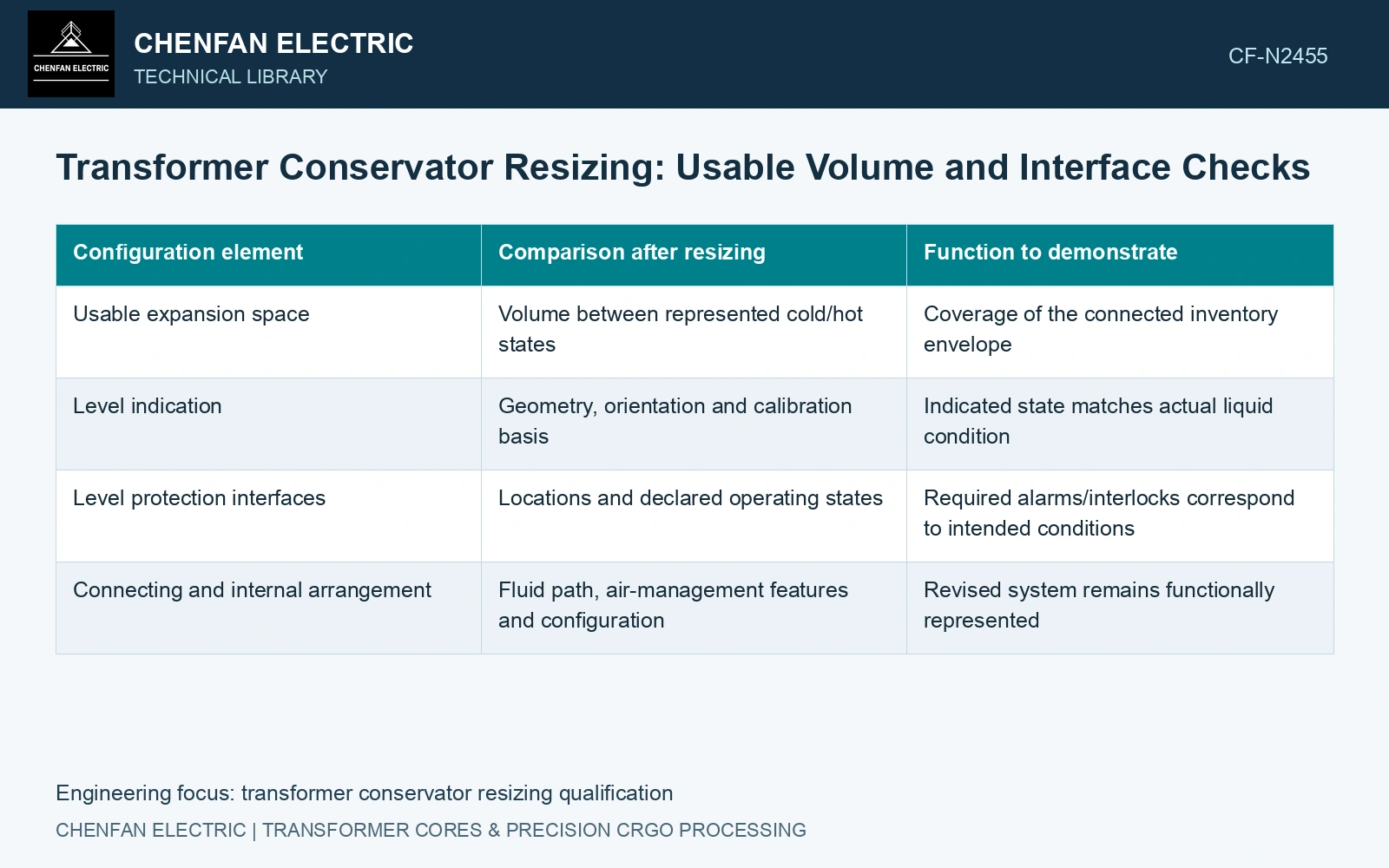
| Configuration element | Comparison after resizing | Function to demonstrate |
|---|---|---|
| Usable expansion space | Volume between represented cold/hot states | Coverage of the connected inventory envelope |
| Level indication | Geometry, orientation and calibration basis | Indicated state matches actual liquid condition |
| Level protection interfaces | Locations and declared operating states | Required alarms/interlocks correspond to intended conditions |
| Connecting and internal arrangement | Fluid path, air-management features and configuration | Revised system remains functionally represented |
Reconcile protection and documentation
Check the meaning of each level signal in the resized geometry. An unchanged switch position or control label does not establish an unchanged physical state. Verify the relevant functional responses through the project’s approved test plan and retain the observed state with the response record. [1]
Keep transport, installation and service drawings distinct where their fluid inventories or connections differ. A level recorded in one state should not become the reference for another without reconciliation. Any revised seal or connection belongs to the system change and requires its own relevant evidence.
Review the old expansion and interface evidence against these actual dependencies. Unchanged main-tank dimensions can preserve part of the inventory calculation while leaving conservator geometry, level calibration or protection response open.
Test the expansion against the usable range
Continue the same assumed 1,000 L, 7 × 10⁻⁴ K⁻¹ and 80 K example. Expansion is 56 L. If the vessel provides an assumed 50 L between its approved low and high operating states, the shortfall is 6 L before any additional reserve. A 100 L gross nameplate volume would not close that gap unless its usable interval actually includes the required 56 L. Verify connected inventory, level indication and oil-preservation equipment [1], then update the configuration and its signal mapping [2].
Approve the fluid-expansion envelope, usable conservator range and corresponding level or protection states on the same controlled configuration. Reconcile transport and installed inventories, then link each indication to the actual vessel geometry.
References
- U.S. Bureau of Reclamation, FIST Volume 3-30, Transformer Maintenance, 2000.
- NASA, NASA Systems Engineering Handbook, section 6.5, Configuration Management, official online text.