

Calculate broken-neutral load voltages from the displaced load star point. With an unbalanced star load, an opened return path can shift that point while the source line voltages remain unchanged. [1] [2]
Define the ideal circuit before calculating
Let Ea, Eb and Ec be source phase-voltage phasors referred to the source neutral, and Ya, Yb and Yc the linear load admittances. With no remaining neutral or earth return, direct Kirchhoff current balance gives Vn = (YaEa + YbEb + YcEc)/(Ya + Yb + Yc).
The load voltages are Ea − Vn, Eb − Vn and Ec − Vn. Subtract complex quantities before taking magnitudes. Averaging the three nominal voltage magnitudes cannot calculate the displaced star point.
Read a complete assumed example
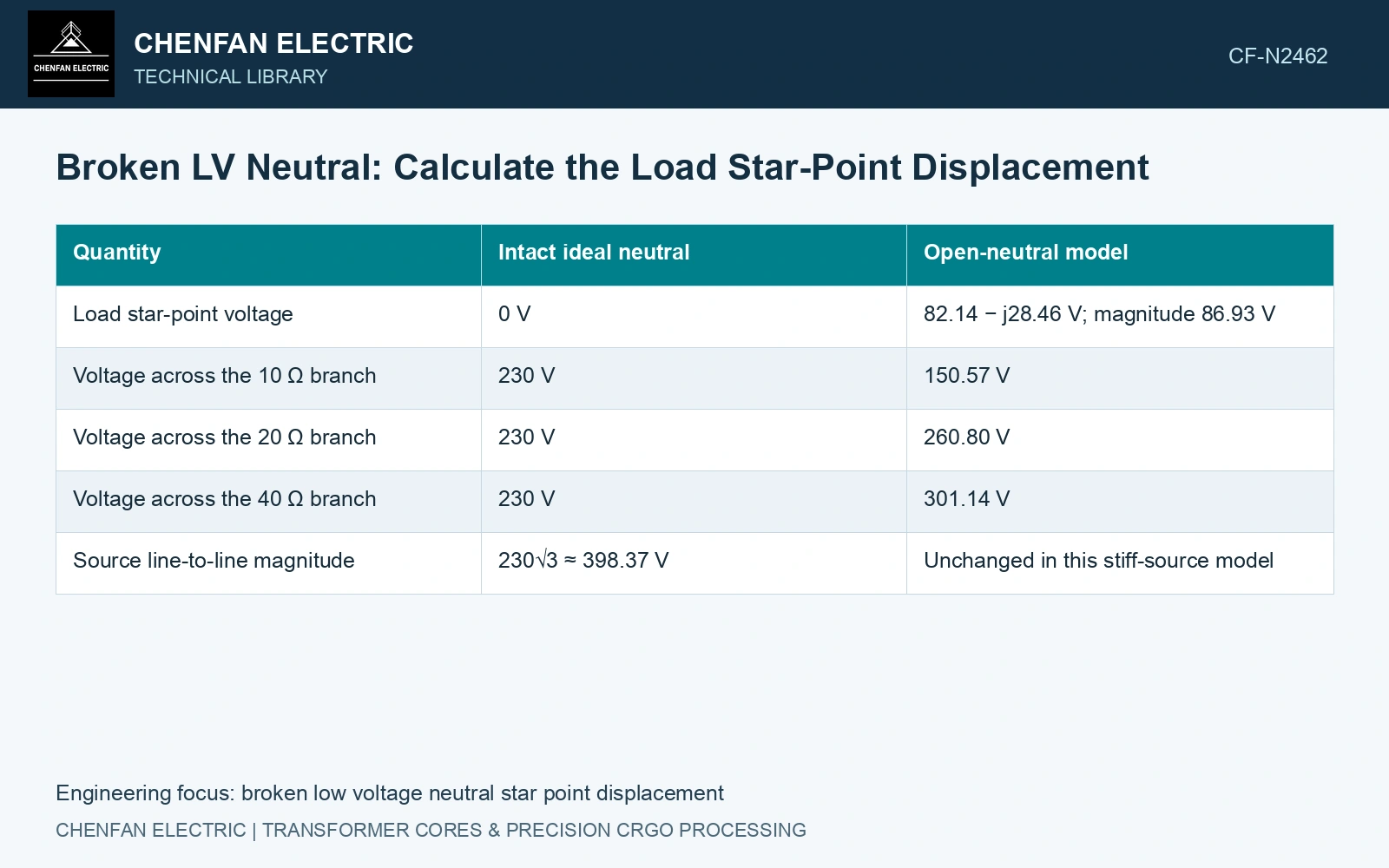
Assume a stiff source of 230∠0°, 230∠−120° and 230∠120° V RMS, with resistive phase loads of 10, 20 and 40 Ω. Source and line impedances, capacitance, protective connections and electronic controls are omitted. This is an assumed circuit, not the CIRED experiment [1].
| Quantity | Intact ideal neutral | Open-neutral model |
|---|---|---|
| Load star-point voltage | 0 V | 82.14 − j28.46 V; magnitude 86.93 V |
| Voltage across the 10 Ω branch | 230 V | 150.57 V |
| Voltage across the 20 Ω branch | 230 V | 260.80 V |
| Voltage across the 40 Ω branch | 230 V | 301.14 V |
| Source line-to-line magnitude | 230√3 ≈ 398.37 V | Unchanged in this stiff-source model |
Scan loads rather than one operating point
Repeat the calculation for plausible load combinations, including equal admittances. In the balanced ideal case, the phasor-weighted numerator sums to zero. One balanced observation can therefore conceal a broken neutral’s consequence when loads subsequently change.
Retain the impedance angles for reactive loads. A magnitude-only resistance table cannot represent arbitrary power factors. For electronically controlled loads, voltage-dependent current and dropout can invalidate the constant-admittance model.
State the unrepresented return paths
An installed system may have additional conductive or capacitive connections. Include their actual topology and impedance before applying the example. Do not silently replace the missing neutral with an ideal earth reference: doing so removes the displacement being investigated. [2]
Use this phasor model in an offline load sweep. The CIRED paper documents broken-neutral detection challenges in LV networks [1]. Select the installed protection assessment from the actual return paths, voltage-dependent loads and resulting exposure; a grounding-reference failure and a load-neutral interruption require different circuit models [2].
References
- J. Campos, G. Freire, A. Babu, S. Keddar and I. Abdulhadi, Detection of broken neutral conductor in LV networks to ensure customer safety, CIRED Paper 1078, CIRED, 2025. DOI: 10.1049/icp.2025.2212.
- D. De Ronde, R. VanHatten and A. Wade, Schweitzer Engineering Laboratories, Loss of Effective System Grounding — Best Practices, Protection Challenges, and Solutions, 2015.