

A thin tank panel can flex while a pull-off adhesion test applies load. The dolly adhesive can also fail before the coating interface. The measured peak is therefore meaningful only with the test geometry and failure surface. [1]
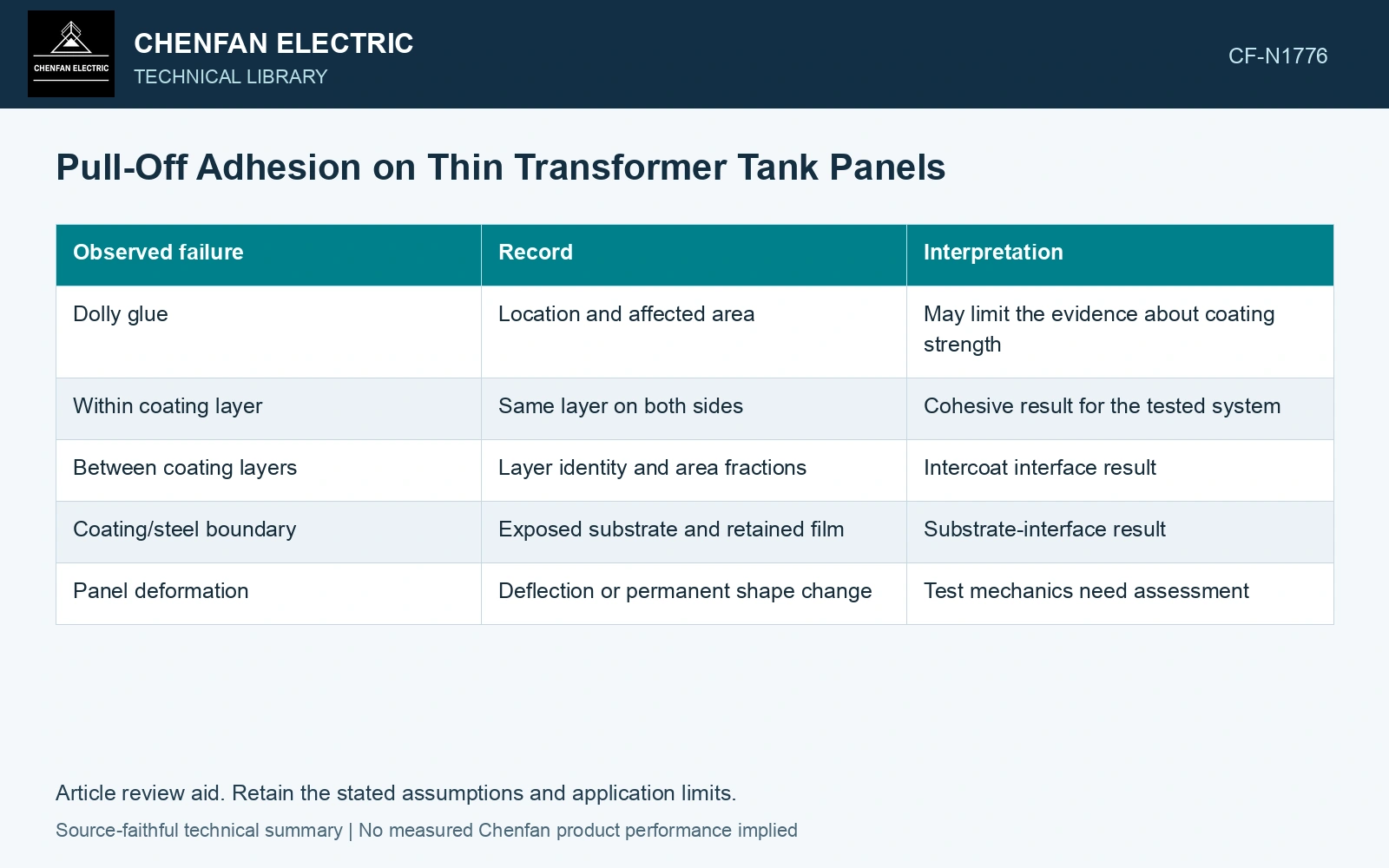
Record where the separation occurred
| Observed failure | Record | Interpretation |
|---|---|---|
| Dolly glue | Location and affected area | May limit the evidence about coating strength |
| Within coating layer | Same layer on both sides | Cohesive result for the tested system |
| Between coating layers | Layer identity and area fractions | Intercoat interface result |
| Coating/steel boundary | Exposed substrate and retained film | Substrate-interface result |
| Panel deformation | Deflection or permanent shape change | Test mechanics need assessment |
Keep force, area and mechanics consistent
Nominal pull stress is F/A, with newtons and m² giving pascals. A smaller dolly changes the load needed for a nominal stress and can change the local deformation. It does not guarantee a directly comparable failure mode.
Record dolly size, alignment, scoring if required, loading method and support arrangement under the applicable procedure. The substrate must represent the intended panel while the apparatus remains appropriate to its thickness and curvature.
Keep paint execution and supervision tied to the actual product and coated region; a finished appearance does not recover missing process evidence. [2]
Calculate nominal pull stress and retain the failure mode
Assumptions: a circular 20 mm dolly reaches 1,000 N, giving nominal F/A = 1,000/[π(0.020²)/4] = 3.18 MPa. A 10 mm dolly reaches the same nominal stress at only 250 N. Suppose the first test ends in dolly-glue failure and permanent panel bending, while the project test plan requires a supported, non-yielding substrate and an identified coating failure surface. Reject that result as evidence of a measured 3.18 MPa coating-interface strength; repeat with an applicable qualified support/apparatus arrangement and retain the actual fracture mode. The lower load of the smaller dolly does not by itself prove mechanical equivalence or authorize changing the test method. [1]
References
- ISO, ISO 4624:2023, Paints and varnishes — Pull-off test for adhesion.
- ISO, ISO 12944-7:2017, Paints and varnishes — Corrosion protection of steel structures by protective paint systems — Part 7: Execution and supervision of paint work.