

Water-ingress detection in a subsea transformer starts with the leak path and the time water takes to reach a sensor. Connector cavities, seals and cellulose surfaces can have different exposure histories from the bulk liquid. Pressure compensation, liquid movement and mixing determine the coverage of each measurement. [1]
Calculation basis. Project-specific values and gates in the illustrative screens below are assumptions; cited catalogue values retain their source test conditions.
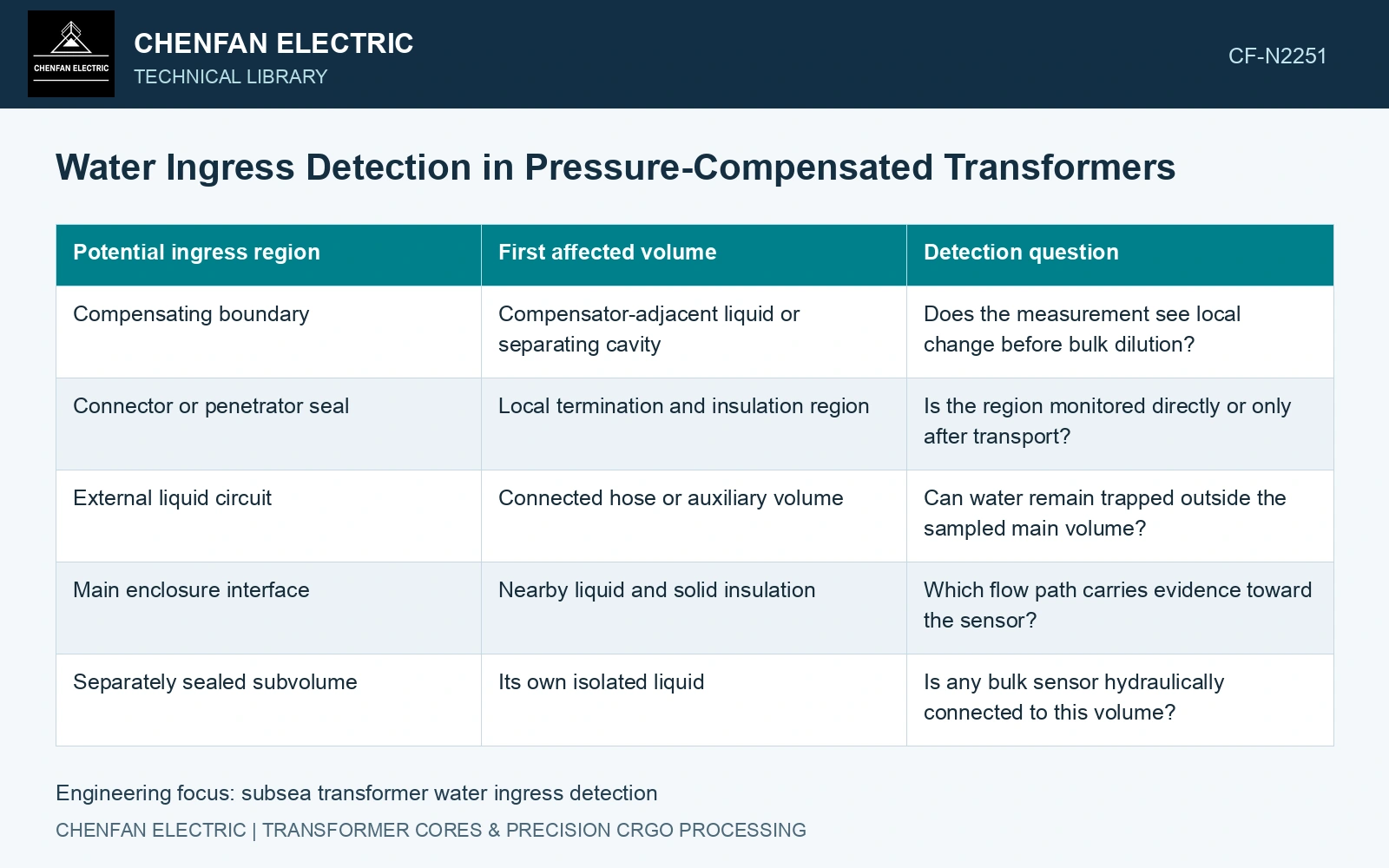
Map the path from seawater to measurement
Trace each separating boundary: main enclosure, compensator, penetrator, connector and any attached hose or liquid circuit. Identify whether water first enters a small local cavity, a circulating passage or the bulk volume. Then connect that region to the proposed detection point through the actual liquid movement and mixing conditions.
| Potential ingress region | First affected volume | Detection question |
|---|---|---|
| Compensating boundary | Compensator-adjacent liquid or separating cavity | Does the measurement see local change before bulk dilution? |
| Connector or penetrator seal | Local termination and insulation region | Is the region monitored directly or only after transport? |
| External liquid circuit | Connected hose or auxiliary volume | Can water remain trapped outside the sampled main volume? |
| Main enclosure interface | Nearby liquid and solid insulation | Which flow path carries evidence toward the sensor? |
| Separately sealed subvolume | Its own isolated liquid | Is any bulk sensor hydraulically connected to this volume? |
Distinguish dilution from absence of ingress
As an illustrative mass balance, 1 g of water dispersed through 1,000 kg of liquid adds 1 mg/kg of total water mass. The same 1 g initially confined to 1 kg represents 1,000 mg/kg of added mass before redistribution. These are bookkeeping concentrations, not predictions that all water remains dissolved. Solubility, droplets and absorption into cellulose change the locally measured state.
A small bulk change can therefore coexist with a much larger local exposure. Conversely, a sensor trend can reflect changing temperature and water partitioning without identifying a new leak. Preserve sensor temperature and the meaning of its output, including whether it measures activity, relative saturation or a converted concentration.
Qualify the complete detection chain
Check sensor response and calibration under the specified pressure, temperature, liquid and electrical environment. Evaluate measurement drift, communication loss and a sensor stuck at a plausible value. A pressure-rated housing alone does not validate the sensing element or its concentration conversion.
Use representative path tests or justified transport analysis to establish what a signal can detect and how long detection can take. Combine local measurements with relevant pressure, compensation-position or electrical indications where they add independent information. More channels do not remove a shared blind region if all sample the same bulk liquid.
Specify detection coverage by ingress path, mixing condition and response time. That gives the project a clear basis for sensor placement, alarm interpretation and the additional checks needed at local cavities.
Distinguish ingress rate from concentration after dilution
Preserve liquid condition, sampling history and the identified component boundary when interpreting maintenance evidence [2].
Assume a compensated circuit holds 1,000 kg of liquid and water inventory rises by 0.10 kg in 24 h with no removal. The average addition is 4.17 g/h and the mass-fraction increment is 100 mg/kg. Reconcile dissolved water, free water and any replenishment before assigning a leak rate from one concentration sample.
References
- IEC/IEEE, IEC/IEEE 61886-2:2025, Subsea equipment — Part 2: Power transformers.
- U.S. Bureau of Reclamation, FIST Volume 3-30, Transformer Maintenance, 2000.