

Subsea pressure changes how fault-generated gas partitions between insulating liquid and a free-gas phase. It also changes the conditions seen by sensors and retrieved samples. Gas diagnosis therefore needs the liquid identity, temperature and pressure history beside the analytical result. [1]
Calculation basis. Project-specific values and gates in the illustrative screens below are assumptions; cited catalogue values retain their source test conditions.
Separate generation from phase equilibrium
Gas generation depends on the fault mechanism and materials. Partition between liquid and a gas phase depends on pressure, temperature, gas composition and the particular insulating liquid. Absence of a visible gas pocket therefore does not demonstrate absence of gas generation.
At dilute equilibrium, one Henry-law convention writes Hi = fi/xi, with gas fugacity fi and dissolved mole fraction xi. Under an additionally justified ideal-gas approximation, fugacity can be approximated by partial pressure yiP. Other Henry constants use inverse or concentration-based conventions, so units and definitions must accompany any value.
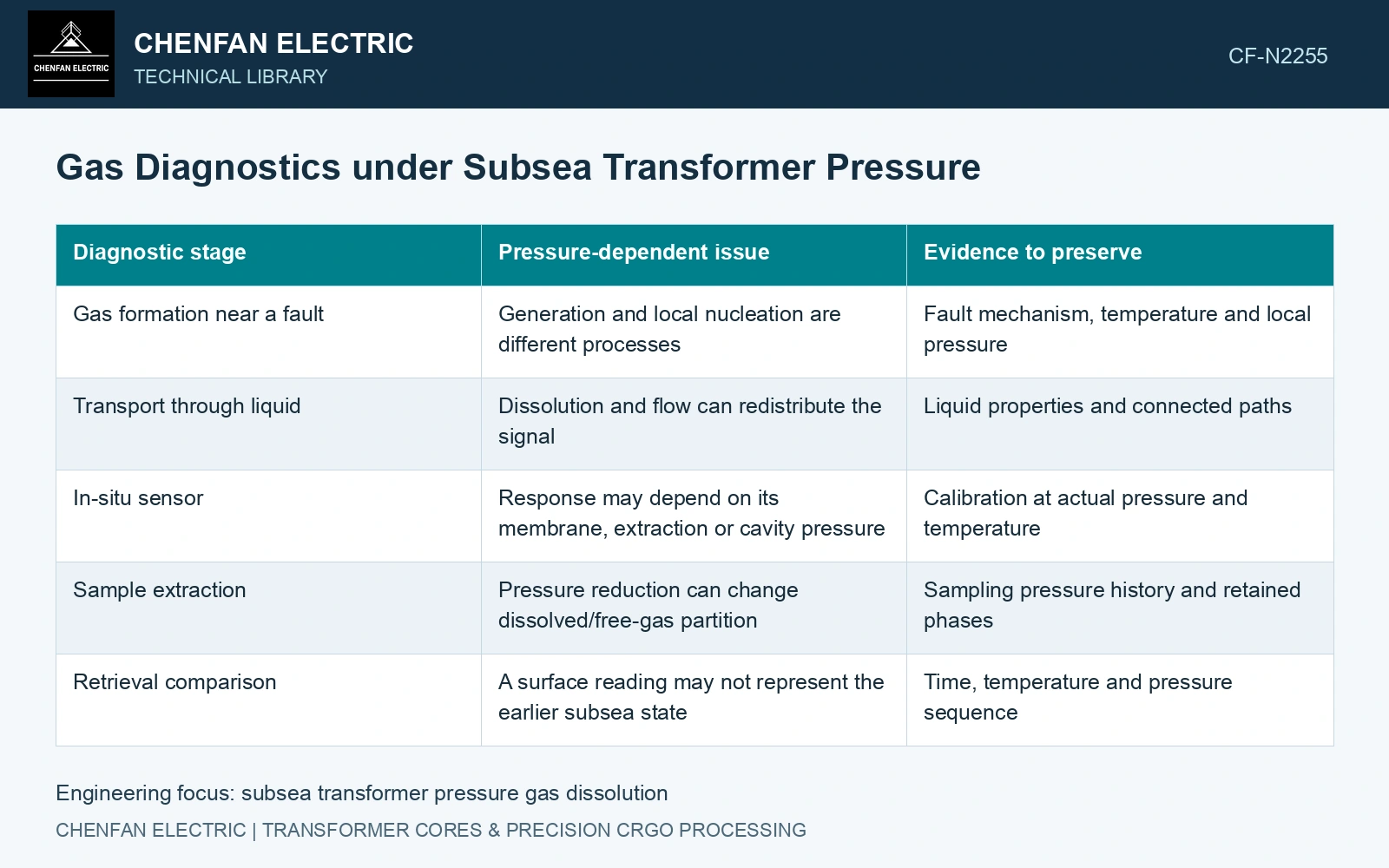
| Diagnostic stage | Pressure-dependent issue | Evidence to preserve |
|---|---|---|
| Gas formation near a fault | Generation and local nucleation are different processes | Fault mechanism, temperature and local pressure |
| Transport through liquid | Dissolution and flow can redistribute the signal | Liquid properties and connected paths |
| In-situ sensor | Response may depend on its membrane, extraction or cavity pressure | Calibration at actual pressure and temperature |
| Sample extraction | Pressure reduction can change dissolved/free-gas partition | Sampling pressure history and retained phases |
| Retrieval comparison | A surface reading may not represent the earlier subsea state | Time, temperature and pressure sequence |
Establish the pressure and liquid basis for comparison
In a deliberately restricted equilibrium illustration with unchanged temperature, a dilute solution, an ideal gas reservoir and an unchanged appropriate H value, doubling the gas partial pressure doubles the predicted dissolved mole fraction. A closed transformer has a finite gas inventory, changing gas composition and possible solid-liquid partition. High-pressure liquid and gas nonideality can also matter. The illustration is therefore not a formula for multiplying a measured DGA concentration by depth pressure.
Use gas/liquid properties valid for the actual range and a model appropriate to the pressure conditions. An ambient aqueous Henry constant cannot be transferred to a high-pressure insulating liquid. Temperature variation alone can invalidate a nominal constant.
Interpret sensors and samples within their validated range
Establish whether an in-situ instrument senses dissolved concentration, extracted gas or a free-gas pocket. Pressure qualification of its housing does not validate its analytical conversion. Review species-dependent response, transport delay and the effects of unloading or depressurization on a retrieved sample.
Compare trends at matched conditions and retain the pressure history of every sample. Use the instrument’s validated measurement basis together with corroborating observations to interpret the fault mechanism.
Keep gas inventory separate from measured concentration
Preserve the Henry-constant convention and temperature basis; high-pressure insulating-liquid coefficients require their own data [2].
Assume a closed 1,000 L liquid volume has an initial dissolved-gas concentration of 100 μL/L at the stated reporting reference. The liquid-phase inventory is 0.100 L on that reference basis. If only 0.060 L remains dissolved after a pressure-temperature change, concentration becomes 60 μL/L even with unchanged total gas inventory. Account for the other phase before concluding gas generation has fallen.
References
- IEC/IEEE, IEC/IEEE 61886-2:2025, Subsea equipment — Part 2: Power transformers.
- F. L. Smith and A. H. Harvey, Avoid Common Pitfalls When Using Henry’s Law, Chemical Engineering Progress, September 2007.