

Cellulose dimensions in a pressure-compensated transformer follow pressure, moisture, temperature and restraint history. Transfer measured directional response through the support geometry to verify oil passages and electrical clearances. [1]
Calculation basis. Project-specific values and gates in the illustrative screens below are assumptions; cited catalogue values retain their source test conditions.
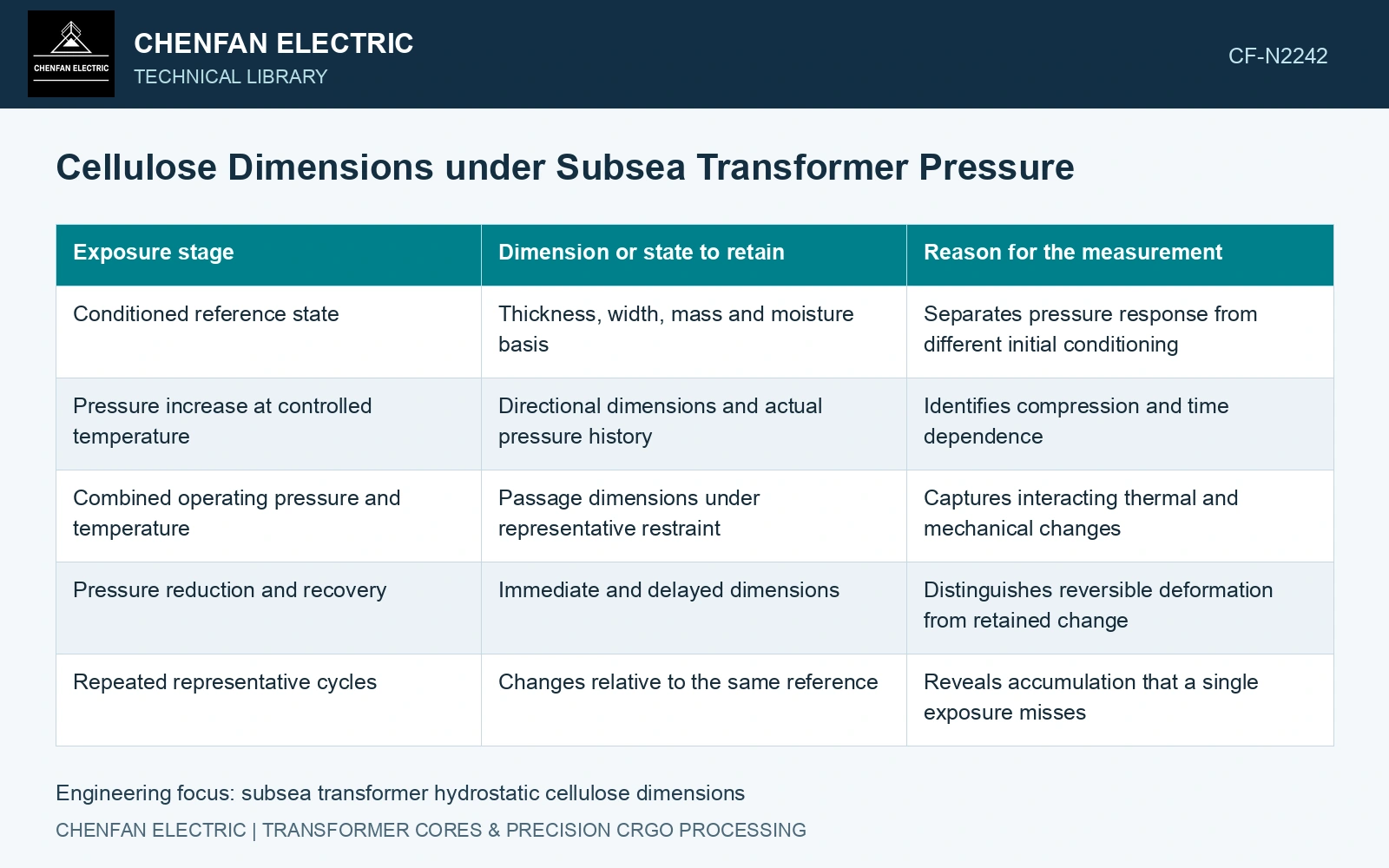
Measure the directions that the assembly uses
Define thickness, in-plane and through-stack directions on each specimen. Preserve the actual material grade, conditioning and oil impregnation state. Compare free specimens with restrained assemblies where the support arrangement changes deformation. An isotropic compressibility assumption can conceal a direction that controls a narrow passage.
| Exposure stage | Dimension or state to retain | Reason for the measurement |
|---|---|---|
| Conditioned reference state | Thickness, width, mass and moisture basis | Separates pressure response from different initial conditioning |
| Pressure increase at controlled temperature | Directional dimensions and actual pressure history | Identifies compression and time dependence |
| Combined operating pressure and temperature | Passage dimensions under representative restraint | Captures interacting thermal and mechanical changes |
| Pressure reduction and recovery | Immediate and delayed dimensions | Distinguishes reversible deformation from retained change |
| Repeated representative cycles | Changes relative to the same reference | Reveals accumulation that a single exposure misses |
Propagate measured strain into the passage
For a simple illustrative geometry, two supporting surfaces initially 10.0 mm apart contain a 6.0 mm spacer, leaving a 4.0 mm passage. Suppose the assumed service-state spacer thickness decreases by 1%, to 5.94 mm, while the supporting-surface separation decreases by 0.20 mm, to 9.80 mm. The passage becomes 3.86 mm, a 3.5% reduction from the initial gap.
The example deliberately combines two motions. Spacer compression alone would suggest a larger gap; the movement of the surrounding structure reverses that conclusion. These dimensions and strains are hypothetical, not cellulose properties or a prediction for a particular depth.
Keep the hydraulic and dielectric conclusions separate
Translate the resulting passage geometry into the appropriate oil-flow model, including parallel paths and changes in restraint. A small gap change may affect local hydraulic resistance differently from its effect on electrical field concentration. Neither consequence can be inferred from the percentage strain alone.
Check recovery after unloading as well as the operating-pressure condition. Retrieval can remove external pressure while leaving altered stack geometry or preload. A qualification record should therefore retain the actual pressure-temperature sequence, directional measurements and assembled constraints.
Use measured dimensional behavior and real support geometry to verify oil routes and insulation distances across the specified service and retrieval states.
Express pressure contraction in the part tolerance chain
Published pressboard-spacer compression data retain material conditioning, ageing and loading history [2]. Use separately established directional pressure response for the installed subsea part.
Assume a directional effective compressibility of 2 × 10⁻¹⁰ Pa⁻¹ for a defined conditioned cellulose dimension. A 10 MPa pressure increase gives an assumed linear strain of 0.002 and shortens a 100 mm dimension by 0.20 mm. An allowed 0.10 mm interface budget would be exceeded by a factor of two. Obtain actual directional pressure-moisture data before releasing the fit.
References
- IEC/IEEE, IEC/IEEE 61886-2:2025, Subsea equipment — Part 2: Power transformers.
- C. Oria et al., Experimental dataset on the compressive mechanical properties of high-density pressboard used in power transformers spacers, Data in Brief 50, 109471, 2023. DOI: 10.1016/j.dib.2023.109471.