

A transformerwood-for-pressboard substitution changes directional mechanics, thermal paths and oil access. Qualify the specified material and geometry against every affected duty before releasing the replacement. [1]
Calculation basis. Project-specific values and gates in the illustrative screens below are assumptions; cited catalogue values retain their source test conditions.
Begin with the exact materials being compared. Plain high-density pressboard, bonded pressboard laminate and resin-densified veneer wood are different constructions. A proposal that names only “insulation board” has not yet defined the substitution.
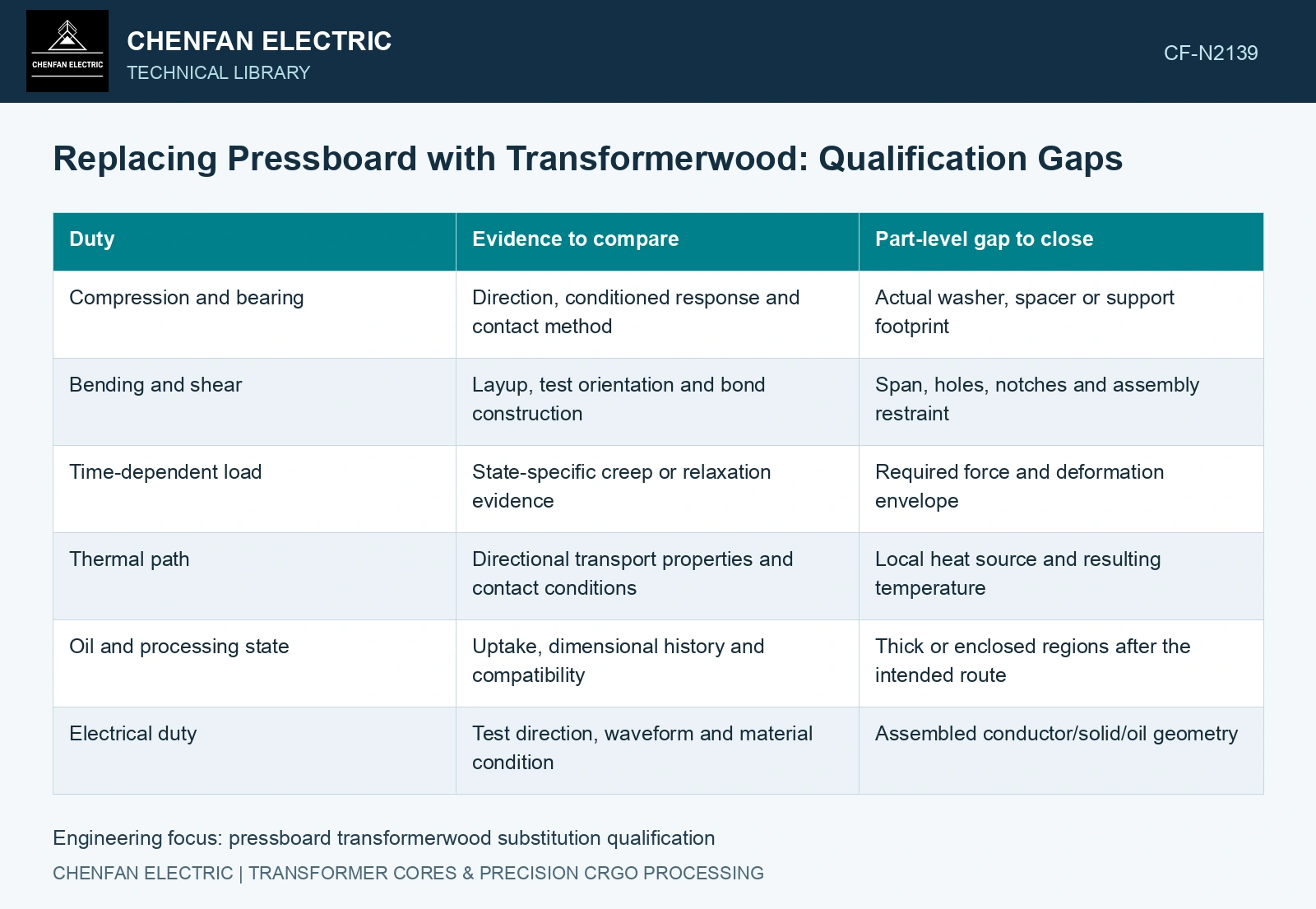
A replacement gap matrix
| Duty | Evidence to compare | Part-level gap to close |
|---|---|---|
| Compression and bearing | Direction, conditioned response and contact method | Actual washer, spacer or support footprint |
| Bending and shear | Layup, test orientation and bond construction | Span, holes, notches and assembly restraint |
| Time-dependent load | State-specific creep or relaxation evidence | Required force and deformation envelope |
| Thermal path | Directional transport properties and contact conditions | Local heat source and resulting temperature |
| Oil and processing state | Uptake, dimensional history and compatibility | Thick or enclosed regions after the intended route |
| Electrical duty | Test direction, waveform and material condition | Assembled conductor/solid/oil geometry |
Do not rank candidates by a single published strength. Datasheet averages come from specific specimens and directions. A higher flexural number does not establish greater bearing capacity beneath a washer or better thread retention.
The assembly can change without changing its outline
Different stiffness can redistribute forces between contacts or parallel members. A stiffer replacement might attract more load rather than simply reduce displacement. Check the relevant joint topology and seating sequence.
The same thickness can also leave a different final fit after drying and impregnation. Record the dimensional states and sheet or veneer orientation. A free coupon change does not describe a constrained cylinder or a support seated against steel.
For the thermal assessment, evaluate where heat enters and leaves the part. Neither the electrical-insulation label nor an isolated conductivity number establishes the contact path or resulting hot region. Where the part lies beside conductive attachments, retain those heat sources in the comparison.
For electrical geometry, matching the outside profile does not guarantee identical field distribution because the material properties and interfaces can change. Material dielectric tests should be relevant to the new field direction and state; they do not replace the applicable assembly evidence.
Use representative part trials for the duties that the comparison leaves unresolved. A reduced coupon programme can establish particular material properties, but holes, contacts, threaded features and enclosed oil regions need appropriate coverage.
List duties covered by existing evidence and those requiring new validation. Approve the defined material and part configuration within that demonstrated scope.
Recheck section stiffness when substituting transformerwood
Match the material identity and relevant test direction before comparing densified-wood evidence [2].
Assume a rectangular support keeps its section and span, with a baseline flexural modulus of 8 GPa. Röchling lists 12 GPa as a guideline flexural modulus for the named wood grade and indicated test direction, requiring at least four longitudinal layers in the tension zone [1]. Use that value only for a direction-matched planning comparison. In the same small-deflection beam screen, stiffness increases 50% and deflection falls to 66.7% of baseline. Now assume a corresponding rigid-plate, parallel-path model: support stiffness changes from 8 to 12 kN/mm, a neighboring path stays at 12 kN/mm, and total force is 20 kN. The replaced path attracts 8 kN before substitution and 10 kN afterward. Against an assumed 9 kN path limit, the stiffer replacement fails even while total movement decreases from 1.000 to 0.833 mm [3]. Verify the actual load redistribution and the separate dielectric, swelling and creep duties.
References
- Röchling Industrial, Lignostone L I/2-E3-HQ (P2R), Technical Data Sheet, version 2.0, released 20 September 2023.
- IEC, IEC 61061-2:1992, Specification for non-impregnated, densified laminated wood for electrical purposes — Part 2: Methods of test.
- R. T. Barrett, Fastener Design Manual, NASA Reference Publication 1228, 1990.