

A parallel-line trip changes the paths through which a phase shifter controls power. Rebuild sensitivity, targets and limiting branches on the remaining topology to assess the supported post-outage region. [1]
Calculation basis. Project-specific values and gates in the illustrative screens below are assumptions; cited catalogue values retain their source test conditions.
Distinguish the immediate post-trip electrical state from later tap actions. A mechanical tap change is not an assumed instantaneous response to a contingency. Protection, voltage and internal current limits can govern before the studied steady adjustment is achieved.
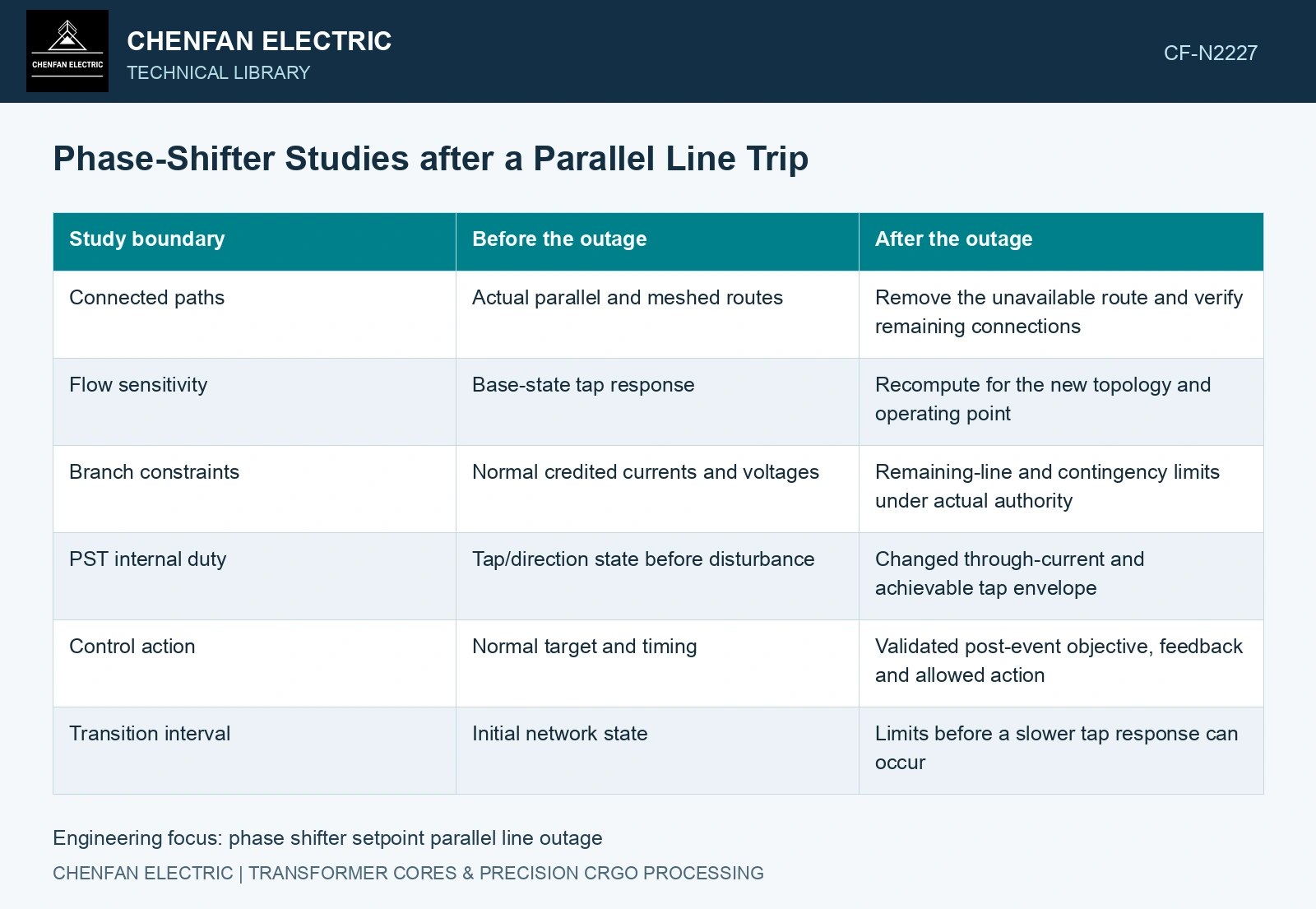
Compare the feasible regions before and after the trip
| Study boundary | Before the outage | After the outage |
|---|---|---|
| Connected paths | Actual parallel and meshed routes | Remove the unavailable route and verify remaining connections |
| Flow sensitivity | Base-state tap response | Recompute for the new topology and operating point |
| Branch constraints | Normal credited currents and voltages | Remaining-line and contingency limits under actual authority |
| PST internal duty | Tap/direction state before disturbance | Changed through-current and achievable tap envelope |
| Control action | Normal target and timing | Validated post-event objective, feedback and allowed action |
| Transition interval | Initial network state | Limits before a slower tap response can occur |
Check whether an alternate path exists
Consider an illustrative two-bus system with fixed 200 MW net transfer and only two parallel routes. Before the outage, suppose each carries 100 MW. If one route is lost and no other path exists, the remaining route must carry the 200 MW transfer in the steady balance.
If its hypothetical supported boundary is 150 MW, changing a phase angle cannot by itself create a missing physical path or reduce the fixed net transfer. The scenario needs another supported system measure or changed transfer requirement.
In a genuinely meshed system, other routes can exist, but their constraints must be included. A favorable reduction on the selected line may move the problem to another corridor.
Validate the post-trip control objective
Use the appropriate load-flow and contingency models, with actual source/load assumptions and device constraints. A pre-trip linear matrix is useful historical context, not a substitute for recomputation.
Retain telemetry validity and achieved tap position. An old topology flag or stale flow can direct an otherwise correct controller toward an invalid target. Check those prerequisites in the control study rather than simply inheriting the previous automatic setpoint.
Keep the post-outage PST duty within its specified application envelope [2].
References
- B. Cook, M. J. Thompson, K. Garg and M. Malichkar, Phase-Shifting Transformer Control and Protection Settings Verification, 2018. DOI: 10.1109/CPRE.2018.8349815.
- IEC, IEC 62032:2012, Guide for the Application, Specification and Testing of Phase-Shifting Transformers.