

Transformer Core Engineering Notes · CF-N216
Oil-paper insulation verified under AC stress is not automatically verified for sustained DC or polarity reversal. AC fields depend strongly on capacitive effects; sustained DC also requires conductivity and charge behaviour to be considered. Converter-transformer insulation may experience combined stresses. This is not a proposal to energize an ordinary AC transformer winding from steady DC.
Use models with the right physical assumptions
A simplified capacitive model shares voltage according to permittivity and geometry. A steady conduction model instead depends on conductivity as well as geometry. Real liquid-solid insulation can include temperature gradients and charge accumulation, so neither simplified model is sufficient for every duty. State whether the calculation addresses AC, initial energization, sustained DC or another transient. A plot without its waveform, material data and boundary conditions cannot establish the relevant design margin.
Material condition can change the comparison
Liquid and solid properties depend on the selected materials and their condition. Moisture, temperature and ageing are therefore relevant inputs rather than optional descriptive notes. Avoid reusing a single room-temperature property for every operating state without justification. A change of insulating liquid may alter both thermal behaviour and the electrical properties used in the field model. The insulation designer must decide which measured or qualified data are applicable to the intended duty.
Consider transitions, not only final steady states
Where polarity changes, interruptions or combined stresses form part of the project duty, specify them explicitly. IEC/IEEE 60076-57-129:2017 addresses liquid-immersed HVDC converter transformers within its scope; a general AC insulation reference alone does not establish that application. The responsible OEM must select the model and verification programme for the actual duty. This article prescribes neither a universal polarity-reversal sequence nor an insulation thickness.
Avoid a misleading certificate transfer
An AC transformer test report demonstrates the conditions stated in that report, not unrestricted DC service. When transferring a reference design, compare waveform, thermal profile, material system and geometry. Identify the new analysis or testing needed for differences that matter. A conservative purchasing document states the intended service accurately and asks for matching evidence; it does not describe any oil-paper system as equally suitable for AC and DC merely because the material names are unchanged.
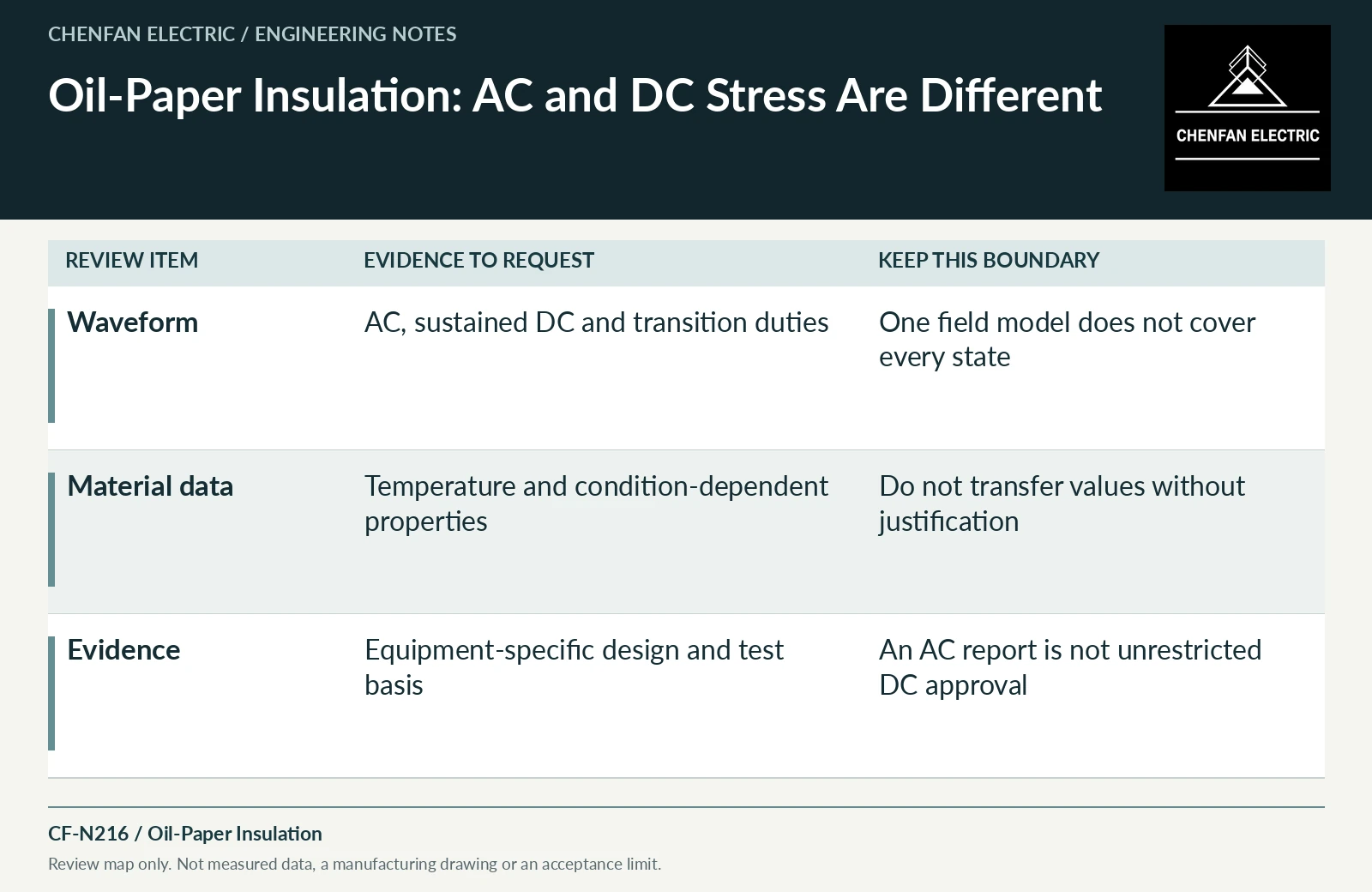
| Review item | Evidence to request | Boundary to preserve |
|---|---|---|
| Waveform | AC, sustained DC and transition duties | One field model does not cover every state |
| Material data | Temperature and condition-dependent properties | Do not transfer values without justification |
| Evidence | Equipment-specific design and test basis | An AC report is not unrestricted DC approval |
References and scope
- IEC/IEEE 60076-57-129:2017 — HVDC converter transformersPublic standard abstract · Scope for liquid-immersed HVDC converter transformers; not approval of an ordinary AC winding for steady-DC excitation.
- IEC 60076-3:2013+AMD1:2018 CSV — Insulation levels and dielectric testsPublic standard abstract · Insulation levels, dielectric testing and external clearances; the article does not reproduce test values or design distances.
- IEEE C57.162-2025 — Interpretation of Moisture Related Parameters in Liquid Immersed Transformers and ReactorsPublic standard abstract · Moisture-related interpretation for liquid-immersed transformers; this is not a DGA guide.