

Loss of synchronism and an approved asynchronous operating mode are different plant situations. A GSU duty review must first identify which one is being considered, its duration and the protection response. A generic statement that a transformer can carry “asynchronous current” settles none of those questions. Set the general power-transformer specification under IEC 60076-1 [1].
Describe the generator speed relative to system frequency, the excitation state and the connected network. Obtain the dynamic phase-current traces through every GSU winding. A terminal apparent-power trace can help explain the event, but it may miss the peak current that matters mechanically.
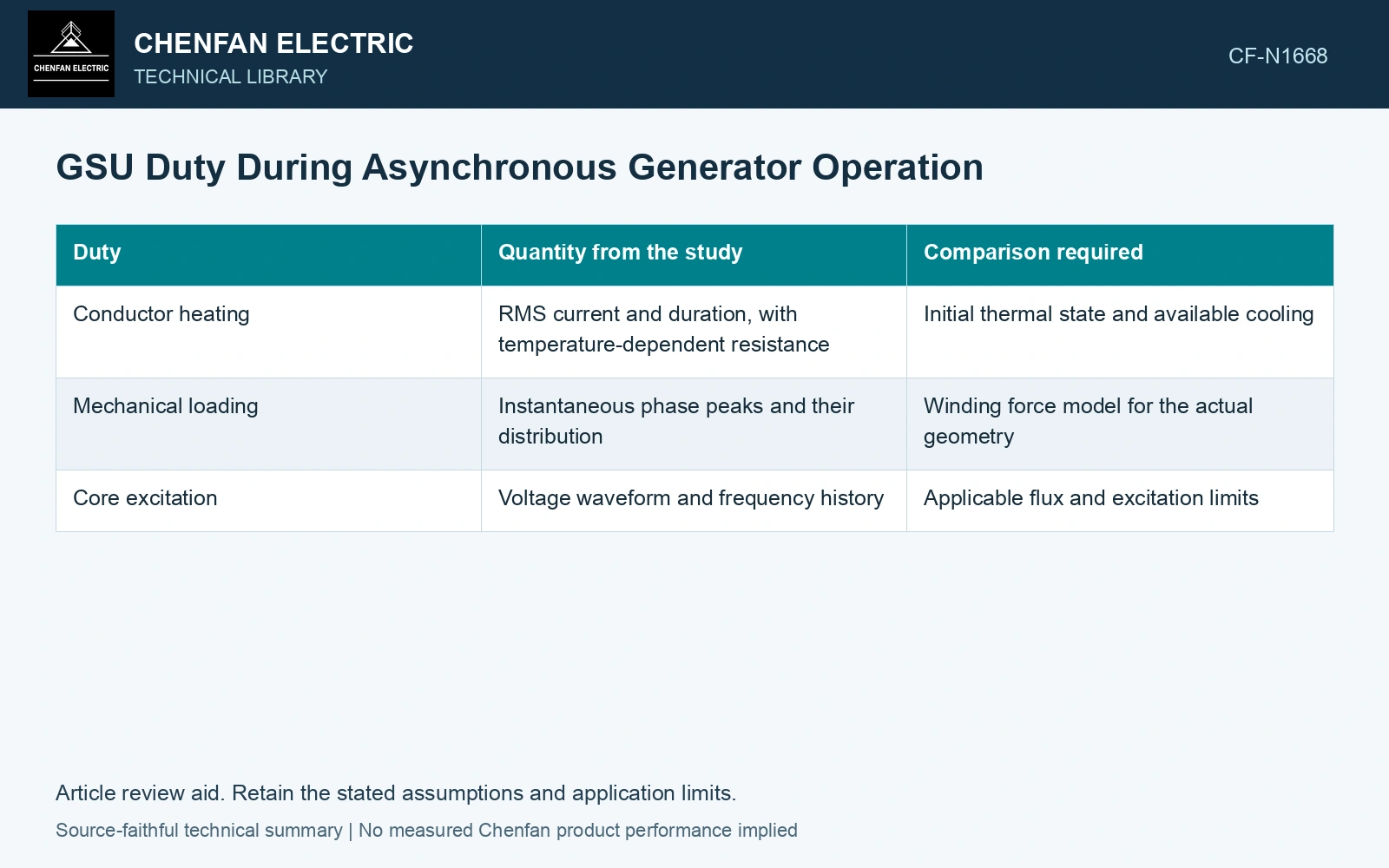
Extract three different duties
| Duty | Quantity from the study | Comparison required |
|---|---|---|
| Conductor heating | RMS current and duration, with temperature-dependent resistance | Initial thermal state and available cooling |
| Mechanical loading | Instantaneous phase peaks and their distribution | Winding force model for the actual geometry |
| Core excitation | Voltage waveform and frequency history | Applicable flux and excitation limits |
These quantities do not scale identically. For one resistive current path in a simplified heating estimate, energy is E = ∫I²R dt, with current in amperes, resistance in ohms, time in seconds and E in joules. Electromagnetic force may also depend approximately on current squared in a fixed, linear geometry, but spatial distribution and leakage-field interaction determine which winding sections carry the load.
Power swings require time resolution
If the relative rotor angle changes, active and reactive power can oscillate rather than settle. Record enough waveform detail to distinguish peak current from a long averaging window. Specify whether the model includes saturation and the control actions relevant to the event.
A case that starts with a hot transformer after full-load generation is different from the same current applied to a cold unit. Loss of cooling during a plant disturbance can further change the temperature trajectory. Keep the event current and the thermal initial condition as separate inputs.
Retain the short high-current part of the swing
Assume a normalized winding-current history of 2.0 pu for 0.20 s followed by 1.0 pu for 0.80 s, with a fixed current base and resistance. The heating integral is 2² × 0.20 + 1² × 0.80 = 1.60 pu²s, equivalent to 1.265 pu RMS over the full second. A low-resolution 1.0 pu substitution misses 37.5% of that integral. Retain the waveform and its 2.0 pu peak for separate thermal and force review; neither value defines the machine’s permitted asynchronous mode.
Review the final connection as well as the event
After generator isolation, the GSU may stay grid energized. Its no-load losses and cooling status then determine recovery. If the grid breaker also opens, residual thermal energy continues to move through the insulation and oil even though electrical heating has stopped.
An asynchronous case needs its current trace, initial temperature and breaker sequence before it can be compared with transformer limits. Unresolved peaks remain unresolved. The machine, network and protection studies must also support the proposed operating mode; a GSU current calculation alone cannot establish that permission.
For mineral-oil equipment, relate the loading assessment to operating temperature and thermal ageing [2].
References
- IEC, IEC 60076-1:2011, Power transformers – Part 1: General.
- IEC, IEC 60076-7:2018, Power transformers – Part 7: Loading guide for mineral-oil-immersed power transformers.