

A neutral CT measures the conductors and branches crossing its aperture. Map that boundary against every fault-return path in the protection zone. Ratio, polarity and measurement quality then apply to the current the CT actually sees. [1]
Calculation basis. Project-specific values and gates in the illustrative screens below are assumptions; cited catalogue values retain their source test conditions.
Draw the transformer neutral node, grounding impedance, bypass, earth connections and any other return paths. Preserve the physical branch points. Two diagrams using the same component names can have different measurement coverage if the CT moves across a branch junction.
Move the CT boundary across the branch point
Case A: neutral → CT → branch point → grounding impedance or bypass → earth
Case B: neutral → branch point → CT → grounding impedance → earth
                              └→ bypass outside the CT → earth
In conceptual case A, both intended return branches pass through the common upstream measurement. In case B, bypass current avoids the CT. This comparison assumes one identified primary conductor crosses the aperture once with the chosen orientation; actual routing, shields and additional conductors must be represented.
The measured primary ampere-turns are the signed sum of currents crossing the aperture. If a conductor passes through in the opposite direction, its contribution subtracts. A diagram that shows only electrical nodes while omitting physical aperture crossings cannot establish that sum.
Create a blind-path ledger
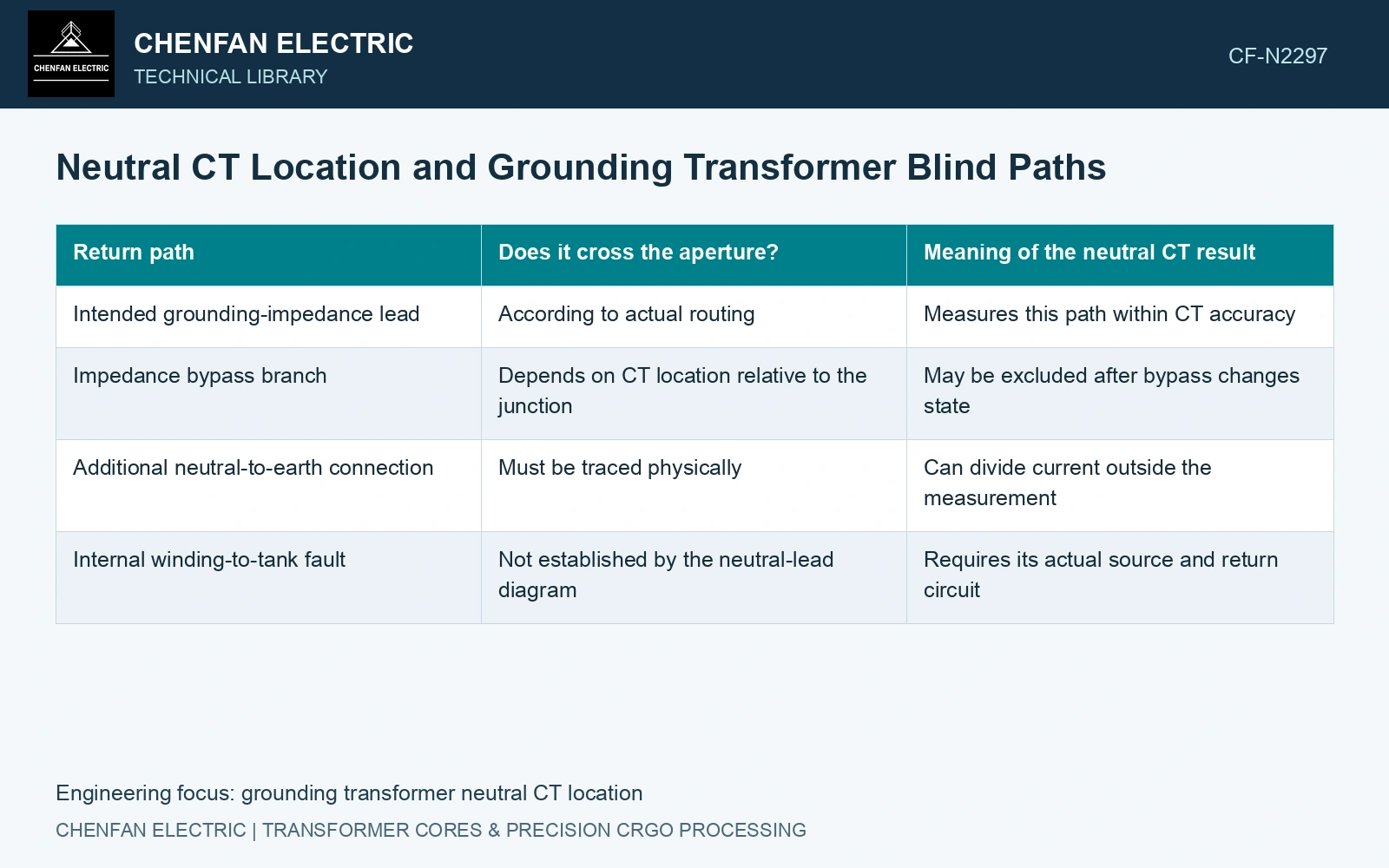
| Return path | Does it cross the aperture? | Meaning of the neutral CT result |
|---|---|---|
| Intended grounding-impedance lead | According to actual routing | Measures this path within CT accuracy |
| Impedance bypass branch | Depends on CT location relative to the junction | May be excluded after bypass changes state |
| Additional neutral-to-earth connection | Must be traced physically | Can divide current outside the measurement |
| Internal winding-to-tank fault | Not established by the neutral-lead diagram | Requires its actual source and return circuit |
An illustrative current balance makes the consequence visible. If 80 A returns through a measured impedance branch and 20 A through an unmeasured parallel path with the same phasor angle, the CT reports 80 A on its primary basis while the total is 100 A. With different phase angles, use phasor sums. These are assumed circuit values, not a relay sensitivity recommendation.
Separate path coverage from measurement quality
Once the paths are correct, assess CT excitation, offset response, burden, secondary polarity and relay processing for the intended waveform. A CT may physically include a path while reproducing its transient poorly. Conversely, excellent transient accuracy cannot recover a current that never crossed the aperture.
Compare synchronized line-current residual and neutral CT evidence where the protection design provides them, retaining their reference directions and measurement limitations. A difference may indicate another return path, but also measurement error or an inconsistent time basis. It does not by itself locate a fault.
Quantify the omitted return current
Specify the earthing-transformer function and its test boundary under the applicable reactor standard [2].
The assumed 80 A measured branch and 20 A blind branch give 100 A total at the same phasor angle. The CT therefore observes 80% of the return current and underreports the total by 20%. Place the coverage decision on the branch drawing; changing CT ratio cannot recover the missing path.
References
- D. De Ronde, R. VanHatten and A. Wade, Loss of Effective System Grounding — Best Practices, Protection Challenges, and Solutions, Schweitzer Engineering Laboratories, 2015.
- IEC, IEC 60076-6:2007, Power transformers — Part 6: Reactors.