

A gas result is an analyte- and method-specific observation. Zhang et al. test SO2/H2S sensor responses in an SF6 diagnostic context [1]; their measured response does not establish another mixture’s chemistry or a transformer’s fault severity. Retain formation, transport and removal history.
Start with the actual gas or mixture. Diagnostic methods and interpretation must match that medium. Oil-transformer dissolved-gas ratios cannot be imported merely because both measurements involve a gas analyzer.
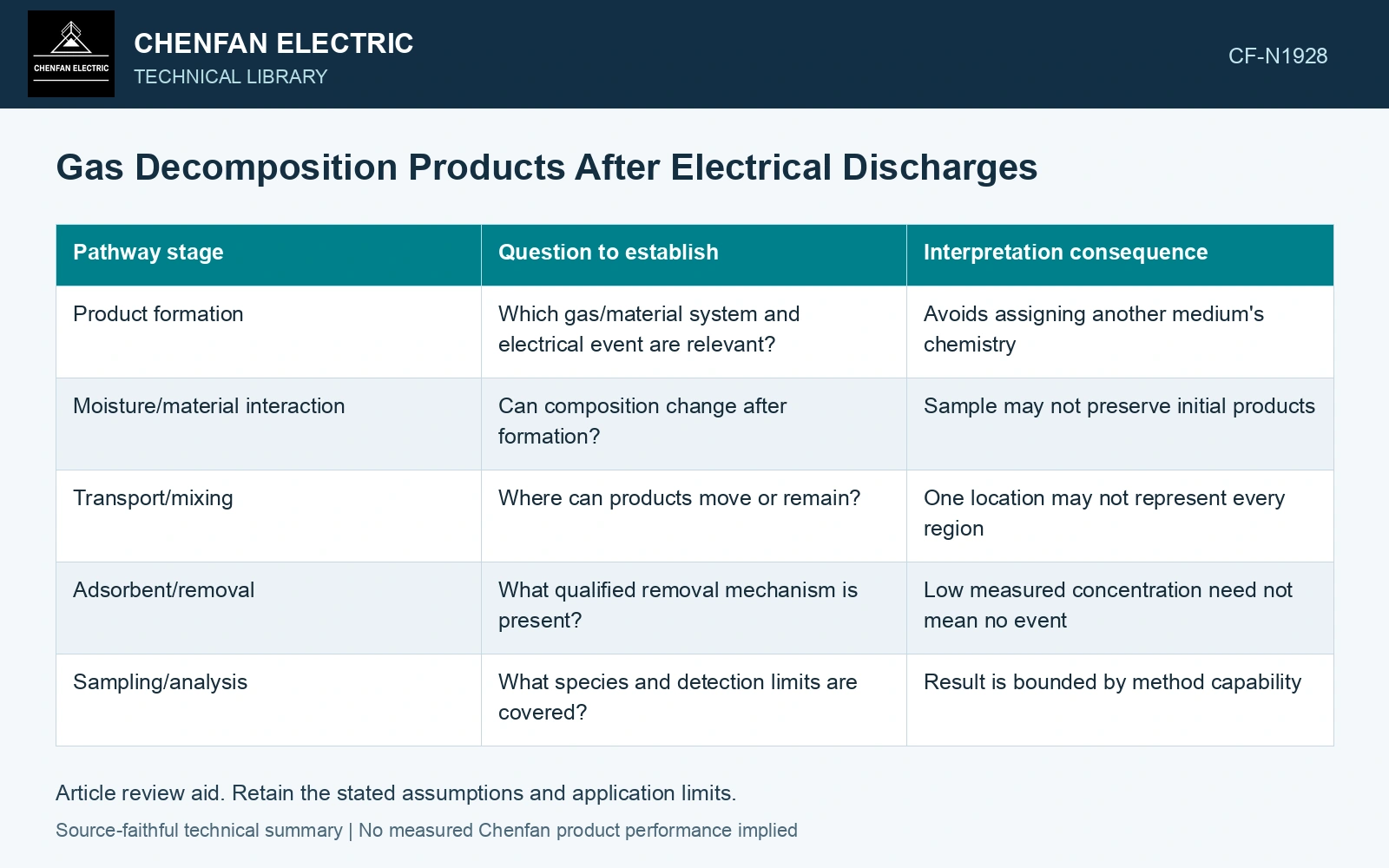
Trace the result from event to sample
| Pathway stage | Question to establish | Interpretation consequence |
|---|---|---|
| Product formation | Which gas/material system and electrical event are relevant? | Avoids assigning another medium’s chemistry |
| Moisture/material interaction | Can composition change after formation? | Sample may not preserve initial products |
| Transport/mixing | Where can products move or remain? | One location may not represent every region |
| Adsorbent/removal | What qualified removal mechanism is present? | Low measured concentration need not mean no event |
| Sampling/analysis | What species and detection limits are covered? | Result is bounded by method capability |
The table provides questions, not a chemistry diagnosis. Species identification and its significance require the qualified gas-specific evidence.
Keep concentration and fault severity separate
A concentration can depend on event energy, affected materials, gas inventory and elapsed time. The same number can arise from different histories. Without a validated interpretation, it cannot supply a universal discharge severity or location.
A low result also has several possible explanations: no relevant product, removal, poor mixing or insufficient method sensitivity. Preserve the distinction between not detected and demonstrated absent.
Control the sampling record
Record compartment identity, gas state, event timing, previous transfers and the analysis method. Sampling after gas replacement answers a different question from sampling the retained event gas.
Work with qualified personnel using the equipment’s gas-specific handling and protection procedure. Fault-affected gas and residues need an assessment appropriate to their actual composition; this article gives no sampling operation or generic handling shortcut.
Use diagnostics as corroborated evidence
An assumed report “<1 ppm” means the method did not report a quantified result above its stated threshold; it is not a deterministic upper bound on true concentration. NIST separates observed decision levels from detection capability and false-negative risk [2]. For a fictional unbiased Gaussian measurement with σ = 0.20 ppm and reporting threshold 0.60 ppm, true concentration 0.40 ppm gives P(report below threshold) = Φ(1) = 84.13%. A non-detect is therefore quite likely despite nonzero analyte. Investigate sampling, blank/calibration, analyte scope and event evidence; these values do not describe the cited sensor’s validated capability.
The final interpretation should name what was measured, what mechanism is supported and what remains uncertain. That makes the analysis useful for a specific fault investigation. A familiar oil DGA rule or an isolated concentration cannot replace the formation and sampling boundaries of the gas-transformer system.
References
- X. Zhang, C. Luo and J. Tang, Sensitivity Characteristic Analysis of Adsorbent-Mixed Carbon Nanotube Sensors for the Detection of SF6 Decomposition Products under PD Conditions, Sensors 13, 15209–15220, 2013, sections 3.2–3.5. DOI: 10.3390/s131115209.
- R. M. Lindstrom (NIST), Limits for Qualitative Detection and Quantitative Determination, NIST Special Publication 958.